Executive summary
Hindi kinakatawan ng ulat na ito ang mga pananaw ng Imbestigasyon. Ang impormasyon ay sumasalamin sa buod ng mga karanasang ibinahagi sa amin ng mga dumalo sa aming mga Roundtable noong 2025. Ang hanay ng mga karanasang ibinahagi sa amin ay nakatulong sa amin na bumuo ng mga temang aming susuriin sa ibaba. Makikita mo ang listahan ng mga organisasyong dumalo sa roundtable sa annex ng ulat na ito.
Ang ulat na ito ay naglalaman ng mga paglalarawan ng mga epekto sa kamatayan, pagpapakamatay, at kalusugang pangkaisipan. Maaaring nakababahala ang mga ito sa ilan. Hinihikayat ang mga mambabasa na humingi ng suporta kung kinakailangan. Ang isang listahan ng mga serbisyong sumusuporta ay ibinibigay sa website ng UK Covid-19 Inquiry.
Noong Marso 2025, tinipon ng UK Covid-19 Inquiry ang mga kinatawan ng mga organisasyon mula sa iba't ibang sektor ng mga pangunahing manggagawa para sa isang roundtable discussion upang tuklasin ang epekto ng pandemya sa mga pangunahing manggagawa, kabilang ang epekto ng mga hakbang na ipinatupad upang tumugon sa pandemya. Hindi kasama rito ang mga manggagawang pangkalusugan at mga manggagawa sa pangangalagang panlipunan, dahil ang epekto sa mga grupong ito ang naging pokus ng Modyul 3 at Modyul 6 ng Pagtatanong.
Binubuod ng ulat na ito ang mga temang itinaas sa mga talakayan kasama ang mga kinatawan sa larangan ng edukasyon, bumbero at pagsagip, libing, libing at kremasyon.1, pulisya at hustisya, mga sektor ng tingian, transportasyon, pamamahagi at pagbobodega.
Ang pandemya ay nagkaroon ng malaking epekto sa mga pangunahing manggagawa sa lahat ng sektor. Kabilang dito ang mga epekto ng pag-unawa at pagpapatupad ng mga paghihigpit ng gobyerno at pamamahala sa kaligtasan sa lugar ng trabaho, at ang takot na mahawa ng Covid-19. Ang takot ay laganap sa mga pangunahing manggagawa na nag-aalala para sa kanilang sariling kaligtasan at para sa kanilang mga pamilya, lalo na kung sila ay nakikipag-ugnayan sa mga taong may klinikal na kahinaan.
Ang kakulangan ng mga planong partikular sa sektor para sa pagtugon sa pandemya ay humantong sa kalituhan, kawalan ng katiyakan, at takot sa mga pangunahing manggagawa. Lalo pa itong pinalala ng mga gabay na inilalabas nang gabi o tuwing Sabado at Linggo, lalo na sa mga unang yugto ng pandemya. Tinalakay ng mga kinatawan kung paano kinailangang bigyang-kahulugan ng mga unyon at lugar ng trabaho ang malawak na gabay nang nakapag-iisa, na kung minsan ay nagreresulta sa hindi pare-parehong mga kasanayan. Ang mga pagbabago sa gabay ng gobyerno at magkasalungat na gabay ay itinampok bilang mga pangunahing isyu at nag-iwan sa mga manggagawa na hindi sigurado sa kung ano ang dapat nilang gawin. Nahirapan din silang ipatupad ang mga itinuturing na hindi praktikal na paghihigpit sa mga gusaling masikip o kulang sa wastong bentilasyon. Nangangahulugan ito na ang mga unyon at mga katawan ng kalakalan ay kailangang gumanap ng mas malaking papel sa pagbuo at pagbabahagi ng kanilang sariling gabay upang suportahan ang mga sektor at ang kanilang mga manggagawa.
Nagdulot din ng mga pagbabago sa mga paraan ng pagtatrabaho ang pandemya. Ang ilang mga manggagawa ay nakapagtrabaho nang malayuan habang ang iba ay kinakailangang patuloy na magtrabaho nang personal at makipag-ugnayan sa mga kasamahan at sa publiko. Sinasabing lumikha ito ng mga tensyon at nagbigay-diin sa hierarchical na katangian ng ilang mga lugar ng trabaho, na nagparamdam sa mga manggagawa na hindi gaanong pinahahalagahan.
Para sa ilang mahahalagang manggagawa, bumuti ang moral sa simula dahil ang mahalagang katangian ng kanilang tungkulin ay kinilala sa isang bagong paraan. Gayunpaman, habang tumatagal ang pandemya, bumaba ang moral sa iba't ibang sektor, lalo na nang magkasakit o namatay ang mga kasamahan dahil sa Covid-19. Bumaba rin ang moral dahil sa patuloy na pagkaramdam ng stress ng mga pangunahing manggagawa at habang tumatagal, minamaliit ang pagpapahalaga.
Ang gabay sa kaligtasan sa lugar ng trabaho ay inilarawan bilang hindi pare-pareho at hindi malinaw, na humantong sa pakiramdam ng mga pangunahing manggagawa na nasa panganib na mahawaan ng Covid-19. Nabanggit ng mga kinatawan na nang ipakilala ang mga hakbang, hindi malinaw kung aling mga hakbang ang pinakamahalaga. Kapag hindi sinunod ang mga hakbang sa lugar ng trabaho, hindi malinaw kung paano dapat iulat ang mga paglabag o kung sino ang dapat managot. Gayunpaman, isinaalang-alang ng mga kinatawan na sa ilang sektor, bumuti ang mga hakbang sa kaligtasan sa lugar ng trabaho habang nagpapatuloy ang pandemya.
Ang mga nagtatrabaho sa mga pampublikong trabaho noong panahon ng pandemya ay inilarawan bilang ang may pinakamalaking panganib na mahawa ng Covid-19. Ang mga manggagawang ito ay sinasabing hindi proporsyonal na nagmula sa mga etnikong minorya at/o kababaihan. Ang panganib na mahawa ng Covid-19 ay itinuring na isang partikular na pag-aalala para sa mga taong nagmula sa mga etnikong minorya na nakaranas ng mas mahinang resulta sa kalusugan dahil sa Covid-19. Itinampok din ng mga kinatawan kung paano naharap sa publiko ang pisikal at berbal na pang-aabuso mula sa publiko dahil sa pagpapatupad ng pagsusuot ng maskara at iba pang mga paghihigpit sa mga lugar tulad ng tingian, transportasyon at sa mga libing, libing, kremasyon at iba pang mga seremonya sa pagtatapos ng buhay.
Noong panahon ng pandemya, ang mga pangunahing manggagawa ay nakaranas ng karagdagang mga pressure sa trabaho bukod pa sa stress ng buhay sa labas ng trabaho dulot ng pandemya, kadalasan ay kakaunti o walang access sa suporta sa kalusugang pangkaisipan at kagalingan. Nadama ng mga kinatawan na ang kawalan ng komprehensibong mga serbisyo sa kalusugang pangkaisipan ay nagpalala sa mga damdamin ng pag-iisa, pagkabalisa, at burnout sa mga pangunahing manggagawa.
Ang mga presyur na kinakaharap ng mga pangunahing manggagawa ay kadalasang tumitindi dahil sa kakulangan ng mga tauhan. Sinabi ng mga kinatawan na ang mga sektor na nahaharap sa kakulangan ng mga tauhan ay minsan ay nagbibigay ng presyur sa kanilang mga pangunahing manggagawa na huwag mag-self-isolate o protektahan mula sa Covid-19 at pumasok sa trabaho. Nanganganib ito na lumala ang kanilang sariling kalusugan at ang kalusugan ng mga nasa kanilang sambahayan.
Ang pandemya ay nagkaroon ng malaking epekto sa pananalapi sa maraming pangunahing manggagawa, lalo na sa mga may kontratang zero-hours o nagtatrabaho para sa mga subcontractor. Ang mga manggagawa ay partikular na madaling kapitan ng kawalan ng seguridad sa pananalapi kapag nahaharap sa pinababang oras ng trabaho o hinihiling na mag-self-isolate nang walang sick pay.
Tinukoy ng mga kinatawan ang mga pare-parehong aral na maaaring matutunan mula sa mga karanasan ng mga pangunahing manggagawa sa lahat ng sektor upang mabawasan ang epekto sa anumang pandemya sa hinaharap. Nadama nila na kailangan ang mas madiskarteng pagpaplano at paghahanda para sa isang pandemya sa hinaharap na iniayon sa mga partikular na sektor, upang matiyak ang mabilis at organisadong tugon. Ang gabay sa pandemya sa hinaharap ay dapat na malinaw, pare-pareho, at napapanahon. Mas makakatulong ito sa mga pangunahing manggagawa na maipatupad ito nang epektibo.
Ang ilang mga puntong nabanggit sa mga roundtable ay naaangkop sa iba't ibang sektor, habang ang iba ay partikular sa sektor. Nilinaw namin ang mga puntong partikular sa sektor, sa pamamagitan ng paggamit ng mga heading na may kulay upang ipahiwatig kung kailan naaangkop ang isang punto sa isang sektor:
Mga Sektor
- Edukasyon
- Sunog at Pagsagip
- Mga Libing, Paglilibing at Kremasyon
- Pulisya at Hustisya
- Transportasyon, Pamamahagi at Pag-iimbak
- Pagtitingi
Binigyang-diin ng maraming kinatawan ang pangangailangan para sa higit na pagkilala at pagpapahalaga na ibigay sa mga pangunahing manggagawa sa isang pandemya sa hinaharap. Kabilang dito ang paglahok sa kanila sa paggawa ng desisyon sa pamamagitan ng kanilang mga unyon, pagpapabuti ng mga hakbang sa kaligtasan sa lugar ng trabaho at pagtiyak ng wastong pagkilala para sa kanilang mga kontribusyon, sa anyo ng suweldo at pasasalamat. Bagama't ang ilang sektor tulad ng transportasyon at bumbero at pagsagip ay nagtatag ng mga forum ng konsultasyon sa gobyerno sa simula pa lamang ng pandemya, na sa palagay nila ay humantong sa mas naaangkop na gabay para sa kanilang sektor, ang iba pang mga sektor tulad ng edukasyon at sektor ng pagtatapos ng buhay ay hindi nakinabang mula sa parehong pamamaraan ng konsultasyon. Nadama nila na humantong ito sa gabay na hindi praktikal para sa kanilang sektor. Binigyang-diin din ng mga organisasyon sa iba't ibang sektor ang pangangailangan para sa mas malaking pagtuon sa madaling makuhang suporta sa kalusugang pangkaisipan upang makatulong na mabawasan ang stress at maiwasan ang burnout.
- Ang karagdagang detalye tungkol sa pagdadalamhati at ang mga epekto ng mga paghihigpit sa mga libing ay makukuha sa ulat ng roundtable para sa mga libing, libing, at suporta sa pagdadalamhati [maaaring i-link kapag nailathala sa website ng Inquiry]. Tinitingnan ng ulat na iyon ang mga libing, libing, at kremasyon mula sa pananaw ng mga naulila noong panahon ng pandemya, habang sa ulat na ito ay nakatuon ang pansin sa mga karanasan ng mga manggagawa.
Mga pangunahing tema
Epekto ng pagpapatupad ng mga paghihigpit at gabay ng gobyerno
Pagbibigay-kahulugan at pagpapatupad ng gabay
Ang mga pangunahing manggagawa ay naharap sa mas matinding presyur noong panahon ng pandemya upang maunawaan at ipatupad ang nagbabagong mga paghihigpit at gabay. Kinailangan nilang umangkop nang mabilis, umako ng mga karagdagang responsibilidad tulad ng pagpapatupad ng pinahusay na mga protocol sa paglilinis, pagpapatupad ng social distancing, pagpapatupad ng mga mandato sa pagsusuot ng maskara at pamamahala ng mga pagbabago sa saklaw ng kanilang tungkulin. Sinasabing ito ang nagpataas ng stress sa mga pangunahing manggagawa sa isang mahirap nang sitwasyon, na lalong nagpalala sa kanilang mga karanasan ng stress.
| “ | Sabi [ng gobyerno] 'gusto naming ayusin ninyo ang mga libreng pagkain sa paaralan, kayo ang magiging eksperto sa kalusugan at kaligtasan, ayusin ang remote learning, gawin ang testing.' Napakaraming demand. Ang mga tao ay nagtatrabaho ng 20 oras sa isang araw… Napakaraming bagong demand na nagpahirap dito.”
– Pambansang Asosasyon ng mga Punong-guro (NAHT) |
Ang patnubay ay inilarawan bilang mabilis na nagbabago, kadalasan nang walang paunang abiso at sa mga hindi kombenyenteng oras tulad ng gabi ng Biyernes o katapusan ng linggo. Nangangahulugan ito na walang oras ang mga sektor upang maghanda o tumugon nang naaangkop. Ang mga madalas na pagbabago ay nag-iwan sa mga pangunahing manggagawa na hindi sigurado kung naipatupad ba nila nang tama ang mga patnubay.
| “ | Mayroong magkasalungat at magkasalungat na patnubay. Pagkalipas ng isang buwan, sasabihan ka na huwag gawin ang X, dapat mong gawin ang Y. Ang paglipat ng mga goal post ay isang problema.
– NAHT |
Binigyang-diin ng mga organisasyon na kapag nakikipag-ugnayan sila sa gobyerno tungkol sa mga nagbabagong sitwasyon at gabay, kung minsan ay inaabot ng ilang linggo bago tumugon ang mga departamento sa kanilang mga katanungan, na humahantong sa kawalan ng katiyakan at pangamba sa mga nagtatrabaho sa frontline.
Habang tumatagal ang pandemya, ang madalas na pag-update ng mga gabay ay humantong sa kalituhan at pagkadismaya sa mga pangunahing manggagawa. Madalas silang kailangang mabilis na umangkop sa mga bagong patakaran nang walang sapat na abiso, pagsasanay, o kalinawan. Ang kakulangan ng pag-unawang ito ay minsan humahantong sa mga komprontasyon sa publiko, na nalilito rin. Ang madalas na mga pagbabago ay nagdulot ng pagdududa sa ilang pangunahing manggagawa tungkol sa kredibilidad ng gabay.
| “ | Sa sandaling magsimulang magbago ang gabay, nagkaroon ng ganap na kawalan ng kredibilidad sa antas ng frontline. Masaya kaming ipatupad ang mga patakaran, ngunit pagkatapos ay nagbabago ang mga patakaran. Magbabago ba ulit ang mga ito?
– Pederasyon ng mga Awtoridad sa Paglilibing at Pagsusunog ng Bangkay (FBCA) |
Nabanggit ng mga kinatawan na ang mga unyon at mga ahensya ng kalakalan ay kadalasang umaasa sa pagbibigay-kahulugan sa gabay at pagbibigay ng angkop na payo sa mga organisasyon at pangunahing manggagawa. Ang suportang ito ay kinakailangan dahil mayroong malaking kakulangan sa kaalaman sa mga protocol sa kaligtasan sa lugar ng trabaho at kakulangan ng kahandaan sa mga employer sa panahon ng pandemya.
Ang pag-asa na ito sa mga unyon at mga sangay ng kalakalan ay nagpatuloy habang naglalabas ang gobyerno ng mas tiyak na patnubay. Nadama ng mga kinatawan na bihirang linawin ng patnubay kung ano ang kailangang unahin, na nag-iiwan sa mga manggagawa na nabibigatan at walang suporta. Ang patnubay ay hindi palaging ibinibigay sa iba't ibang wika upang matugunan ang mga pangunahing manggagawa na hindi nagsasalita ng Ingles, na nangangahulugan na marami ang hindi nakakaintindi ng mga protocol sa kaligtasan o sa kanilang mga karapatan sa pagtatrabaho. Dahil dito, sila ay partikular na mahina sa pagsasamantala ng mga employer at may mga halimbawa ng mga employer na pinipilit ang mga manggagawa na magtrabaho sa mga hindi ligtas na kondisyon.
| “ | [Mayroong] isang kompanya ng pagmamanupaktura na may mga manggagawang hindi talaga nagsasalita ng Ingles at [sinasabihan] nila silang pumasok sa trabaho, kahit na sila ay may sakit... Walang gabay sa puntong ito sa sektor, walang komunikasyon sa ibang wika maliban sa Ingles.
– Unyon ng GMB |
Tumutok sa: pulisya at hustisya
Sinabi ng mga kinatawan ng pulisya at hustisya na ang bilis ng mga pagbabago sa gabay ay nangangahulugan na walang oras para sa pinasadyang pagsasanay na karaniwang nagaganap para sa mga pagbabago sa batas. Nagpahayag ng mga alalahanin ang Police Federation na ang kakulangan ng kalinawan sa bagong gabay ay nag-iwan sa mga opisyal ng pulisya na hindi sapat ang kaalaman tungkol sa kung paano gagawin ang mga kinakailangang pagbabago sa mabilis na bilis. Nadama nila na naapektuhan nito ang kakayahan ng mga opisyal na ipatupad nang epektibo ang gabay.
| “ | Ang karaniwang nangyayari kapag may ipinakikilalang bagong batas, magkakaroon tayo ng 140,000 opisyal ng pulisya na siyang magsasagawa nito at magdidisenyo kayo ng pagsasanay. Dahil sa mga pangyayari, hindi natin ito magagawa.”
– Ang Pederasyon ng Pulisya |
Binigyang-diin ng UNISON ang isang pagkakaiba sa paraan ng pagsunod ng mga organisasyon ng pulisya, bilangguan, at probasyon sa mga kinakailangan ng regulasyon para sa pag-uulat ng mga alalahanin sa kalusugan at kaligtasan sa ilalim ng pag-uulat ng Injuries, Diseases and Dangerous Occurrences Regulations (RIDDOR). Sinabi nila na ang mga puwersa ng pulisya ay nagpatupad ng isang sistema para sa pare-parehong pag-uulat ng pinaghihinalaang pagkalat ng Covid-19 sa lugar ng trabaho sa ilalim ng RIDDOR, habang ang mga serbisyo sa bilangguan at probasyon ay tumigil sa pagsusumite ng mga ulat dahil sa gabay ng Public Health England na may kaugnayan sa patunay na naganap ang pagkalat sa lugar ng trabaho.
| “ | Regular na naglalabas ang mga pulis ng mga ulat ng RIDDOR kung saan pinaniniwalaang nagkaroon ng transmisyon sa lugar ng trabaho. Hindi iyon ang kaso sa [HM Prison and Probation Service], sinusunod nila ang gabay ng [Public Health England]… labis kaming nalungkot tungkol doon… may mga insidente kung saan dalawang tao ang namatay habang nagtatrabaho sa iisang opisina sa loob ng maikling panahon… dapat sana ay may ulat ng RIDDOR na imbestigahan.”
– UNISON |
Tinukoy ng UNISON ang malaking epekto nito sa kaligtasan sa lugar ng trabaho at isinaalang-alang na ang kawalan ng pormal na pag-uulat ay maaaring makasira sa pagtukoy ng mga pattern ng pagkalat, na humahantong sa mas maraming tao na mahawaan ng Covid-19 sa lugar ng trabaho.
Tumutok sa: edukasyon
Sa sektor ng edukasyon, nagsalita ang mga kinatawan mula sa mga unyon kung paano sila nagtulungan upang lumikha ng mga checklist upang suportahan ang mga organisasyon sa pagsunod sa mga gabay at pag-unawa sa mga prayoridad. Nagbigay ang mga unyon ng pagsasanay sa bentilasyon, mga pagtatasa ng panganib at ang hirarkiya ng kontrol.2 upang suportahan ang mga miyembro at paaralan na maunawaan kung paano pinakamahusay na protektahan ang kanilang mga manggagawa.
Ipinaliwanag nila na isang kinakailangan sa batas sa kalusugan at kaligtasan ang pagkakaroon ng mga 'may kakayahang tao' na may mga kinakailangang kasanayan, kaalaman, at karanasan upang matukoy ang mga panganib sa lugar ng trabaho at mga hakbang sa pagkontrol upang protektahan ang mga tao mula sa pinsala.3 Sinabi ng mga kinatawan mula sa mga unyon na nagkaroon ng kawalan ng prayoridad at kakulangan sa pondo para sa mga propesyonal sa kalusugan at kaligtasan sa mga lugar ng edukasyon, na humantong sa kakulangan ng mga 'may kakayahang tao' bago ang pandemya. Nangangahulugan ito na ang sektor ay partikular na hindi handa upang protektahan ang mga tao sakaling magkaroon ng emergency.
| “ | Mahigit 1000 miyembro ang sumali sa mga panawagang ito – ang mga employer ay nagtatanong ng mga pangunahing bagay tulad ng kung ano ang risk assessment, itinuturo lang sa kanila kung ano iyon at ang herarkiya ng kontrol. Hindi kapani-paniwala na wala ang kaalamang iyon, mas malala ito kaysa sa inaakala namin. Madalas ay walang mga espesyalistang safety person sa site, inaasahan na mayroon nito ang mga manager.”
– Unyon ng Unibersidad at Kolehiyo (UCU) |
Sinasabing naapektuhan ang mga pagsisikap na isulong ang pag-unawa sa kalusugan at kaligtasan sa lugar ng trabaho dahil sa kakulangan ng gabay kung aling mga kontrol ang dapat unahin ng mga employer upang masunod nang epektibo ang isang hierarchy of control approach. Ang epekto nito ay ang mga kontrol tulad ng pinahusay na bentilasyon at paglilinis ng hangin tulad ng HEPA filtration ay hindi inuuna kaysa sa mas madali at mas mababang gastos na mga kontrol tulad ng paghuhugas ng kamay, sa kabila ng posibilidad na ang airborne transmission ay isang pangunahing ruta ng transmission. Iniulat na nagdulot ito ng alitan sa pagitan ng mga employer at mga unyon kung saan ang mga unyon ay nagtutulak para sa mas epektibong mga hakbang sa kaligtasan sa lugar ng trabaho, ngunit sinasabi ng mga employer na sinusunod nila ang gabay ng gobyerno.
| “ | Kung hindi mo naiintindihan ang papel ng bentilasyon, [maiiwan ka] sa maling katiyakan na 'patuloy na maghugas ng kamay.' Ang mga [pamamaraan sa kaligtasan] na mas mahirap gawin na makakagawa ng pagbabago ay isinantabi. Ang mga mas madaling bagay ay inuna. Kung ginugugol mo ang iyong mga araw sa loob nito tulad namin, naiintindihan namin ito, ngunit hindi namin maiparating ang mensaheng ito.
– Pambansang Unyon ng Edukasyon (NEU) |
Nang magsimula ang programa ng pagbabakuna, sinabi ng University and College Union (UCU) na maraming lugar ng edukasyon ang gumamit nito bilang katwiran para alisin ang lahat ng iba pang kontrol sa kaligtasan. Ang paniniwala na ang bakuna ay sapat na proteksyon para sa mga manggagawa sa mga lugar ng edukasyon ay inilarawan bilang humahantong sa hindi ligtas na mga kapaligiran sa pagtatrabaho.
Binigyang-diin din ng mga unyon sa edukasyon ang epekto ng mga pagkaantala sa paglalathala ng gabay para sa mga partikular na bahagi ng sektor ng edukasyon tulad ng mga paaralang nagtuturo sa mga batang may mga espesyal na pangangailangan at kapansanan sa edukasyon (SEND), mga tagapagturo na nagtatrabaho sa mga bilangguan at mga tagapagturo na nagtatrabaho sa mga nursery. Ang mga manggagawa sa mga setting na ito ay kinailangang maghintay nang mas matagal para sa gabay kumpara sa ibang mga paaralan.4Nang ilabas ang patnubay, nadama nila na hindi nito kinikilala ang mga natatanging gawain na kailangang gawin ng mga guro at kawani ng suporta sa pagkatuto, kabilang ang pagbibigay ng pangangalagang medikal o pagtulong sa mga mag-aaral na gumamit ng palikuran. Dahil dito, pakiramdam ng mga manggagawa ay nakalimutan sila at nag-aalala na hindi sila sumusunod nang maayos sa patnubay.
Sinabi ng NASUWT – Unyon ng mga Guro – na kakaunti ang gabay ng mga manggagawa sa pamamaraang dapat nilang gamitin (kabilang ang kaugnay ng mga pagsusulit) na humahantong sa kalituhan sa mga magulang at kawani ng edukasyon kung paano ihahanda ang mga mag-aaral.
| “ | Kulang ang gabay para sa mga manggagawa sa edukasyon, masyadong kulang, huli na ang lahat. Ang mga sitwasyong kinalalagyan nila sa trabaho ay hindi tatanggapin sa ibang lugar – ang ilang kawani ay malapit na nakikipag-ugnayan sa daan-daang mga mag-aaral sa isang araw. Ang mas malawak na gabay ay sadyang hindi angkop.
– NASUWT |
| “ | "Parang isang isla ang [Edukasyon] kumpara sa ibang sektor kung saan mayroong ilang uri ng pagkakapare-pareho. Iba ang patakaran tungkol sa mga maskara, test and trace, at iba pa... iyan ay isang matinding paghihiwalay para sa isang populasyon ng manggagawa na hindi nauunawaan. Sila [mga manggagawa sa edukasyon] ay nakaramdam ng pag-iisa at hindi pinapansin at pagkatapos ay nakaramdam ng pagsubok mula sa gobyerno."
– Kongreso ng Unyon ng mga Manggagawa (TUC) |
| “ | Ang laban na dapat marinig, sa palagay ko iyon ang kailangang baguhin sa susunod. Ang pinakamatinding halimbawa ay noong 2021 [noong Enero nang magbukas ang mga paaralan sa loob ng isang araw] nang pinayuhan namin ang aming mga miyembro isang araw bago magsara ang mga paaralan na ipadala ang Seksyon 44.5 mga abiso sa kanilang mga employer.”
– NEU |
Tumutok sa: transportasyon, pamamahagi at pag-iimbak
Mga kinatawan ng transportasyon, pamamahagi at pag-iimbak inilarawan kung gaano kabilis nila kinailangang bigyang-kahulugan at ipamahagi ang patnubay ng gobyerno sa kanilang mga miyembro, mga kinatawan ng kalusugan at kaligtasan, at mga indibidwal na operator ng transportasyon. Bagama't sinabi nilang ang ilang operator ay nagtulungan upang bigyang-kahulugan at ilapat ang patnubay, ang iba, lalo na ang mga pribadong kumpanya, ay kumilos nang mas malaya. Nagresulta ito sa patnubay na ipinatupad nang iba at kawalan ng komunikasyon tungkol sa pinakamahusay na kasanayan, na posibleng lumikha ng mga panganib sa kaligtasan para sa mga manggagawa.
Nagkaroon ng kakulangan ng kalinawan tungkol sa legal na katayuan ng patnubay na ginawa ng iba't ibang pamahalaan at mga pampublikong katawan na lumikha ng kalituhan sa mga manggagawa. Sa sektor ng transportasyon, pamamahagi, at pag-iimbak, binigyang-diin ng mga kinatawan ang mga hindi kinakailangang komplikasyon na kaakibat ng pagkakaiba sa pagitan ng patnubay, patakaran, at batas, na nagpapahirap sa pagtukoy kung aling mga hakbang sa kaligtasan ang ipinag-uutos at alin ang mga rekomendasyon.
| “ | Walang nakakaalam kung kaninong awtoridad ang magpatupad ng [pagsusuot ng maskara]. Ayaw ng mga tao na ilagay ang kanilang mga tauhan sa unahan ng pagpapatupad ng pagsusuot ng maskara. Habang nagbabago ang gabay, kinailangan mong sumang-ayon sa mga employer kung paano iyon gagana... Agad nitong inilalagay ang mga tao sa mga sitwasyon na may mas malaking panganib.
– Pambansang Unyon ng mga Manggagawa sa Riles, Maritima at Transportasyon (RMT) |
Tumutok sa: mga libing, libing at kremasyon
Tinalakay ng mga kinatawan mula sa sektor ng mga libing, paglilibing, at kremasyon kung paano lubos na binago ng mga paghihigpit at patnubay na inilabas ng gobyerno ang paraan ng pagsasagawa ng mga libing, na nagkait sa mga pamilya ng pagkakataon para sa mga tradisyonal na pamamaalam. Ipinagbawal ang mahahalagang kultural na ritwal tulad ng pagdalo sa mga serbisyo ng krematorium, pagdadala ng mga kabaong, pag-awit habang nagsasagawa ng mga seremonya, mga pamilyang magkakasamang naglalakbay sa mga prusisyon ng libing at pagtingin sa namatay bago ang libing o kremasyon. Sinabi ng mga nagtatrabaho sa loob ng sektor ng libing na nakakaramdam sila ng matinding pressure at isang matinding obligasyon na tiyakin ang marangal na pamamaalam para sa namatay, sa kabila ng mahigpit na mga paghihigpit na ipinatutupad.
| “ | Sinisikap naming tiyakin na mayroong koordinadong pagsisikap upang matiyak na ang mga taong namamatay ay tinatrato nang maayos... kinailangan naming kumilos upang matiyak na ang mga tao ay mabibigyan ng dignidad na nararapat sa kanila.
– Pambansang Konseho ng Libing (NBC) |
Binigyang-diin ng mga organisasyon na nang maglabas ng partikular na patnubay para sa sektor, nagbigay ito ng kalinawan at ginhawa sa pamamagitan ng pag-alis ng pasanin sa mga direktor ng punerarya, na dating napilitang gumawa ng sarili nilang mga desisyon tungkol sa kung paano dapat ilapat ang mga paghihigpit. Gayunpaman, patuloy na nagkaroon ng kalituhan, dahil nabigo ang patnubay na isaalang-alang ang mga pangangailangan ng sektor kaugnay ng mga kinakailangan sa paghawak para sa namatay.
Binigyang-diin din ng mga kinatawan ang mga hamon sa pagsasama-sama ng iba't ibang pananampalataya at kultural na kasanayan sa pamamagitan ng gabay ng gobyerno. Halimbawa, inilarawan ng kinatawan para sa National Burial Council (NBC) kung paano ang ritwal na paghuhugas ay isang mahalagang bahagi ng paghahanda para sa libing sa mga pananampalatayang Hudyo at Muslim at, bago ang pandemya, karaniwang isinasagawa ng mga matatanda mula sa pamilya o komunidad. Gayunpaman, kasunod ng pagpapakilala ng gabay ng gobyerno na hindi ito dapat gawin ng mga taong mahigit 60 taong gulang dahil sa mga panganib sa kalusugan, kinailangang mabilis na sanayin ng sektor ang mga nakababata. Nagdagdag ito sa workload at nagpataas ng pressure sa mga kawani sa panahon ng nakababahalang panahon. Kinailangan din nilang limitahan ang bilang ng mga taong nakikilahok sa paghuhugas ng mga bangkay.
| “ | Hindi kami makapaglagay ng team [para maghugas ng mga bangkay] dahil hindi puwedeng ganoon karami ang tao sa silid. Walang nakakaalam kung paano nahawa ang Covid-19. Para sa amin, talagang nakakapangilabot na hindi magawa ang huling bagay na iyon [paghuhugas] para sa isang tao dahil ito ay isang mahalagang bahagi ng aming proseso ng libing. Nakakapangilabot ito.”
– Samahang Pinagsamang Libing ng mga Hudyo (JJBS) |
Ang pagpapatupad at pagpapatupad ng mga paghihigpit sa bilang ng mga taong maaaring dumalo sa mga libing ay partikular na mahirap sa mga sitwasyon kung saan ang komunidad ng kultura o relihiyon ay karaniwang nag-oorganisa ng malalaking libing. Ipinaliwanag ng NBC na, para sa mga pamilyang Muslim, ang mga libing ay malalim na mga kaganapang pangkomunidad, na kadalasang dinadaluhan ng mas malawak na network ng mga kamag-anak at miyembro ng komunidad. Ang paglimita sa pagdalo ay hindi lamang nakagambala sa mga gawaing pangrelihiyon na ito kundi nagdulot din ng matinding emosyonal na pagkabalisa. Ang pagpapatupad ng mga paghihigpit ay naglagay sa mga kawani sa frontline sa mahihirap na posisyon,
na nangangailangan ng sensitibong negosasyon at kamalayang kultural at ang pangangailangang itaguyod ang dignidad, mga kaugaliang nakabatay sa pananampalataya, at mahabaging pangangalaga.
Binigyang-diin ng National Association of Funeral Directors (NAFD) kung paano ang mga tagubiling ibinibigay sa mga ahensya ng gobyerno, tulad ng Pandemic Multiagency Response Teams (PMART)6 at ang kakulangan ng pakikilahok ng mga direktor ng punerarya sa unang pagtugon sa mga pagkamatay dahil sa Covid, ay nagdulot ng pagkalito at pagkalito sa mga nagtatrabaho sa loob ng sektor, lalo na sa mga ruta ng pagkalat at mga kinakailangan sa ligtas na pagtatrabaho.
| “ | May isang maagang kaso ng isang paramedic na ipinadala upang beripikahin ang [isang] pagkamatay at isa pang opisyal upang tumulong sa… pagtatakip [sa] katawan mula sa itaas at ibaba gamit ang cable tie… Sinasabihan nila ang pamilya na huwag pumasok sa isang silid at makipag-ugnayan agad sa direktor ng punerarya. Ito ay naging problematiko dahil sa ilang kadahilanan: A) bakit may isang taong tinatrato nang ganoon? B) Pagkakakilanlan: paano natin makukumpirma ang pagkakakilanlan nang hindi binubuksan ang balot ng katawan? C) Pagtitiwala. Ang ahensya ng gobyerno na ito ay kumikilos nang ibang-iba sa sinasabi sa atin.”
– NAFD |
Binigyang-diin din nila na ang paghawak sa namatay alinsunod sa mga tagubiling ito ay itinuturing na walang pakialam, na nagdudulot ng matinding pagkabalisa kapwa sa mga pamilya ng mga namatay at sa mga direktor ng punerarya na dumalo.
Nagtulungan ang mga pinuno ng sektor upang bigyang-kahulugan ang gabay, na nag-aalok ng suporta at payo mula sa mga kapantay sa mga organisasyon. Ang kolaborasyong ito ay itinuring na mahalaga para mabawasan ang epekto sa mga negosyo, manggagawa, at mga serbisyong iniaalok nila sa mga nagdadalamhating pamilya.
| “ | Ang ating sama-samang pagsisikap ang nakagawa ng pagbabago. Sa pamamagitan ng pagtutulungan, natulungan nating matiyak na ang epekto ay hindi magiging kasingtindi ng maaaring mangyari kung hindi man.”
– NBC |
Itinampok din ng mga nasa loob ng sektor kung paano sa kasalukuyan ay walang iisang departamento ng gobyerno na responsable sa pangangasiwa ng mga serbisyo sa libing, kung saan ang iba't ibang aspeto ay nasa ilalim ng iba't ibang responsibilidad ng departamento. Nadama nila na ang pira-pirasong pamamaraang ito ay lumikha ng mga hamon sa koordinasyon at nangangahulugan na walang malinaw na punto ng pakikipag-ugnayan kung kailan inilabas ang patnubay.
| “ | Ang gobyerno, sa pangkalahatan, ay hindi humahawak sa mga libing. Walang departamento na humahawak sa mga libing.
– JJBS |
Tumutok sa: sunog at pagsagip
Inilarawan ng Fire Brigades Union (FBU) kung paano nila sinusubaybayan ang mga nangyayari bago ang unang lockdown at nag-ambag sa mga konsultasyon ng gobyerno tungkol sa mga paghihigpit sa pandemya, na nagbigay-daan sa kanila na magsimula ng mga talakayan sa mga employer dalawang linggo bago mailathala ang patnubay. Ang FBU, mga employer ng bumbero, at mga punong opisyal ng bumbero ay nakipagnegosasyon para sa isang pambansang kasunduan upang mapanatili ang regular na paggana ng interbensyong pang-emerhensya, habang pinapayagan ang mga bumbero na ligtas na magboluntaryo para sa mga karagdagang aktibidad na kinakailangan sa kanila. Ito ay napakahalaga para sa unang siyam na buwan ng pandemya sa pagtiyak ng kaligtasan ng mga manggagawa.
Gayunpaman, ang kakulangan ng espesipikong impormasyon sa loob ng gabay sa sunog at pagsagip ay nangangahulugan na mayroong iba't ibang interpretasyon kung paano dapat ipatupad ang mga hakbang sa mga lugar ng trabaho sa sunog at pagsagip. Ito ay inilarawan bilang partikular na mapanghamon kapag nagpapatupad ng social distancing at self-isolation at nakaapekto sa kung paano ipinapatupad ang mga hakbang sa kaligtasan ng Covid-19 sa mas pangkalahatang paraan.
| “ | Masasabi kong mayroon kaming 50 iba't ibang interpretasyon ng patnubay ng gobyerno mula sa bawat serbisyo ng bumbero at pagsagip.
– FBU |
Ang epekto ng magkasalungat na patnubay
Tumutok sa: mga libing, libing at kremasyon
Inilarawan ng sektor ng mga libing, paglilibing, at kremasyon kung paano, sa isang yugto, hindi pinapayagang buksan sa publiko ang mga sementeryo, maliban sa mga libing. Gayunpaman, ang ilang bakuran ng krematorium ay nanatiling bukas sa publiko para sa ehersisyo, pagbisita, at paglilibing. Lumikha ito ng mga problema sa operasyon para sa mga namamahala sa mga lugar na nag-aalok ng parehong serbisyo sa libing at kremasyon. Inilarawan din nila ang iba pang nakalilitong mga senaryo, tulad ng gabay na nagsasaad na ang mga sementeryo ay maaaring gamitin para sa pang-araw-araw na ehersisyo, habang ang pagdalo sa libing ay pinaghihigpitan pa rin. Naging mahirap para sa mga kawani ng sementeryo na pamahalaan at ipatupad ang iba't ibang mga patakaran para sa mga taong gumagamit ng parehong espasyo para sa iba't ibang layunin.
Nagkaroon din ng magkasalungat na impormasyon tungkol sa mga aspeto ng operasyon ng kanilang tungkulin, kabilang ang paggamit ng mga body bag at kung pinahihintulutan ang pag-embalsamo. Nagdulot ito ng kalituhan at hindi pantay-pantay na mga kasanayan sa buong sektor.
| “ | Nagbabago ang mga bagay-bagay araw-araw. Halimbawa, mga body bag: dalawa sa Northern Ireland, 1 sa England. Ano ang gagawin natin? ...Paano naman ang pag-embalsamar? Mga taong bumibisita?”
– Instituto ng Pamamahala ng Sementeryo at Krematorium (ICCM) |
Tumutok sa: pulisya at hustisya
Nagbigay ang kinatawan para sa UNISON ng isang halimbawa ng pagtanggap ng magkasalungat na gabay sa pagpapatupad ng social distancing at pagsusuot ng mask sa puwersa ng pulisya. Sinabi nila na sa simula ng pandemya, sinabihan ang pulisya ng National Police Coordination Centre7, na bilang isang panloob na lugar ng trabaho, kung saan hindi posible ang social distancing, dapat magsuot ng mga maskara. Pagkatapos ay nakatanggap sila ng patnubay mula sa Public Health England (PHE) na hindi kailangang magsuot ng mga maskara. Sinabi ng kinatawan na nagpasya ang puwersa ng pulisya na ipatupad ang pagsusuot ng maskara sa anumang pagkakataon upang protektahan ang kanilang mga manggagawa, ngunit sinabi nila na ito ay nagdulot ng kalituhan at nagpahina sa tiwala sa patnubay ng gobyerno.
Inilarawan ng kinatawan para sa National Police Chiefs' Council (NPCC) kung paano minsan sumasalungat ang gabay ng gobyerno sa umiiral na batas, na sa palagay nila ay nagiging dahilan upang hindi maipatupad ang gabay. Bagama't binanggit ng mga kinatawan na may mga pagpapabuti sa gabay sa paglipas ng panahon, sa palagay nila ay nananatili ang isyu na ang gabay ay kulang sa pag-unawa sa mga praktikalidad ng pagpapatupad nito.
| “ | Sa ilang pagkakataon, ang patnubay [ng gobyerno] ay hindi batas at mali talaga, na lumikha ng tunggalian noong sinusubukan naming ipatupad iyon sa antas ng publiko dahil palagi kaming sinusuri. [Ang NPCC] ay gumagawa ng mga patnubay na may katiyakan sa kalidad, legal na sinuri para magamit ng aming mga kawani sa frontline, at umabot sa puntong masasabi naming maliban kung dumaan ito sa prosesong iyon, hindi namin ito ipinapatupad.”
– NPCC |
Tumutok sa: edukasyon
Nagbigay ng mga halimbawa ng mga katulad na isyu ang mga kinatawan ng edukasyon. Sinabi nila na nakatanggap sila ng magkasalungat na patnubay mula sa iba't ibang departamento ng gobyerno at mga lokal na awtoridad. Ibabahagi rin ng mga magulang ang patnubay na natanggap nila mula sa kanilang sariling mga employer sa mga kawani ng edukasyon, na kung minsan ay sumasalungat sa patnubay na ibinibigay ng mga paaralan. Ang kakulangan ng kalinawan na ito ay lumikha ng kalituhan at nakadagdag sa workload ng mga kawani ng edukasyon habang sinusubukan nilang mag-navigate sa iba't ibang patnubay. Ang magkasalungat na patnubay ay nangangahulugan din ng kawalan ng kumpiyansa kung paano pinakamahusay na mapapanatili ng mga kawani ng edukasyon ang kanilang sarili, ang kanilang mga kasamahan at mga bata at kabataan na ligtas kapag pumapasok sa mga paaralan at kolehiyo nang personal.
Nagmuni-muni ang mga kinatawan tungkol sa epekto ng iba't ibang patakaran na ipinapatupad sa mga devolved na bansa at sa ilang mga kaso sa pagitan ng mga lokal na lugar ng konseho. Para sa mga manggagawang naninirahan sa hangganan ng isang bansa at nagtatrabaho sa isa pa, kinailangan nilang sundin at sundan ang dalawang magkaibang hanay ng gabay. Halimbawa, ang isang guro ay maaaring naninirahan sa Wales, ngunit ipinapatupad ang mga patakaran ng Ingles habang nagtatrabaho sa isang kapaligirang pang-edukasyon sa England. Nagdulot ito ng kalituhan tungkol sa kung aling gabay ang dapat sundin at ipatupad ng mga manggagawa sa loob ng kanilang mga lugar ng trabaho.
Itinaas ng UCU ang epekto ng paglalabas ng magkasalungat na patnubay para sa iba't ibang sektor ng edukasyon nang sabay-sabay. Nagsalita sila tungkol sa patnubay para sa sektor ng karagdagang edukasyon na hindi naaayon sa patnubay para sa sektor ng mas mataas na edukasyon, na lumilikha ng pagdududa at takot para sa mga manggagawa tungkol sa kung aling patnubay ang ibabatay sa agham at pananatilihin silang ligtas. May mga katulad na isyu para sa mga nagtatrabaho sa edukasyon sa bilangguan na may magkakaibang patnubay mula sa mga departamento ng gobyerno. Kinailangang bigyang-kahulugan ng UCU ang patnubay upang matukoy kung paano pinakamahusay na protektahan ang mga tagapagturo na nagtatrabaho sa mga bilangguan at mga institusyon ng mga batang nagkasala. Ang mga pagkakaiba sa pagitan ng patnubay para sa mga manggagawa sa opisina at mga kawani ng contact center sa mga setting ng edukasyon at mga kawani ng edukasyon ay lumikha ng karagdagang kalituhan tungkol sa kung ano ang ligtas.
Iniulat din ng mga kinatawan ng edukasyon na hindi malinaw kung saan legal na nakapaloob ang gabay patungkol sa batas sa kalusugan at kaligtasan, lalo na kung saan pinapahina ng gabay ang ilan sa mga kontrol sa mas mataas na antas na kadalasang natutukoy sa mga pagtatasa ng panganib sa lugar ng trabaho. Naging mahirap para sa mga unyon na magpayo kung ano ang magpapanatili sa kaligtasan ng mga manggagawa sa iba't ibang setting, na humahantong sa mga makabuluhang pagkakaiba sa aplikasyon ng gabay sa buong sektor.
Nagkaroon ng pinagkasunduan ang lahat ng unyon sa edukasyon tungkol sa mapaminsalang epekto ng muling pagbubukas ng mga paaralan sa loob lamang ng isang araw noong ika-4 ng Enero 2021. Sumang-ayon sila na ang mabilis at malaking pagbabagong ito sa gabay ay lubos na nagpahina sa tiwala sa mga patakaran ng gobyerno tungkol sa edukasyon, na naging dahilan upang labis na mag-alala ang mga kawani tungkol sa kanilang kalusugan at kaligtasan at sa potensyal na pagkalat ng Covid-19 sa iba pa sa kanilang mga tahanan.
| “ | Noong ika-4 ng Enero, sa gitna ng pandemya, inakala ng mga guro na hindi na sila babalik. Ina-update na mismo ng mga guro ang [gabay] at inaasahang babalik na sila sa trabaho sa araw na iyon… ang mensahe mula sa gobyerno ay 'babalik kayo' at pagkatapos ay hindi na pala.
– NASUWT |
Tumutok sa: tingian
Ang mga negosyong tingian na may mga tindahan sa buong UK ay kinailangang sumunod sa iba't ibang mga patakaran sa bawat bansa at subukang ipabatid ang mga ito nang tumpak sa kanilang mga manggagawa. Nagdulot ito ng hindi kinakailangang komplikasyon, pagtaas ng workload para sa mga negosyo, at kalituhan sa mga kawani.
Paggawa nang malayuan
Tumutok sa: edukasyon
Sa sektor ng edukasyon, ang mga paghihigpit sa lockdown dahil sa Covid-19 ay nangailangan ng paglipat sa online learning, kasabay ng pagtuturo sa mga pangunahing manggagawang bata sa mga paaralan at kolehiyo. Sinabi ng mga kinatawan na ang online learning ay humantong sa mga isyu sa pangangalaga para sa parehong kawani at mga mag-aaral. Sa partikular, may mga alalahanin tungkol sa privacy dahil sa mga estudyanteng nagre-record ng mga online lesson nang walang pahintulot, na nagpaparamdam sa mga kawani ng edukasyon na hindi komportable. Binigyang-diin ng NASUWT na ang paglipat sa online learning ay nagpalabo rin sa mga propesyonal na hangganan, dahil ang mga impormal na setting ng mga tahanan ng mga mag-aaral at kawani ng edukasyon ay hindi palaging angkop na kapaligiran sa pag-aaral.
Binigyang-diin ng mga kinatawan ang paglipat sa online learning noong panahon ng pandemya na naglantad sa mga hindi pagkakapantay-pantay sa pag-access sa mga mahahalagang device, tulad ng mga laptop, para sa parehong mga manggagawa at estudyante. Tinukoy nila ang mga hadlang sa pag-access at paggamit ng teknolohiya dahil sa mga limitasyon sa pananalapi, hindi sapat na pamumuhunan sa teknolohiya at hindi maaasahang koneksyon sa internet. Nabanggit ng NASUWT na ang teknolohiyang ibinibigay ng mga paaralan ay kadalasang hindi sapat, na pinipilit ang mga kawani ng edukasyon na bumili ng sarili nilang kagamitan, na siyang nagpabigat sa kanilang personal na pananalapi.
Sinasabing ang paglipat sa malayuang pagtuturo noong panahon ng pandemya ay nagpakita ng malaking kakulangan sa kahandaan at kawalan ng malinaw na gabay, lalo na tungkol sa mga isyu sa kalusugan at kaligtasan, pagsunod sa batas sa personal na datos, at suporta para sa mga mag-aaral ng SEND. Sinabi ng mga kinatawan na lumikha ito ng karagdagang presyon sa mga kawani ng edukasyon na kinailangang harapin ang mga hamong ito nang walang wastong suporta o malinaw na mga protokol.
| “ | May palagay noon na lahat ay maaaring maghatid ng online learning kahit na hindi sila sinanay at walang angkop na kagamitan… maraming miyembro ang nagmamadaling bumili ng sarili nilang laptop. Madalas na nasusumpungan ng mga guro ang kanilang mga sarili na walang pribadong espasyo para magturo, at pagkatapos ay hindi patas na napapailalim sa masusing pagsisiyasat at mga reklamo mula sa mga magulang tungkol sa kung paano sila nagtuturo.”
– NASUWT |
Binigyang-diin ng NASUWT ang epekto ng malayuang pagkatuto sa mga bagong kwalipikadong guro, na kadalasang nahihirapang bumalik sa silid-aralan, dahil karamihan sa kanilang karanasan sa pagtuturo ay online. Marami sa mga gurong ito ang umalis na sa propesyon, na nagpapakita ng pangmatagalang epekto ng pandemya sa mga manggagawa sa edukasyon.
Iniulat ng mga unyon na ang mga manggagawang clinically vulnerable (kabilang ang mga buntis) na pinayuhan ng gobyerno na mag-shield ay, sa halos lahat ng bahagi, protektado mula sa pagpasok sa mga paaralan at pinapayagang magtrabaho nang malayuan. Gayunpaman, sinabi ng NASUWT na ang kanilang mga miyembro na may dati nang mga kondisyon sa kalusugan, ngunit walang mga sulat na nagpapayo sa kanila na mag-shield, o ang mga nag-aalaga sa mga miyembro ng pamilya na clinically vulnerable, ay madalas na kailangang ipaglaban ang kanilang karapatan na magtrabaho nang malayuan. Binigyang-diin nila ang pagkabalisang dulot nito para sa mga kawani ng edukasyon sa mga sitwasyong ito.
Pokus sa: pulisya, hustisya at serbisyo sibil
Inilarawan ng Public and Commercial Services Union (PCS) kung paano sa buong Serbisyo Sibil ay may iba't ibang pamamaraan sa pagbibigay ng mga laptop at IT system upang paganahin ang mga pangunahing manggagawa na magtrabaho mula sa bahay. Bagama't ang ilang mga departamento ng gobyerno tulad ng Department for Work and Pensions (DWP) at HM Revenue and Customs (HMRC) ay mabilis na nakapag-deploy ng mga laptop at kagamitan sa pagtatrabaho sa bahay, ang ibang mga departamento ng gobyerno ay kulang sa karagdagang mga laptop o imprastraktura upang suportahan ang remote working. Nangangahulugan ito na ang ilang mga manggagawa ay kinailangang magpatuloy sa pagtatrabaho sa mga opisina, makihalubilo sa mga kasamahan at publiko, na naglalagay sa kanila sa panganib na mahawaan ng Covid-19.
| “ | Maswerte talaga ang teknolohiya, depende sa imprastraktura, at kung kailangan mong pabilisin ang pag-unlad... Natapos naman ito sa tamang panahon pero sa unang 2-3 buwan, medyo mahirap para sa mga organisasyon kung hindi pa sila handa para sa remote working, kahit na gusto nilang magkaroon ng access sa mga bagay-bagay.”
– NPCC |
Tinalakay din ng PCS na, para sa sektor ng pulisya at hustisya, hindi laging malinaw mula sa gabay kung aling mga manggagawa ang maaaring magtrabaho mula sa bahay at kung aling mga pangunahing manggagawa ang kinakailangang dumalo sa trabaho nang personal. Ang kakulangan ng kalinawan na ito ay humantong sa mga pagkaantala sa pagtatakda, kung saan at paano, dapat magtrabaho ang mga kawani sa panahon ng pandemya.
| “ | Walang kalinawan kung aling mga grupo ng tao ang sinasabi ng gobyerno na dapat talagang magtrabaho sa bahay. Kaya, ang mga interpretasyon ay isang bangungot, at medyo natagalan bago iyon naunawaan.”
– Mga PC |
Tumutok sa: tingian
Inilarawan ng mga kinatawan sa sektor ng tingian kung paano nagsimulang lumitaw ang mga tensyon sa pagitan ng mga taong kayang magtrabaho nang malayuan (karaniwan ay ang mga nasa mas senior/managerial na posisyon o nasa mga tungkuling administratibo) at ng mga hindi kayang magtrabaho (karaniwan ay ang mga nasa frontline). Sinabi nila kung gaano ito kawalang-katarungan para sa mga kawani sa frontline at kung minsan ay binibigyang-diin ang hierarchical na istruktura ng kanilang lugar ng trabaho.
| “ | May isang pabrika sa York kung saan ang mga manggagawa sa talyer ay karamihang mga itim na manggagawa at mga puting manggagawa sa pamamahala. Napakabilis na nakakapagtrabaho ang mga pamamahala mula sa bahay at bihirang pumasok sa lugar ng trabaho. Ang mga pananaw at alalahanin na ibinahagi mula sa mga manggagawa [sa talyer] ay hindi pinakinggan at nagkaroon kami ng tunay na problema sa mga pagsiklab ng sakit sa lugar na iyon.
– Unyon ng mga Manggagawa sa Tindahan, Distributibo at Kaalyado (USDAW) |
Epekto sa kaligtasan sa lugar ng trabaho
Mga hakbang sa kaligtasan sa lugar ng trabaho
Sa mga unang yugto ng pandemya, sinabi ng mga kinatawan na ang gabay at suporta ng gobyerno upang protektahan ang mga manggagawa mula sa pagkahawa ng Covid-19 ay napakalimitado. Ipinaliwanag nila na kakaunti ang kaalaman tungkol sa virus at kung paano ito nalilipat na nangangahulugan na ang mga hakbang sa kaligtasan ay kadalasang hindi pare-pareho at hindi epektibo. Halimbawa, inilarawan ng mga kinatawan para sa mga manggagawa sa tingian kung paano sa mga unang yugto ng pandemya, pinayuhan ang mga manggagawa na ibalot ang mga t-shirt sa harap ng kanilang mga bibig sa halip na gumamit ng mga face mask. Ipinakita nila na ipinapakita nito ang kakulangan ng pag-unawa kung paano maiiwasan ang pagkalat ng virus at mailalagay sa panganib ang mga manggagawa.
| “ | Nakikipag-usap kami sa Health and Safety Executive nang maaga tungkol sa gabay, ngunit sinabihan kami na wala nito dahil ito ay isang isyu sa kalusugan ng publiko. …Hindi maipapatupad ang gabay ng gobyerno, kaya nasa sitwasyon ka kung saan ang karamihan sa mga manggagawang nasa trabaho at hindi nagtatrabaho sa sektor ng edukasyon o kalusugan ay halos walang proteksyon na ngayon.”
– Unyon ng GMB |
Tumutok sa: mga libing, libing at kremasyon
Isang malaking alalahanin para sa mga manggagawa sa libing, libing, at kremasyon ay ang pagpapasya kung paano ligtas na makikipagtulungan sa mga yumaong taong maaaring namatay dahil sa Covid-19. Kabilang dito ang pamamahala sa mga panganib sa kanilang sariling kalusugan na nauugnay sa pagkolekta, paghawak, at paghahanda ng mga bangkay, pati na rin ang mga panganib sa pagkalat nito sa kanilang mga mahal sa buhay o kasamahan. Sa mga unang yugto ng pandemya, ang mga manggagawa sa libing, libing, at kremasyon ay hindi sinabihan kung ang mga tao ay namatay mula sa o may Covid-19 dahil sa mga patakaran sa pagiging kumpidensyal ng doktor-pasyente. Nangangahulugan ito na hindi maayos na masuri ng mga manggagawa ang kanilang sariling panganib ng pagkakalantad sa Covid-19 o ang panganib ng pagkahawa sa iba.
| “ | Sa mga unang yugto, hindi sinabihan ang mga manggagawa sa pagdadalamhati kung ang mga indibidwal ay namatay dahil sa Covid-19, na naglilimita sa kanilang kakayahang masuri ang mga panganib ng pagkakalantad. Sa mga huling yugto lamang pinayagan ang mga registrar na ibunyag ang impormasyong ito.
– NBC |
Binigyang-diin din ng sektor ng mga libing, paglilibing, at kremasyon na ang panganib ng pagdalo ng mga taong positibo sa Covid sa mga libing ay nakadagdag sa stress ng mga nagtatangkang magsagawa ng mga serbisyo sa libing, sa panahon ng pangkalahatang kawalan ng katiyakan.
| “ | [Mayroong] dalawang [panganib]: [ang] namatay at ang mga panganib na ito, at ang mga buhay na taong nakakasalamuha mo sa mga sitwasyong ito.
– ICCM |
Medyo natagalan bago mailabas ang gabay sa kaligtasan sa lugar ng trabaho para sa kanilang sektor at humantong ito sa iba't ibang pamamaraan ng mga organisasyon upang subukang protektahan ang mga manggagawa. Sinabi nila na ang mas malalaking negosyo ay may posibilidad na magkaroon ng mas mahigpit na mga protocol sa kaligtasan sa lugar ng trabaho bilang paraan ng pamamahala ng panganib ng korporasyon. Nang mailabas ang gabay sa kaligtasan sa lugar ng trabaho, hindi ito kasinghigpit ng mga hakbang sa kaligtasan sa lugar ng trabaho na ipinasiya ng ilang organisasyon sa sektor na ipatupad, na partikular na mahirap ipaliwanag sa mga frontline worker.
| “ | Nang dumating ang gabay mula sa gobyerno, mukhang mas magaan na ito kaysa sa napagpasyahan ng mga tao na kailangan nila. Matagal bago natiyak sa mga tao na ayos lang ang lahat.”
– NAFD |
Tumutok sa: transportasyon, pamamahagi at pag-iimbak
Para sa sektor ng transportasyon, distribusyon, at pag-iimbak, ang mga ipinapatupad na hakbang sa kaligtasan sa lugar ng trabaho ay nakadepende sa mga partikular na tungkulin at iba-iba ayon sa organisasyon, kabilang ang kung ang mga kumpanya ay pribado o pampublikong pag-aari. Binigyang-diin ng Union of Shop, Distributive and Allied Workers (USDAW) na ang paggamit ng mga third-party logistic company at subcontracted workforce ay lalong nagpahirap na matiyak na ang mga protocol sa kaligtasan sa lugar ng trabaho ay palaging nasusunod. Ang National Union of Rail, Maritime and Transport Workers (RMT) ay nagbigay ng isang halimbawa ng isang kumpanya ng bus na gumagamit ng plastic shower curtain upang paghiwalayin ang mga drayber mula sa mga pasahero, na sinabi nilang hindi epektibo.
Binigyang-diin nila na ang ilang bodega at pabrika, na may maalikabok na kondisyon at malapit na pakikisalamuha sa mga manggagawa, ay nahaharap sa mas mataas na pagkakalantad sa Covid-19 at mga panganib sa impeksyon na may sterile. Sa kabaligtaran, ang mga lugar ng paggawa ng pagkain ay nakatuon na sa kalinisan at pinapanatili ang isang mas sterile na kapaligiran. Nangangahulugan ito na mas mahusay nilang maipapatupad ang mga karagdagang hakbang sa kaligtasan tulad ng pagsusuri ng temperatura ng katawan, mga testing center, at mga isolation room upang protektahan ang mga kawani.
Tumutok sa: edukasyon
Naisip ng mga kinatawan ng edukasyon na hindi sapat ang kalinawan ng papel ng Health and Safety Executive (HSE) noong panahon ng pandemya, na nangangahulugang hindi alam ng mga organisasyon kung maaari silang pumunta sa HSE upang humingi ng gabay. Humantong ito sa hindi pare-parehong mga kasanayan sa kaligtasan sa lugar ng trabaho at kawalan ng pagsunod sa kaligtasan sa mga lugar ng trabaho. Nais ng mga kinatawan na magkaroon ng mas malaking papel ang HSE sa pagpapanatiling ligtas ng mga manggagawa mula sa pagkahawa ng Covid-19 at sa pagpapanagot sa mga organisasyon para sa mga paglabag sa mga protocol sa kaligtasan sa lugar ng trabaho.
Ang ilang mga kinontratang manggagawa sa mga lugar ng edukasyon, tulad ng mga gurong nagsusuplay o kawani ng paglilinis, ay hinihiling pa ring magtrabaho sa maraming lokasyon halimbawa sa maraming paaralan sa isang trust, o sa mga kampus ng unibersidad. Nagpataas ito ng panganib ng impeksyon at pagkalat ng Covid-19 sa mga lugar ng edukasyon.
Mga hakbang sa kaligtasan sa lugar ng trabaho habang niluwagan ang mga paghihigpit
Habang nagpapatuloy ang pandemya, may persepsyon na ang kaligtasan ng mga manggagawa ay naging hindi gaanong prayoridad. Ito ay isang lumalaking pag-aalala habang ang mga pangkalahatang paghihigpit dulot ng pandemya ay nagsimulang lumuwag, na nag-iiwan sa mga pangunahing manggagawa sa ilang sektor na lalong nakakaramdam ng kahinaan sa pagkahawa ng Covid-19.
Tumutok sa: tingian
Nagkaroon ng kalituhan sa mga manggagawa sa tingian nang bawasan ang mga alituntunin sa social distancing mula dalawang metro patungong isang metro noong Hulyo 2020, habang nanatiling mandatory ang pagsusuot ng mga maskara sa mga lugar ng tingian. Pinaniniwalaan na ang partikular na pagbabagong ito ay sumira sa tiwala ng mga manggagawa sa tingian sa gobyerno at sinira ang kanilang tiwala sa gabay.
| “ | Ang gabay ay naging lubhang nakakalito, kung nanatili lang sila sa iisang mensahe. Ang 2 metro hanggang 1 metro pataas, para sa akin, ang simula ng tunay na epekto sa aming mga miyembro sa lugar ng trabaho.”
– Unyon ng mga Manggagawa sa Panaderya, Pagkain at Alyado (BFAWU) |
Tumutok sa: transportasyon, pamamahagi at pag-iimbak
Nakaramdam ng matinding pressure ang mga manggagawa sa sektor ng transportasyon, distribusyon, at pag-iimbak na bumalik sa normal na operasyon. May persepsyon sa sektor na inuuna ang ekonomiya kaysa sa kaligtasan ng mga manggagawa, na lumilikha ng kapaligirang puno ng takot at kawalan ng katiyakan.
| “ | Palagi kaming nag-aalala tungkol sa kung ano ang nagtutulak sa mga pagbabago sa gabay. Ang lahat ng bagay sa likod ng mga pagbabago ay hinihimok ng kanilang pagnanais na buksan ang ekonomiya. Iyon ang nangingibabaw sa kahalagahan ng kaligtasan.
– RMT |
Kagamitang Pangproteksyon sa Sarili (PPE)
Sa iba't ibang sektor, may mga halimbawa ng mga manggagawang hindi binigyan ng prayoridad para sa Personal Protective Equipment (PPE) noong mga unang bahagi ng pandemya at ibinahagi ng mga kinatawan ang epekto nito sa kanila. Ang kakulangan ng mga suplay ng PPE ay nagdulot ng pakiramdam ng ilang manggagawa na sila ay hindi ligtas at minamaliit.
Tumutok sa: edukasyon
Binigyang-diin ng mga kinatawan ng edukasyon kung paano nag-aalala ang mga nagtatrabaho sa mga paaralan para sa kanilang sariling kaligtasan dahil sa kakulangan ng PPE kapag nakikipagtulungan sa mga estudyante. Ipinaliwanag nila kung paano karamihan sa mga estudyanteng pumapasok sa paaralan sa panahon ng mga lockdown ay mga anak ng iba pang mahahalagang manggagawa, na marami sa kanila ay nagtatrabaho sa mga sektor ng kalusugan at pangangalagang panlipunan. Nakita ito ng mga nagtatrabaho sa mga paaralan bilang isang malaking panganib.
| “ | Noong una ay sinabihan ang mga kawani ng paaralan na hindi nila kailangan ng PPE. Walang naisip na mga kawani ang magbibigay ng pangangalaga, tulad ng mga first aider at mga nakikitungo sa mga mahihinang bata.
– Unyon ng GMB |
Pinag-usapan din nila kung paano hindi naipatupad ang pinakamabisang mga hakbang sa pangangalaga sa paghinga. Halimbawa, kinakailangang magsuot ng surgical mask ang mga guro, sa halip na mga FFP3 mask na sana'y makapagbibigay ng mas mahusay na proteksyon.
Itinala ng UNISON at UCU ang hindi proporsyonal na epekto ng pandemya sa mga kawani ng suporta, kabilang ang mga kawani ng suporta sa pag-aaral, kawani ng aklatan, mga tagapamahala ng hall of residence, mga propesyonal na kawani ng administratibo, mga drayber ng bus, mga tagalinis at mga kawani ng catering sa mga setting ng edukasyon, na pawang nagtatrabaho sa mga tungkuling malapitang makipag-ugnayan. Sinabi ng kinatawan ng UNISON na ang mga kawani ng suporta na ito ay hindi kasama sa listahan ng mga pangunahing manggagawa sa simula at nangangahulugan ito na hindi sila nakatanggap ng suporta sa kaligtasan sa lugar ng trabaho na kailangan nila, kabilang ang prayoridad na pag-access sa PPE. Ito ay kalaunan ay inamyendahan kasunod ng interbensyon ng mga unyon.
| “ | Siksikan ang mga kawani ng catering sa mga kusina. Walang anumang PPE, kung mayroon man. May mga ulat kami tungkol sa isang manager sa isang pribadong kontrata sa paglilinis na nagtatangkang suhulan ang mga kawani para umalis sa unyon kapalit ng pagkakaloob ng mga pangunahing PPE.
– UNISON |
Tumutok sa: mga libing, libing at kremasyon
Inilarawan ng sektor ng libing, paglilibing, at kremasyon ang mga katulad na isyu sa pag-access sa PPE, dahil ang mga kawani ay hindi paunang inuri bilang mga pangunahing manggagawa. Kinailangang gumamit ang mga organisasyon ng mga komersyal na ruta o mga umiiral na network upang subukang makakuha ng mga suplay at hindi ito palaging matagumpay.
| “ | Walang malinaw na mandato mula sa gobyerno na nagsasabing ito ay isang sektor na nangangailangan ng pagkakaloob ng PPE… Dahil dito, ang buong sektor ng punerarya ay walang anumang kakayahan, maliban sa kakayahang pangkomersyo, na makakuha ng PPE.”
– FBCA |
| “ | Kami [ang sektor ng mga libing, libing, at kremasyon] ay hindi pinansin. Bukod sa NHS at mga manggagawa sa pangangalaga, kami ang pinakanaapektuhan.”
– JJBS |
Tumutok sa: transportasyon, pamamahagi at pag-iimbak
Sinabi ng sektor ng transportasyon, distribusyon, at pag-iimbak na ang pag-access sa PPE ay lubhang iba-iba. Inilarawan ng RMT ang hindi pantay-pantay na probisyon ng PPE sa buong workforce ng transportasyon, kabilang ang kakulangan ng suplay para sa mga nagtatrabaho sa mga bus at hindi sapat na suplay at kalidad ng PPE para sa mga kawani ng paglilinis. Dahil dito, pakiramdam ng mga manggagawa ay nalantad at minamaliit ang kanilang halaga.
| “ | Nagsagawa kami ng survey noong 2021; ang pandemya ay umiiral nang wala pang isang taon at lahat ng mga problema ng hindi pagsunod sa gabay [sa sektor ng bus]. Sinuri namin sila nang mga sumunod na taon at karamihan sa kanila ay walang anumang PPE, karamihan sa kanila ay ganap na hindi kumbinsido na ang kanilang kumpanya ay may ideya tungkol sa gabay... Sinukat namin ang antas ng kumpiyansa ng mga manggagawa at sa mga bus ito ay napakababa.
– RMT |
Tumutok sa: pulisya at hustisya
Inilarawan ng Prison Officers Association (POA) kung paano sumalungat ang gabay sa paggamit ng PPE sa mga bilangguan sa Scotland at Northern Ireland sa payo na sumasaklaw sa England at Wales. Nagdulot ito ng mga pagkakaiba sa antas ng proteksyon para sa mga manggagawa sa bilangguan sa buong UK.
| “ | Dinadala namin ang mga bilanggo sa ospital na may Covid-19 at nakasuot ng karaniwang PPE na inisyu sa mga bilangguan at [ang mga manggagawa] ay hinarang sa ospital at sinabihan na hindi sila maaaring pumasok dahil hindi sila nakasuot ng 'tamang PPE'.
– POA |
Sumang-ayon ang mga kinatawan na ang patuloy na komunikasyon mula sa mga nakatataas na liderato tungkol sa mga hakbang sa kaligtasan at PPE ay nagkaroon ng positibong epekto sa pagpigil sa pagkalat ng Covid-19 at mga pagkamatay sa mga lugar ng pulisya at hustisya. Gayunpaman, nadama ng kinatawan ng UNISON na may mga isyu sa pagkakaroon at kalidad ng PPE sa sektor, lalo na sa mga unang bahagi ng pandemya, kung saan kung minsan ay hindi alam ng mga manggagawa na ang kagamitang ibinigay sa kanila ay hindi kasing pamantayan ng iba pang mga serbisyong pang-emerhensya.
| “ | Ang kawalan ng kahandaan ng karamihan sa mga serbisyong pampubliko upang harapin ang pandemya ay isa ring pangunahing problema noong unang bahagi ng pandemya, lalo na ang kakulangan ng PPE at ang mga pagkaantala dahil sa logistik pati na rin ang payo kung ano ang angkop na PPE sa mga partikular na sitwasyon.
– UNISON |
Paghihiwalay sa sarili at pagsusuri
Tumutok sa: transportasyon, pamamahagi at pag-iimbak
Inilarawan ng mga sektor ng transportasyon, distribusyon, at pagbobodega kung paanong ang isang malaking bilang ng mga tauhan ay "nai-ping"8 ng NHS Covid-19 contact tracing app9 Nagdulot ito ng malaking kakulangan sa mga tauhan. Sinabi nila na ang pagkaantala na ito ang nag-udyok sa ilang organisasyon ng transportasyon na hilingin sa kanilang mga manggagawa na i-disable ang app, na nagdulot ng pag-aalala at kawalan ng tiwala sa mga manggagawa.
| “ | Ang Test and Trace app ay naging isang tunay na problema para sa industriya ng riles… dahil napakaraming tao ang na-ping at inaasahang mag-self-isolate. Kung lahat ng na-ping ay nag-self-isolate, magsasara ang buong sektor.”
– RMT |
Pinayuhan ng programa ng contact tracing ang mga kawani na mag-self-isolate sa loob ng sampung araw kapag may 'ping' ngunit kalaunan ay ipinakilala ng gobyerno ang isang programang Test and Release kung saan maaaring kumuha ang mga kawani ng lateral flow Covid-19 test at kung negatibo, mas maagang makabalik sa trabaho, na nakakatulong upang matugunan ang kakulangan ng mga manggagawa. Gayunpaman, ikinagalit ito ng maraming manggagawa, na nakita ang mga pagbabagong ito bilang pagbibigay-priyoridad sa mga pangangailangan sa operasyon kaysa sa kaligtasan ng mga manggagawa.
Tumutok sa: edukasyon
Nag-ulat ang mga kinatawan ng edukasyon ng mga katulad na isyu, kung saan hindi tiyak ang mga guro at kawani ng suporta kung dapat ba nilang sundin ang gabay sa paghihiwalay ng NHS Covid-19 contact tracing app. May mga ulat na hiniling sa ilang manggagawa sa edukasyon na tuluyang i-disable ang app, para manatili sila sa lugar ng trabaho.
| “ | Sinabihan ang mga guro na dapat silang mag-isolate gamit ang [NHS Covid-19 contact tracing] app at pagkatapos ay sinabihan sila na hindi ito dapat ilapat sa mga manggagawa sa paaralan at dapat nilang i-off ang app.
– Unyon ng GMB |
Tumutok sa: pulisya at hustisya
Binigyang-diin din ng UNISON ang kalituhan sa mga puwersa ng pulisya patungkol sa NHS Covid-19 contact tracing app. Mayroong magkasalungat na payo sa loob ng sektor kung dapat bang i-activate ang app o hindi, na humantong sa hindi pagkakapare-pareho sa mga puwersa ng pulisya at kalituhan sa mga kawani.
| “ | Nais ko ring tukuyin ang NHS Track and Trace dahil may ilang pwersa ng pulisya na, noong una pa… ay nagmungkahi sa mga kawani sa mga kritikal na tungkulin na dapat nila itong patayin… dahil may pag-aalala tungkol sa kawalan ng abala mula sa lugar ng trabaho at ang pangangailangang mag-self-isolate… ang NPCC10 Malinaw na dapat panatilihing naka-on ang Test and Trace app sa trabaho ng mga kawani at opisyal at hindi ito labag sa batas na gumagana.”
– UNISON |
Tumutok sa: sunog at pagsagip
Tinukoy ng FBU ang mga kahirapan sa pagsunod sa gabay sa self-isolate sa konteksto ng kakulangan ng mga tauhan. Ipinaliwanag nila na ito ay isang pinagmumulan ng tensyon sa sektor dahil ang mga serbisyo ng bumbero at pagsagip ay hindi hinihikayat ang self-isolation sa simula ng pandemya dahil sa mga pressure sa mga serbisyo. Inilarawan nila kung paano ang National Fire Chiefs' Council11 ay naglalayong bawasan ang mga hakbang na may kaugnayan sa mga kinakailangan sa self-isolation at pagsusuri para sa mga kawaning nagsasagawa ng 'mga karagdagang aktibidad', tulad ng trabaho sa mortuary o pagmamaneho ng ambulansya. Mariing hindi sumang-ayon ang mga bumbero sa mga pagbabagong ito, dahil sa pangambang mas mataas ang panganib ng pagkalat ng Covid-19 sa mga hindi nagsasagawa ng 'mga karagdagang aktibidad' kapag bumalik sila sa kanilang mga lugar ng trabaho sa istasyon ng bumbero para sa kanilang mga regular na tungkulin.
Ang mga pinababang hakbang na ito ay partikular na naging problematiko para sa mga manggagawang may dati nang mga kondisyon sa kalusugan o mga responsibilidad sa pangangalaga, na nag-aalala tungkol sa kanilang sariling pagtaas ng panganib ng malubhang sakit at pagkahawa sa mga mahihinang miyembro ng pamilya. Sa ilang mga kaso, sinasabing humantong ito sa aksyong pandisiplina laban sa mga bumbero at kawani ng kontrol na gustong mag-self-isolate upang protektahan ang isang mahal sa buhay. Lalong lumala ang sitwasyon nang, noong huling bahagi ng 2020, ang NFCC at pagkatapos ay ang mga employer ng bumbero ay tumalikod sa pambansang kasunduan na ginawa sa pagitan ng FBU, mga employer ng bumbero at mga punong opisyal ng bumbero. Ang pambansang kasunduang ito ay napagkasunduan upang mapanatili ang regular na paggana ng interbensyong pang-emerhensya, habang nagbibigay-daan sa mga bumbero na ligtas na magboluntaryo para sa mga karagdagang aktibidad na kinakailangan sa kanila.
| “ | Mayroong presyur na ipagawa sa mga bumbero ang regular na trabaho, dagdag pa ang parami nang parami ng mga karagdagang aktibidad ngunit isinasakripisyo ang kaligtasan.”
– FBU |
Pagpapanatili ng pagitan mula sa kapwa-tao
Tumutok sa: edukasyon
Tinalakay ng mga kumakatawan sa sektor ng edukasyon kung paano nagkaroon ng palagay sa publiko na sarado ang mga paaralan, kolehiyo, unibersidad, at iba pang mga lugar ng edukasyon noong panahon ng pandemya, kung saan sinusuportahan ng mga kawani ang online na pag-aaral mula sa bahay. Hindi ito ang kaso, dahil maraming kawani, na ang ilan ay klinikal na mahina, ang patuloy na nagtatrabaho sa mga lugar ng edukasyon. Kabilang dito ang pagtuturo sa mga anak ng mga pangunahing manggagawa, pagtuturo sa mga batang nasa kustodiya, at pagbibigay ng edukasyon sa mga bilangguan. Nangangahulugan ito na inilalagay nila ang kanilang sarili sa panganib na mahawa ng Covid-19 araw-araw.
| “ | Ang ilan ay nasa bahay paminsan-minsan, ngunit marami sa kanila ay nasa lugar halos lahat ng oras na walang pahinga, nagtatrabaho sa masikip at mahinang bentilasyon na mga sitwasyon kung saan mahirap ang social distancing.
– NEU |
Nakasaad sa gabay ng gobyerno na dapat hatiin ang mga estudyante sa mga grupo (o 'mga bula') na may labindalawa, na mangangailangan sana ng paghahati ng mga klase sa tatlong grupo. Ipinaliwanag ng mga kinatawan kung paano binago ang gabay upang ang mga klase ay magkaroon na lamang ng labinlimang estudyante. Ang desisyong ito na lumipat sa mas malalaking grupo ay sumasalungat sa mas malawak na mga patakaran noong panahong iyon tungkol sa social distancing at paghahalo-halo, kabilang ang mga pagtitipon na limitado sa maximum na anim na tao. Ito ang naging dahilan upang mawalan ng tiwala ang mga kawani ng edukasyon sa gabay at mabigo dahil iniisip nilang nalalagay sila sa panganib. Gayundin, ang mga kawani ng sekondaryang paaralan ay madalas na nasa 'mga bula' na kinabibilangan ng mga pangkat ng buong taon.
| “ | Hindi praktikal ang gabay ng Kagawaran ng Edukasyon tungkol sa mga bula. Sasabihin sana ng agham na mas maliliit na bula, ngunit ang patakaran ay ibabalik ang lahat [sa mga sekondaryang paaralan]. Mayroon kang 200-300 sa isang bula at mga kawani na nagtatrabaho sa mga bula. Sa mga paaralang elementarya, mayroon kang mga bula sa klase, ngunit ito ay isang sistemang siksikan pa rin. Hindi ito makatuwiran. Hindi ito gumagana at hindi nito makontrol ang impeksyon.
– UNISON |
Inilarawan ng UNISON kung paano hindi pinapanatili ang mga 'bubbles' sa mga school bus dahil sa dami ng mga mag-aaral na sumasakay dito. May mga alalahanin noong panahong iyon tungkol sa kakulangan ng sapat na PPE para sa mga driver ng school bus at ang kawalan ng social distancing sa mga school bus, na nag-iwan sa mga driver ng bus na takot na mahawaan ng Covid-19.
Sinabi ng mga nasa sektor ng edukasyon na lalong mahirap ipatupad ang social distancing kapag nagtatrabaho kasama ang mga mas batang bata at sa mga paaralan ng SEND. Marami sa mga batang ito ang hindi nauunawaan ang konsepto ng social distancing, kaya imposible para sa mga kawani na sumunod sa gabay. Gayundin, binanggit ng UCU kung paano hindi isinasaalang-alang ng gabay sa social distancing para sa edukasyon ang mas mataas na panganib ng karahasan sa loob ng bilangguan at kung paano maaaring hindi praktikal ang social distancing para sa mga tagapagturo ng bilangguan. Iniulat din nila na hindi isinasaalang-alang ng gabay ang mga asignaturang bokasyonal na itinuturo sa mga paaralan, kolehiyo, at bilangguan, na nangangailangan ng malapit na pakikipag-ugnayan kapag nagtuturo.
| “ | Ang isang limang taong gulang na nagagalit o nangangailangan ng isang nakatatanda ay malamang na hindi susunod sa isang patakaran na nag-aatas sa kanila na magpanatili ng dalawang metrong distansya mula sa iba. Nagbibigay ito sa mga paaralan ng imposibleng gabay.
– NAHT |
Tumutok sa: mga libing, libing at kremasyon
Binigyang-diin ng mga nasa sektor ng libing, paglilibing, at kremasyon na mayroong malaking panganib na mahawaan ng Covid-19 ang mga kawani mula sa pakikisalamuha sa mga kasamahan at sa mga dumadalo sa mga seremonya. Itinuro ng kinatawan mula sa FBCA na sa ilang mga sementeryo at krematorya, kahit na may mga paghihigpit, ang mga kawani ay nakikisalamuha sa daan-daang tao bawat linggo. Ito ay inilarawan bilang lubhang nakakatakot para sa mga manggagawa at lumikha ng patuloy na mga alalahanin tungkol sa mga potensyal na antas ng pagkakalantad sa Covid-19.
Tumutok sa: pulisya at hustisya
Inilarawan ng POA kung gaano kahirap ipatupad ang social distancing sa mga bilangguan. Ito ay partikular na naging problematiko kung saan kinakailangan ang pisikal na pakikipag-ugnayan, kabilang ang kapag ang mga bilanggo ay nananakit sa sarili o nakikipag-away. Gayundin, ibinahagi ng kinatawan mula sa PCS kung paano naging hamon ang social distancing dahil sa layout ng mga gusali ng korte. Gayunpaman, ang ilang alternatibong paraan ng pagtatrabaho ay nakatulong upang mabawasan ang malapit na pakikipag-ugnayan, tulad ng pagdalo ng mga legal na propesyonal sa mga pagdinig sa korte nang malayuan.
Ibinahagi ng NPCC kung paano nagsimulang magtrabaho ang mga pulis sa magkakahiwalay na pangkat na hindi nagsasama-sama upang mabawasan ang pagkalat ng sakit sa mga manggagawa at komunidad.
| “ | Kung saan mo napagtanto na kakailanganin mong makipag-ugnayan sa mga mahihinang komunidad at mga taong nagpoprotekta…nangangahulugan ito [mga silo ng koponan] na maaari nilang [pulis] na magpatuloy sa pagtatrabaho sa loob ng kanilang trabaho nang hindi inilalagay sa panganib ang iba.”
– NPCC |
Tumutok sa: tingian
Sinasabing ang laki at uri ng espasyong pangtingian ay nagkaroon ng epekto sa kung paano maipapatupad ang mga hakbang sa kaligtasan sa lugar ng trabaho. Inilarawan ng USDAW kung paano ang mas maliliit na convenience store ay may mas kaunting espasyo para sa social distancing at kadalasang mas mahina ang bentilasyon kaysa sa mas malalaking tindahan at supermarket.
Binigyang-diin ng GMB Union na kahit na nagawang mapanatili ng mga kawani sa mga tindahan ang social distancing, hindi nasunod ang mga hakbang na iyon sa kantina ng mga kawani.
| “ | Nakalagay na ang lahat ng kontrol, naka-screen, may social distancing, may mga hand sanitizer, at nakasuot ng face mask ang mga tao, pero sa staff room, wala ni isa sa mga iyon ang nagamit. Gumagana nang maayos ang lahat ng kontrol sa shop floor, pero may impeksyon pa rin sa canteen at naroon ang lahat ng panganib ng kontaminasyon.”
– Unyon ng GMB |
Tumutok sa: transportasyon, pamamahagi at pag-iimbak
Sinabi ng USDAW na ang mga kompanya ng paghahatid ay nagsimulang maghatid ng mga test kit at PPE noong panahon ng pandemya, na kinasasangkutan ng mga drayber na malapit na nakipag-ugnayan sa mga indibidwal na posibleng nahawahan. Limitado ang gabay ng mga drayber ng paghahatid kung paano ligtas na maghatid ng mga item habang sinusunod ang mga hakbang sa social distancing, na lumikha ng kawalan ng katiyakan at pagkabalisa sa mga manggagawa.
| “ | Sobrang abala ang mga kompanya ng paghahatid ng parsela dahil nasa bahay ang mga tao… pero naghahatid din sila ng mga test kit sa mga taong posibleng may COVID… parang walang alam ang mga kasamahan nila.”
– USDAW |
Tumutok sa: sunog at pagsagip
Inilarawan ng FBU kung paano hindi isinasaalang-alang ng mga hakbang sa social distancing ang natatanging katangian ng pag-apula ng sunog at ang lapit na kailangan sa pagitan ng mga bumbero at mga kawani ng emergency control upang magampanan nang epektibo ang kanilang trabaho.
| “ | Sila [mga bumbero] ay nakaupo nang magkakalapit sa isang nakasarang espasyo. Ano ang hitsura ng social distancing sa banyo? Nasa shift kayo, kumakain nang magkakasama, nagsasanay nang magkakasama, at sama-samang pinapakilos. Ano ang hitsura ng social distancing sa isang bumbero? Mayroon kayong 5-6 na tao sa isang taksi. Hindi iyon 2 metro ang pagitan.”
– FBU |
Bentilasyon at iba pang mga hakbang sa pagkontrol
Binanggit ng mga kinatawan na habang tumataas ang kamalayan sa pagkalat ng Covid-19 sa pamamagitan ng hangin, nagkaroon din ng pagtaas ng pokus sa mga gabay sa bentilasyon. Tulad ng social distancing, mas mahirap itong ipatupad sa mas masisikip na mga espasyo tulad ng mga tindahan, silid-aralan, bilangguan, at mga lugar ng transportasyon kung saan hindi laging posible ang bentilasyon.
Tumutok sa: edukasyon
Maraming gusaling pang-edukasyon ang may mahinang bentilasyon dahil sa mga bintana na hindi mabuksan. Samakatuwid, ang mga nanatiling bukas ay hindi nakasunod sa gabay at nakapagbigay ng ligtas na kapaligiran na makakabawas sa pagkalat ng Covid-19. Kinailangang magpatuloy ang mga manggagawa sa pagtatrabaho sa mga espasyong walang sapat na bentilasyon, na lumilikha ng patuloy na mga alalahanin sa kaligtasan tungkol sa pagkalat ng virus sa hangin. Sa mga lugar ng edukasyon kung saan maaaring buksan ang mga bintana, sinabi ng mga kinatawan na sa panahon ng taglamig, ang mga silid ay masyadong malamig para sa mga manggagawa, bata, at kabataan, na lumilikha ng isang kapaligirang hindi angkop para sa pag-aaral.
| “ | Nang [ganap na muling nagbukas ang mga paaralan] noong taglamig ng 2021, napakababa ng temperatura kaya't iniulat ng mga miyembro ang mga bata at kawani na may mga namumulang kamay at labi dahil ang payo sa bentilasyon ay 'buksan ang mga bintana'. Nakabalot na para sa taglamig at nakikita ang sarili nilang hininga; hindi ito angkop na kapaligiran sa pag-aaral.
– NASUWT |
Itinampok ng mga nasa sektor ng edukasyon ang mga kasanayan na sa tingin nila ay nakatulong upang mapabuti ang pagkakapare-pareho ng kaligtasan sa lugar ng trabaho habang nagpapatuloy ang pandemya. Sinabi ng UCU na ang ilang mga employer ay nagsimulang magplano ng espasyo upang makamit ang naaangkop na antas ng bentilasyon, itinigil ang paggamit ng mga lugar na hindi maganda ang bentilasyon at naglagay ng air conditioning at HEPA filter.12, ngunit nadama nila na huli na itong naipatupad sa panahon ng pandemya. Naisip din ng mga kinatawan na ang mga monitor ng CO213 sa mga setting ng edukasyon ay huli na para magkaroon ng malaking epekto sa kaligtasan sa lugar ng trabaho, lalo na't walang mananagot sa pagtiyak na ang antas ng CO2 ay mananatiling ligtas, o para sa lumalaking alalahanin kung ito ay maging masyadong mataas. Iniulat din ng mga kawani ang kalituhan tungkol sa kung anong antas ng CO2 ang nakakatulong para sa isang ligtas na kapaligiran sa pag-aaral. Sa mga setting ng prison estate at mga youth offender, iniulat ng UCU na ang ilang mga gusali ay walang heater at ang mga tagapagturo sa bilangguan ay hinihiling na magturo sa wing kaysa magturo sa mga education block, na naglalagay sa kanila sa mas malaking panganib.
| “ | Malaki ang kakulangan ng pamumuhunan sa mga bilangguan at mga kolehiyo. Hindi mabuksan ang mga bintana, mahina ang bentilasyon, maliliit ang mga espasyo, ang ilan ay walang bintana. Ang ilan ay walang pampainit.”
– UCU |
| “ | Kalaunan, nang dumating ang mga CO2 monitor, isa na lang para sa bawat silid-aralan, pagkatapos ay isa na rin para sa bawat silid-aralan, ngunit nang mga panahong iyon ay nasa huling yugto na tayo ng pandemya – dapat ay mas maaga pa sana nangyari ang paglulunsad.”
– NEU |
Binigyang-diin ng mga kinatawan ang kahalagahan ng pagkakaroon ng presensya ng unyon at mga kinatawan ng kalusugan at kaligtasan upang makatulong na makamit ang mas ligtas na kapaligiran sa pagtatrabaho.
Tumutok sa: transportasyon, pamamahagi at pag-iimbak
Ang pagtatatag ng mga forum na partikular sa industriya, tulad ng Rail Industry Coronavirus Forum, ay itinuturing na mahalaga para sa pagpapalaganap ng mas malawak na kolaborasyon sa pagitan ng mga operator ng transportasyon at mga unyon. Nagbigay din ang mga ito ng plataporma para sa mga organisasyon na magkasundo sa mga ligtas na kondisyon at kasanayan sa pagtatrabaho.
Gumawa ng mga hakbang upang mabawasan ang mga panganib ng Covid-19 sa pamamagitan ng pagbabago sa mga tungkulin sa trabaho at mga kondisyon sa pagtatrabaho. Halimbawa, sa sektor ng transportasyon, inalis nila ang mga kawani ng tren sa pangongolekta ng pamasahe, staggered starting times, naglagay ng mga istasyon ng paghuhugas ng kamay, at nagsara ng mga kantina. Nagbigay ito sa mga manggagawa ng higit na katiyakan tungkol sa kanilang kapaligiran sa pagtatrabaho at nabawasan ang mga pangamba sa Covid-19.
Tumutok sa: tingian
Ang ilang teknolohikal na adaptasyon ay nagbigay ng mabisang proteksyon para sa mga manggagawa sa tingian. Binigyang-diin ng Bakers, Food and Allied Workers' Union (BFAWU) kung paano nakatulong ang pagtaas ng mga contactless payment system na maalis ang pangangailangan ng mga manggagawa na humawak ng pera mula sa mga customer. Gayunpaman, ang iba pang mga hakbang sa kaligtasan ay nagkaroon ng magkahalong resulta. Bagama't ipinatupad ang mga maskara at screen sa mga cash desk upang mapahusay ang kaligtasan ng mga manggagawa, binanggit ng GMB Union na madalas na nadarama ng mga customer na ang mga screen ay nangangahulugan na hindi na nila kailangang magsuot ng maskara, na nagpapataas ng mga panganib sa pagkalat para sa mga kawani.
Tumutok sa: mga libing, libing at kremasyon
Inilarawan ng mga nasa sektor ng libing, paglilibing, at kremasyon ang positibong epekto ng mga serbisyo sa digital na pagpaparehistro ng kamatayan. Itinampok nila kung paano naging epektibo ang kakayahang magparehistro ng mga pagkamatay at magsumite ng mga dokumento online, at nagpahayag ng pag-asa na ang mga digital na kakayahan na ito ay patuloy na magagamit.
| “ | Isang bagay na naging epektibo – ang kakayahang magrehistro ng kamatayan online. Sana ay bumalik [ito]. Ang kakayahang magsumite ng mga bagay nang digital ay naging epektibo nang husto.”
– ICCM |
Nabanggit ng NBC na lubos na pinahahalagahan ng mga komunidad ng mga Hudyo at Muslim ang bilis ng pagproseso ng mga papeles. Ang kakayahang pamahalaan ang dokumentasyon nang digital ay nagbigay-daan sa mga pamilya na maisagawa ang mga libing nang agaran, alinsunod sa mga kinakailangan sa relihiyon.
| “ | Labis ang pasasalamat ng mga komunidad ng mga Hudyo at Muslim sa kung gaano kabilis nila inasikaso ang mga papeles. [Ito] ay nagbigay-daan sa amin upang mabilis na mailibing ang aming mga mahal sa buhay, dahil nagawa naming pangasiwaan ang mga bagay-bagay nang digital.
– NBC |
Tumutok sa: pulisya at hustisya
Ipinaliwanag ng UNISON at ng NPCC na ang mga pagtatasa ng panganib na isinagawa sa mga serbisyo ng pulisya at probasyon ay nagsiwalat ng hindi proporsyonal na panganib ng Covid-19 na magdulot ng malubhang sakit para sa mga manggagawang may etnikong minorya, lalo na sa mga may lahing Itim at Asyano. Ang mga pagtatasa na ito ay humantong sa mga iniakmang hakbang sa suporta para sa mga kawaning may lahing minorya, kabilang ang mga kaayusan sa malayuang pagtatrabaho at mga kahilingan sa pagsasanggalang para sa mga nahaharap sa hindi proporsyonal na panganib ng Covid-19.
| “ | Para sa aming mga miyembro na nagmula sa mga komunidad [ng etnikong minorya], mayroong dagdag na stress sa pagkaalam na ang mga miyembro ng kanilang sariling mga komunidad ay hindi proporsyonal na naaapektuhan at mas maraming namamatay.
– UNISON |
Epekto sa pisikal na kalusugan, kalusugang pangkaisipan, at kagalingan ng mga pangunahing manggagawa
Sa simula ng pandemya, inilarawan ng mga pangunahing manggagawa ang isang paunang pakiramdam ng pagmamalaki dahil kinilala sila para sa kanilang mahahalagang tungkulin sa mga unang yugto ng lockdown, lalo na sa sektor ng retail, pulisya, at hustisya. Halimbawa, ipinaliwanag ng GMB Union kung paano, sa sektor ng retail, mayroong pakiramdam na umaasa sa kanila ang bansa.
| “ | May kaunting pakinabang dahil sa palakpakan at pagkilala sa sektor ng tingian sa buong lipunan, na kung minsan ay naririnig mo pa rin, bagama't tila mabilis itong nakalimutan.
– Unyon ng GMB |
Gayundin, ibinahagi ng BFAWU na sa unang lockdown ay nagkaroon ng pagtaas sa mga pumapasok sa trabaho sa buong sektor ng tingian. Naisip nila na ito ay dahil nadama ng mga tao na may kapangyarihan sila sa pagkakataong 'gawin ang kanilang bahagi' sa panahon ng pambansang krisis.
Gayunpaman, ang maagang karanasang ito ay hindi naibahagi sa lahat ng sektor at panandalian lamang sa iba. Mayroong pinagkaisahang opinyon na ang mga manggagawa ay nakaranas ng lumalaking galit at pagkayamot dahil sa hindi pagpapahalaga sa kanilang trabaho sa frontline, kumpara sa pagkilalang sa tingin nila ay, nararapat lamang, ay para sa mga manggagawa sa kalusugan at pangangalagang pangkalusugan.
Sa sektor ng transportasyon, bodega, at distribusyon, naobserbahan ng mga manggagawa ang pagkakaiba sa persepsyon ng publiko at ng kanilang sariling mga karanasan sa trabaho. Bagama't madalas na pinupuri ng media ang mga mahahalagang manggagawang ito, ang mababang sahod at pagtrato na natanggap nila ay nag-iwan sa kanila ng pakiramdam na minamaliit sila. Sinabi ng mga nasa sektor ng libing, paglilibing, at kremasyon na hindi naramdaman ng mga manggagawa na pinahahalagahan o kinikilala sila para sa trabahong kanilang ginawa sa simula ng pandemya, sa kabila ng matinding presyur na kanilang kinaharap. Nakaramdam sila ng pag-abandona at takot sa kung ano ang mangyayari dahil kakaunti ang kanilang natatanggap na komunikasyon tungkol sa mga desisyong ginagawa.
| “ | Sa loob ng mahabang panahon, ang mga manggagawa sa libing ay hindi kinilala bilang mga pangunahing manggagawa, sa kabila ng kanilang operasyon sa frontline sa buong panahon ng pandemya. Ang pinakamarami Ang mahirap na aspeto ay ang pagiging bahagi ng isang hindi nakikitang manggagawa—naiiwan sa lantad na anyo ng mga desisyong ginawa nang walang konsultasyon o sapat na komunikasyon.” – NBC |
Ang pakiramdam ng kawalan ng pagpapahalaga at kawalan ng pagkilala ay lalong naramdaman nang mamatay ang mga pangunahing manggagawa dahil sa Covid-19 o magkaroon ng pangmatagalang kondisyon pagkatapos ng virus tulad ng Long Covid. Maraming organisasyon ang sumang-ayon na dapat magkaroon ng mga alaala sa buong UK para sa mga pangunahing manggagawa na namatay dahil sa Covid-19 noong panahon ng pandemya upang pasalamatan sila sa kanilang mga serbisyo. Nadama nila na ang kawalan ng anumang alaala o paggunita para sa mga namatay ay nagkaroon ng pangmatagalang epekto sa moral ng mga pangunahing manggagawa, na patuloy na nakakaramdam na hindi sila kinikilala.
Presyon sa trabaho at epekto nito sa kalusugang pangkaisipan at kagalingan
Nagkaroon ng pinagkasunduan sa iba't ibang sektor na ang pandemya ay humantong sa pagsisikap ng mga manggagawa na balansehin ang isang mahalaga at lalong nagiging mahirap na trabaho sa mga pressure na madalas nilang kinakaharap sa kanilang personal na buhay. Marami ang nababahala tungkol sa kanilang sariling kalusugan, sa kalusugan ng mga miyembro ng pamilya na klinikal na mahina, o may mga responsibilidad sa pangangalaga. Sinabi nila na nangangahulugan ito na ang mga manggagawa ay nahaharap sa mahihirap na pagpili tungkol sa pagbabalanse ng trabaho at personal na mga responsibilidad, kung saan ang ilan ay umalis sa kanilang mga trabaho bilang resulta.
| “ | Para kang kumukuha ng isang taong gumagawa na ng isang napaka-emosyonal na trabaho at pagkatapos ay nagdadagdag ka ng isa pang masalimuot na patong. Sa esensya, paano ako mabubuhay kasama ang mga kondisyong ito sa aking indibidwal na buhay? Isa pa, lahat ng bagay na sinasabi sa akin na gawin nang pribado, kailangan kong balewalain kapag pumapasok ako sa trabaho para magawa ko ang aking trabaho.
– FBCA |
Tumutok sa: edukasyon
Inilarawan ng sektor ng edukasyon kung gaano karaming mga serbisyong pangsuporta ang isinara, na nangangahulugang kinailangang gampanan ng mga manggagawa sa edukasyon ang mga karagdagang responsibilidad sa pastoral o pangangalagang panlipunan para sa mga mahihinang bata at kabataan. Tinalakay ng UNISON ang tungkol sa mga kawani ng edukasyon na kinakailangang suportahan ang mga bata at kabataan na nakaranas ng pangungulila dahil sa Covid-19. Ang karagdagang responsibilidad na punan ang kakulangan sa suporta sa pangungulila, na kadalasang walang espesyal na pagsasanay, ay naglagay ng malaking pasanin sa kagalingang pangkaisipan ng mga kawani.
Binigyang-diin din nila na dahil sa kawalan ng mga kawani, ang mga kawani ng suporta, partikular na, ang madalas na inaasahan sa panahon ng pandemya upang patakbuhin ang mga wellbeing hub, o gampanan ang iba pang mga responsibilidad na karaniwang nakaatang sa mga guro. Itinaas ng NASUWT na dahil sa mga karagdagang responsibilidad na ito, ang mga guro ay kadalasang walang mga kawani ng suporta sa pag-aaral sa mga silid-aralan. Ang suporta para sa mga bata ay hindi laging magagamit para sa mga nangangailangan nito, na nagpapahirap sa mga trabaho ng mga guro.
Inilarawan ng UCU ang epekto ng kalusugang pangkaisipan sa mga akademiko, propesyonal na serbisyo, at mga kawani ng hall of residence sa mga setting ng mas mataas na edukasyon. Madalas silang nakikitungo sa mga estudyanteng nangangailangan ng karagdagang suporta o nasa krisis, kadalasan sa pamamagitan ng email o telepono. Ayon sa kanilang mga miyembro, ang mga kawani ay madalas na hinihiling na gampanan ang mga karagdagang tungkuling pastoral na ito nang walang sapat na pagsasanay o suporta.
| “ | Sa mas mataas na edukasyon, [nagkaroon] ng malaking epekto sa kapakanan ng mga kawani dahil kinailangan nilang tumugon nang may napakakaunting kasanayan [sa larangang ito] sa mga taong may matinding alalahanin sa kapakanan.”
– UCU |
Binigyang-diin ng NASUWT ang epekto ng pandemya sa mga bagong kwalipikadong guro na hindi nakatanggap ng suporta sa pagtuturo na karaniwan sana nilang natatanggap. Iniulat nila na nahawakan na nila ang mga kaso ng mga bagong kwalipikadong guro na pumapasok sa performance management sa kanilang mga unang taon ng pagtuturo. Tiwala ang NASUWT na hindi ito mangyayari kung ang mga guro at tagapagturo ay may kakayahang magbigay ng mas maagang mga interbensyon.
| “ | Ang mga bagong kwalipikadong guro ay itinatapon sa pinakamahirap na posisyon nang walang suporta. Ang ilan ay sinabihan na sila ay hindi sapat at iyon ay lubos na hindi naaangkop... nakita natin ang negatibong reaksiyon nito ngayon habang sila ay nag-aaral.”
– NASUWT |
Inilarawan din nila kung paano noong tag-init ng 2020 at 2021, ang mga manggagawa sa edukasyon, lalo na ang mga guro, ay nakaranas ng malaking karagdagang pressure sa workload dahil sa mga pagbabago sa proseso ng pagsusulit at paggawad ng kwalipikasyon. Kinakailangang gampanan ng mga guro ang mga karagdagang responsibilidad at inatasang ipatupad ang mga kumplikadong bagong balangkas ng pagmamarka at pagtatasa na pumalit sa mga karaniwang pamamaraan ng pagsusulit.
| “ | Sobrang na-overload ang mga guro noong tag-init ng 2020 at 2021 dahil sa buong kabiguan sa paggawad ng kwalipikasyon. Iginiit ng gobyerno na huwag ipagpaliban ng mga paaralan ang mga taong papasok sa mas mataas na edukasyon… lumikha ito ng napakaraming dagdag na trabaho para sa mga guro.”
– NASUWT |
Iniulat ng mga unyon sa edukasyon na daan-daang miyembro ng kanilang mga buntis ang nakaranas ng matinding pagkabalisa tungkol sa ligtas na pagpapatuloy sa pagtatrabaho matapos maiuri ang mga buntis na mahina sa Covid-19. Idinagdag ng NASUWT na ang kanilang mga miyembro mula sa mga etnikong minorya o mga sambahayan na may maraming henerasyon ay nababalisa rin tungkol sa pagbabalik sa mga paaralan, dahil sinasabihan sila sa balita na sila ang pinakamapanganib mula sa Covid-19. Sinabi nila na ang ibang mga propesyonal sa edukasyon ay madalas na nagsasabi sa mga tao mula sa mga grupong ito na dapat nilang isaalang-alang kung dapat ba silang magtrabaho. Ang magkahalong mensaheng ito ay may negatibong epekto sa kalusugan ng isip ng mga kawani.
Tumutok sa: sunog at pagsagip
Nagdulot ng karagdagang pasanin sa mga bumbero ang pandemya, dahil direktang nakikipag-ugnayan sila sa ibang tao kapag rumesponde sa mga insidente, na posibleng nagpapataas ng kanilang panganib na mahawaan ng Covid-19.
| “ | Napakaraming [mga bumbero] ang nag-aalala tungkol sa pagkalat ng virus sa kanilang mga pamilya, na nagkaroon ng malaking epekto sa kanilang kalusugang pangkaisipan, dahil araw-araw kang nagtatrabaho sa isang frontline na kapaligiran ngunit ang panganib na maaari kang makapagdala ng isang bagay pauwi ay napakataas at nakakatakot. Ito ay isang napakalaking pressure at walang katapusan ito. Ang mga manggagawa ay kailangang maging lubos na mulat at sensitibo sa kanilang nararamdaman.
– FBU |
Tumutok sa: mga libing, libing at kremasyon
Inilarawan ng sektor ng libing, paglilibing, at kremasyon kung paano nangangamba ang mga manggagawa tungkol sa kanilang pagtaas ng workload at kakayahang makayanan ang walang kapantay na laki ng mga pagkamatay, lalo na sa simula ng pandemya. Ang patuloy na matinding presyur ay nagkaroon ng malaking epekto sa kalusugan ng isip ng mga manggagawa, na nag-ambag sa pagtaas ng mga taong umaalis sa sektor at sa ilang mga kaso, mga pagtatangkang magpakamatay.
| “ | Nawalan kami ng isang kasamahan dahil sa pagpapakamatay; marami ang nagtangkang magpakamatay. Maraming tao ang umaalis sa sektor dahil sila ay pagod na pagod na.
– NAFD |
Inilarawan ng Jewish Joint Burial Society (JJBS) kung paano nila isinagawa ang 450% ng kanilang normal na bilang ng mga libing sa London noong Abril 2020. Itinampok ng NBC kung paano ang bilang ng mga pagkamatay, kasama ang kahalagahan ng mabilis na paglilibing sa mga mahal sa buhay, ay nag-iwan sa mga kawani na labis na nababalisa at nababalisa. Sa buong sektor, tumataas din ang takot tungkol sa modelo ng gobyerno na nagmumungkahi na maaaring mayroong daan-daang libong pagkamatay. Itinampok ng ICCM at FBCA na noong Pebrero 2020 ay tinanong sila ng gobyerno, kung gaano karaming tao ang maaaring ma-accommodate para sa mga libing kung ang bawat sementeryo at crematorium ay gagana nang may kapasidad. Mabilis na ibinigay ang isang pagtatantya, ngunit hindi sila nakatanggap ng tugon sa loob ng dalawa at kalahating linggo, na nagdulot ng pangamba mula sa kanilang mga miyembro.
| “ | Sinabihan kami minsan na makakaranas kami ng isang taon ng pagkamatay sa loob ng tatlong buwan.”
– ICCM |
Ang kawalan ng katiyakang ito ay lumikha ng mas matinding pagkabalisa sa mga nagtatrabaho sa loob ng sektor, dahil mayroong pangunahing agwat sa pagitan ng inaasahang laki ng krisis at ng praktikal na kakayahang pamahalaan ito.
| “ | Sa simula, walang konsultasyon o pagsasaalang-alang kung ano talaga ang kapasidad ng paglibing at kremasyon. Sinabihan kami na maghanda para sa kalahating milyong pagkamatay. Kung naganap ang senaryong iyon, malamang na nalulula ang sektor.
– NBC |
Nagkaroon ng pagtaas sa mga direktang kremasyon14 noong panahon ng pandemya, na dulot ng mga paghihigpit na ipinatutupad sa halip na ng kagustuhan ng pamilya. Ang mga nagtatrabaho sa sektor ay naharap hindi lamang sa pagtaas ng kanilang workload, kundi pati na rin sa emosyonal na pasanin ng pagkaalam na maraming pamilya ang hindi nakakatanggap ng uri ng serbisyo sa libing na gusto nila para sa kanilang mga mahal sa buhay. Ang sitwasyong ito ay lumikha ng mas matinding pressure at moral na pagkabalisa para sa mga nagtatrabaho sa sektor, na nakakaapekto sa kanilang emosyonal na kagalingan.
| “ | Kung titingnan mo ang mga estadistika tungkol sa mga direktang kremasyon, [mayroong] 2% bago ang pandemya [at] 50% noong panahong iyon. [Maaaring] hindi ito ang gusto ng pamilya, ngunit kung ano ang napilitan silang gawin…”
– ICCM |
Nagkaroon din ng kalituhan at pagkabalisa na dulot ng pagpapatupad ng mga paghihigpit ng Covid-19 sa mga libing noong panahon ng pandemya. Sa simula, sinisingil ng pulisya ang mga direktor ng punerarya para sa kanilang itinuturing na 'mga ilegal na pagtitipon'.15. Ang mga singil na ito ay lumikha ng karagdagang stress para sa mga nagtatrabaho sa sektor, na nahaharap na sa mga walang kapantay na presyur.
| “ | [Ayon sa patnubay ng gobyerno noong panahong iyon] kinasuhan ng pulisya ang mga direktor ng punerarya para sa mga 'ilegal na pagtitipon'. [Ang mga ito ay] kalaunan ay pinawalang-bisa ngunit isa na namang pang-abala at lubhang nakababahala.”
– Pambansang Samahan ng mga Direktor ng Alyado at Malayang Libing (SAIF) |
Pang-aabuso sa lugar ng trabaho
Ang ilang mga frontline worker ay nakaranas ng galit, pang-aabuso at kung minsan ay pisikal na karahasan mula sa publiko nang ipatupad nila ang mga paghihigpit, tulad ng pagsusuot ng maskara, social distancing o mga patakaran tungkol sa pinakamataas na bilang ng mga taong pinapayagan sa isang lugar. Mas karaniwan ito sa mga tungkuling nakaharap sa publiko, tulad ng mga sektor ng tingian, transportasyon, pamamahagi, libing, libing at kremasyon. Sinabi nila na ito ang dahilan kung bakit natatakot ang ilang mga manggagawa na gawin ang kanilang trabaho at mas nag-aatubiling makipag-ugnayan sa mga customer at ipatupad ang mga patakaran.
| “ | Ang hamong nabuo noong panahon ng pandemya, naroon ang panahon noong simula kung saan nagkaroon ng kakulangan sa mga imbentaryo at inaasahang magpatupad ng mga limitasyon ang mga manggagawa sa tindahan sa mga produktong binibili ng mga tao, na nagkaroon ng epekto sa pang-aabuso sa mga manggagawa sa tingian.
– USDAW |
Ang kakulangan ng kalinawan sa pagpapatupad ng pagsusuot ng maskara ay nagdulot ng pakiramdam ng mga frontline staff na walang suporta at nanganganib na maabuso mula sa publiko na ayaw magsuot ng maskara. Ito ay naging mas isyu habang lumuwag ang mga paghihigpit at nagsimulang maniwala ang publiko na hindi na nila kailangang mag-alala tungkol sa Covid-19. Naisip ng mga kinatawan na ang pang-aabuso ay hindi proporsyonal na nakatuon sa mga kababaihan at manggagawa mula sa mga etnikong minorya, na bumubuo sa karamihan ng mga frontline worker sa sektor ng tingian, transportasyon, pamamahagi at pag-iimbak.
| “ | Ang mga kababaihan sa tren ay may posibilidad na nasa mga pampublikong posisyon. Sila ang mga taong humaharap sa mga interaksyon at may problema sa karahasan at agresyon ng mga lalaking pasahero na nakadirekta sa kanila.
– RMT |
Nabanggit ng RMT na ang pagtaas ng pang-aabuso at agresyon sa mga kawani ng transportasyon sa panahon ng pandemya ay nagpatuloy mula noon. Gayundin, tinukoy ng USDAW ang isang survey na kanilang isinagawa sa kanilang mga miyembro, na nagpapakita ng pagtaas ng pang-aabuso at karahasan sa customer sa tingian sa panahon ng pandemya, na hindi nabawasan mula noon. Pareho silang nagsalita tungkol sa malaking epekto ng pang-aabuso sa mga frontline worker.
| “ | Hindi mo maaaring maliitin ang epekto ng karahasan at pang-aabuso [sa] kalusugang pangkaisipan at pisikal, at ang mga tao ay tunay na inaatake dahil sa pagkakaroon ng tinadtad na kamatis, pasta, o anumang nasa estante at iyon ay nagkaroon ng malaking epekto sa mga manggagawa. – USDAW |
Tumutok sa: mga libing, libing at kremasyon
Nagsalita rin ang sektor ng mga libing, burol, at kremasyon tungkol sa pang-aabusong naranasan sa pagsisikap na ipatupad ang social distancing at limitahan ang bilang ng mga taong maaaring dumalo sa mga libing, burol, at serbisyo ng kremasyon. Binigyang-diin nila na ang mga kawani ng sementeryo at krematoryo ay nahaharap sa araw-araw na marahas na pagsabog sa maraming lugar. Ang mga kawani ay inabuso, dinuraan, inatake, at siniraan sa media dahil sa pagtiyak na magpapatuloy ang mga libing. Nagbigay ang FBCA ng isang halimbawa ng mahigit 200 katao na dumalo sa isang libing para sa isang kabataan at kung paano hiniling sa mga kawani na pamahalaan ang sitwasyong ito, na naglalagay sa kanila sa malubhang panganib ng berbal o pisikal na pang-aabuso.
Nagbigay ng halimbawa ang ICCM ng isang direktor ng punerarya na siniraan ng loob sa media dahil sa pagpapatupad ng mga paghihigpit.
| “ | Noong may gabay, ang mga tao ay [kailangan] ng 2 metrong distansya. Sa isang libing, inilapit ng isang anak na lalaki ang kanyang upuan sa kanyang ina upang aliwin ito at pinagsabihan ng direktor ng punerarya. Ito ay naging laman ng mga headline sa unang pahina.
– ICCM |
Maraming kawani ang umaalis sa sektor, nagreretiro nang maaga, o nagpalit ng karera na iniuugnay ng mga kinatawan sa mga nakapangingilabot na karanasang tiniis ng mga manggagawa noong panahon ng pandemya na para sa marami ay hindi kinilala.
Pagkahawa ng Covid-19
Pagkatapos ng mga unang linggo ng mga paghihigpit, ang mga manggagawa sa iba't ibang sektor ay inilarawan na nagiging pagod sa pag-iisip at pisikal. Lumala ang morale nang dumami ang bilang ng mga kasamahan sa frontline na namatay. Ibinahagi ng BFAWU na ang ilang miyembro ng kanilang unyon ay namatay dahil sa pagkakahawa ng Covid-19 sa lugar ng trabaho, o kaya naman ay dinala nila ang virus sa kanilang tahanan at humantong ito sa pagkamatay ng mga miyembro ng kanilang pamilya, lalo na ang mga nakatatandang kamag-anak. Inilarawan nila kung paano nito sinaktan ang mga taong nagtatrabaho sa mga kapaligirang ito.
| “ | Bumagsak ang morale ng mga tao nang magsimulang mamatay ang mga ito dahil mga kaibigan at kasamahan nila ang mga ito. Dinala ng mga tao ang sakit na ito pauwi at pinatay ang kanilang mga kamag-anak, ang kanilang matatandang magulang. Nakakapanghina iyon at nagdudulot ito ng matinding pinsala sa mga tao sa lugar ng trabaho at sa komunidad na iyon.
– BFAWU |
Inilarawan ng NPCC kung paano walang ibang pagpipilian ang puwersa ng pulisya kundi ang pisikal na makasama at makihalubilo sa ibang tao. Ang pakikipag-ugnayan sa iba ay patuloy na isang likas at hindi maaaring ipagpalit na bahagi ng maraming pangunahing tungkulin ng mga manggagawa, na naglalagay sa kanila sa panganib.
| “ | Sinabi nila na matindi ang pressure mula sa sitwasyon, sa mental at pisikal na aspeto, ang mga hindi alam ay nakakapagod sa pag-iisip at madalas gamitin ng mga detenido ang virus bilang banta, habang umuubo at dumudura. Ito ang pakiramdam ng hindi alam at hindi alam kung anong panganib ang kinalalagyan mo; kung anong panganib ang posibleng ilalagay mo sa iyong pamilya.
– NPCC |
Tumutok sa: edukasyon
Tinalakay ng mga kinatawan ng edukasyon ang malaking epekto ng Covid sa pisikal at mental na kapakanan ng mga kawani. Itinaas ng NEU ang mataas na paglaganap ng Long Covid sa mga kawani sa mga setting ng edukasyon. Iminungkahi nila na ang mga hindi ligtas na lugar ng trabaho ay humantong sa pagkahawa ng Covid-19 sa mga kawani at pagdanas ng pangmatagalang problema sa kalusugan. Binigyang-diin din ng NASUWT na napakalaki ng epekto sa pag-iisip sa mga nawawalang kasamahan.
| “ | Nakatanggap ako ng voicemail mula sa isang miyembro na naggigiit na nahawa siya ng Covid mula sa isang [mag-aaral] na nagkasakit habang nasa paaralan. Sabi niya, 'Kailangan kong manatili sa [mag-aaral] na ito hanggang sa makuha siya ng mga magulang niya.' Pinauwi siya para mag-isolate, kalaunan ay naospital dahil sa Covid at nakalulungkot na namatay sa loob ng 3 linggo. Hindi masukat ang epekto nito sa mga kasamahan.
– NASUWT |
Ang mga nagtatrabaho sa edukasyon ay nag-aalala para sa kanilang sariling mga pamilya at sambahayan. Nagbigay ang kinatawan para sa NAHT ng mga halimbawa ng mga manggagawa sa edukasyon na lumilipat palabas ng kanilang mga tahanan upang maiwasan ang pagkalat ng Covid-19 sa mga miyembro ng pamilya. Nadama ng ilang manggagawa na kailangan nilang labhan ang mga damit na kanilang isinuot papasok sa trabaho sa sandaling makapasok sila sa kanilang mga tahanan upang maiwasan ang kontaminasyon. Ang ilang kawani ay hindi nakapagtrabaho sa isang kapaligirang pang-edukasyon dahil sa klinikal na kahinaan, kung saan ang ilan ay umaalis sa propesyon dahil sa pakiramdam na hindi sapat ang kaligtasan upang pumasok sa trabaho.
| “ | Bilang isang pinuno ng paaralan, nag-aalala ka para sa iyong mga kawani, sa iyong sariling sitwasyon, at pamilya. Nakakalimutan natin kung gaano nakakatakot ang mga linggo at buwang iyon noong simula pa lang, kung kailan inakala ng mga tao na baka mawalan na sila ng buhay.
– NAHT |
Tumutok sa: tingian
Binigyang-diin ng mga kinatawan na ang mga manggagawa sa paggawa ng pagkain ay naharap sa hindi proporsyonal na mataas na antas ng pagkamatay noong panahon ng pandemya, lalo na noong unang bugso sa pagitan ng Marso at Mayo 2020. Ipinaliwanag ng kinatawan mula sa GMB Union kung paano ang mga manggagawa sa mga panaderya at iba pang malapit na lugar ng paggawa ng pagkain ay nakaranas ng ilan sa pinakamataas na antas ng pagkamatay kumpara sa anumang pangunahing grupo ng manggagawa. Bagama't ang mga lugar ng paggawa ng pagkain sa pangkalahatan ay may mahigpit na mga kasanayan sa kalinisan, ang mga ito ay hindi agad na inangkop o pinahusay para sa proteksyon laban sa Covid-19. Ito, kasama ang malapit na pakikipag-ugnayan sa trabaho at mga presyon sa mga manggagawa na magpatuloy sa pagtatrabaho kapag may sakit, ay kalaunan ay lumikha ng mga kondisyon para sa mas mataas na antas ng pagkalat at pagkamatay.
Gayunpaman, ang kanilang mga karanasan ay nanatiling halos hindi nakikita ng publiko, dahil hindi ito nakaharap sa publiko at kumakatawan sa mas maliit na bilang ng mga manggagawa kumpara sa mga sektor tulad ng kalusugan at pangangalagang panlipunan.
Kawalan ng pagkilala bilang mga pangunahing manggagawa
Tumutok sa: edukasyon
Sa sektor ng edukasyon, nadama na ang mga manggagawa ay hindi wastong pinahahalagahan noong panahon ng pandemya. Nagsalita rin ang mga kinatawan tungkol sa kung paano, sa ilang mga kaso, ang mga kawani ng edukasyon ay minamaliit sa media dahil sa mga alalahaning kanilang ibinahagi tungkol sa muling pagbubukas ng mga paaralan at naharap sa pang-aabuso mula sa mga magulang at tagapag-alaga tungkol sa kung paano sila nagtuturo. Maraming miyembro ng mga unyon ng edukasyon ang nadama na mayroong maling persepsyon sa publiko na ang mga paaralan at kolehiyo ay sarado at ang mga kawani ay hindi nagtatrabaho. Nadama na hindi sila kinikilala para sa mga panganib na kanilang kinuha, pati na rin ang pagtanggap ng mga karagdagang responsibilidad noong panahon ng pandemya.
| “ | Halos mabilaukan ka, sinisisi sa [pandemya] na 'Iniiwasan mong bumalik sa paaralan,' [ito ay] isang pag-atake sa mga guro. Hindi, gusto lang namin na maging ligtas ito.”
– NAHT |
Nagdulot ito ng masamang epekto sa kapakanan ng mga kawani ng edukasyon. Patuloy na nakakaramdam ng galit at hinanakit ang mga manggagawa sa sektor dahil naniniwala silang hindi sila nabigyan ng sapat na suporta o pagpapahalaga noong panahon ng pandemya.
| “ | Pakiramdam nila [mga guro] ay minamaliit ang kanilang pagpapahalaga. Lagi silang nariyan para sa mga mag-aaral, at isinusuko ang kanilang personal na espasyo, kadalasan habang sabay na tinuturuan ang kanilang sariling mga anak, kinakaya ang pagkakasakit ng pamilya, ang stress ng online learning at mga karagdagang pressure sa trabaho – ang ilan ay buong pusong nakayanan ang pagdadalamhati. – NASUWT |
Tumutok sa: tingian
Nakaramdam ng pagmamaliit at paghusga ang mga frontline retail worker nang subukang makakuha ng access sa mga opsyon sa pangangalaga ng bata na available para sa mga pangunahing manggagawa. Kinailangan ng USDAW na sumulat sa iba't ibang lokal na awtoridad upang bigyang-katwiran ang mga pagtatangka ng mga retail worker na makakuha ng access sa pangangalaga ng bata para sa mga pangunahing manggagawa.
| “ | Tunay nga, para sa mga manggagawa sa tingian sa mga lugar tulad ng Poundland at B&M na umaasa ang mga tao para sa mga diskwentong produkto, mayroong pagmamataas mula sa mga paaralan at mga tagapagbigay ng pangangalaga sa bata kung isinasaalang-alang ba nila ang mga manggagawang iyon… [ito] ay nakaapekto kung ang mga manggagawang iyon ay maaaring makakuha ng pangangalaga sa bata bilang mga pangunahing manggagawa.”
– USDAW |
Tumutok sa: mga libing, libing at kremasyon
Inilarawan ng sektor ng libing, paglilibing, at kremasyon kung paano sila hindi kinilala bilang mga pangunahing manggagawa, kahit na patuloy silang nagtatrabaho sa buong pandemya. Ang kakulangan ng pagkilalang ito ay nakaapekto sa suportang iniaalok sa kanila, pati na rin sa kalusugang pangkaisipan ng mga nagtatrabaho sa loob ng sektor.
| “ | Wala talagang suporta mula sa gobyerno. Hindi kami pinapansin. Bukod sa NHS at mga care worker, kami ang pinakanaapektuhan.”
– JJBS |
Binigyang-diin ng ICCM na ang mga frontliner ng punerarya, libing, at kremasyon ay hindi makakuha ng bakuna, dahil hindi sila nagtatrabaho sa lugar ng isang direktor ng punerarya at samakatuwid ay hindi itinuturing na mga pangunahing manggagawa. Nadama ng mga manggagawa na sila ay pinarusahan dahil sa pagiging tapat tungkol sa kanilang lugar ng trabaho, na sa huli ay naglalagay sa kanila sa mas malaking panganib na mahawaan ng Covid.
| “ | ...hindi kami itinuring na mga pangunahing manggagawa, kaya hindi kami inuna para sa mga bakuna.”
– ICCM |
| “ | Mula sa aming pananaw, ang mga bakuna ay isang mahalagang aspeto ng kaligtasan sa lugar ng trabaho.
– NBC |
Binanggit din ng mga kumakatawan sa sektor na ang hindi pagkilala bilang mga tumugon sa Kategorya 216 ay lubhang nakaapekto sa kanilang trabaho, dahil hindi sila kinonsulta sa anumang desisyong ginawa.
| “ | Wala kaming representasyon sa proseso ng paggawa ng desisyon… magkasalungat na impormasyon mula sa iba't ibang sektor – mga hindi pagkakapare-pareho. Ang katotohanan na hindi kami kinikilala bilang mga tumugon sa Kategorya 2 ay lalong nagpalala nito.”
– NAFD |
Access sa suporta
Inilarawan ng maraming sektor kung paano pinalala ng hindi sapat na suporta sa kalusugang pangkaisipan at kagalingan para sa mga manggagawa ang pakiramdam ng pagiging minamaliit. Marami ang nadama nitong nakahiwalay, nahihirapang harapin ang mga presyur na kanilang kinakaharap at nasa panganib ng burnout. Binigyang-diin ng mga sektor ng transportasyon, pamamahagi, at pag-iimbak na sa maraming pagkakataon, walang suportang magagamit ang mga manggagawa.
Sa ilang mga kaso, may suportang iniaalok, ngunit nadama na maaaring mas malaki sana ang responsibilidad ng mga employer upang matiyak na magagamit ito ng mga kawani. Kung walang sapat na suporta, ang mga manggagawa ay kailangang umasa sa suporta ng mga kapantay o wala talagang suporta.
| “ | Sinunog nila ang mga manggagawa. Higit pa sa inaasahan ang ginawa ng lahat ng kawani ng edukasyon. Ipinagmamalaki namin ang lahat ng kanilang ginawa, ngunit iniwan silang pagod na pagod. Hindi pa kinikilala ang lawak ng burnout; nananatili silang mababa ang pagpapahalaga at kulang ang sahod.
– NASUWT |
Tumutok sa: sunog at pagsagip
Itinampok ng FBU ang epekto ng pagbabago ng mga gawi sa pagtatrabaho sa mga bumbero at kawani ng kontrol. Naranasan nila ang pagkawala ng kanilang regular na network ng suporta sa mga kasamahan dahil sa kakulangan ng personal na pakikipag-ugnayan, na ginagawang mas mahirap na pamahalaan ang stress at mga hinihingi ng kanilang trabaho. Ang pagtanggap ng suporta sa kapakanan sa pamamagitan ng mga video call at mga online na mapagkukunan, sa halip na magkaroon ng mga personal na sesyon habang naka-duty, ay nag-iwan sa maraming bumbero at kawani ng kontrol na pakiramdam ay napapabayaan at walang suporta.
| “ | Nagkaroon ng malawakang pagtutulak para sa mga boluntaryo para sa mga serbisyong pang-emerhensya at lahat ay may moral na tungkulin na gawin ang kanilang makakaya sa panahon ng pandemya. Nagkaroon ng matinding presyur na ipinataw sa mga bumbero at sa paglipas ng panahon, ang pagkapagod ay nakaapekto rin. Nagkaroon ito ng epekto sa mga taong kumukuha ng sick leave.
– FBU |
Tumutok sa: mga libing, libing at kremasyon
Sa sektor ng libing, paglilibing, at kremasyon, walang koordinadong pambansang pagsisikap na mag-alok ng mga serbisyong suporta para sa mga manggagawa sa panahon ng isang walang kapantay at traumatikong panahon. Bagama't ang ilang indibidwal na negosyo at organisasyon ay nagtatag ng sarili nilang mga alok ng suporta, ipinakita ng mga kinatawan na dapat sana ay mas marami pang ginawa ang sektor upang mag-alok ng mas mahusay na suporta sa kalusugang pangkaisipan sa lahat ng manggagawa.
| “ | Malaking tulong ang ibinigay ng komunidad—pagtitipon-tipon para magtanong kung ano ang kailangan namin, pagdadala ng pagkain habang nagtatrabaho kami, at pag-alalay sa amin sa mga mahihirap na panahon. Nagtatag kami ng sarili naming serbisyo sa pagsuporta sa pagluluksa, at marami sa amin ay humugot ng lakas mula sa aming pananampalataya, kasama ang mga lider ng pananampalataya na nagbibigay ng mahalagang kaaliwan at gabay.” – NBC |
Epekto sa pananalapi sa mga pangunahing manggagawa
Ilang halimbawa ang ibinigay tungkol sa malaking epekto sa pananalapi ng pandemya sa mga pangunahing manggagawa, lalo na sa mga nasa 'zero hours', mga pansamantalang kontrata, at mga sub-contracted/outsourced na pangunahing manggagawa. Nagkaroon ng pinagkasunduan sa mga kinatawan na ang sick pay para sa mga may sakit dahil sa Covid-19 ay hindi sapat o hindi naa-access para sa mga nangangailangan nito.
Ipinaliwanag ng BFAWU kung paano nito partikular na naapektuhan ang ilang migranteng manggagawa nang walang tulong mula sa pondo ng publiko o bayad sa pagkakasakit. May mga halimbawa ng mga kawani sa lahat ng sektor na umaalis sa mga propesyon sa frontline at nawalan ng kita, matapos silang tanggihan ng mga employer ng pahintulot na mag-shield upang protektahan ang mga miyembro ng pamilya na klinikal na mahihina.
| “ | Ang suweldo dahil sa pagkakasakit ay isang malaking hamon para sa mga manggagawa; ito ay isang isyu na nagpatuloy sa buong pandemya. Nadama ng mga tao na kailangan nilang pumasok sa trabaho, kahit na may virus, at pagkatapos ay kakalat ang virus.
– BFAWU |
Tumutok sa: pulisya at hustisya
Inilarawan ng Police Federation kung paano nabawasan ang karagdagang bayad para sa overtime o iba't ibang pattern ng shift sa puwersa ng pulisya, dahil sa paglipat sa remote working. Kadalasan, ito ay isang mahalagang pinagkukunan ng kita para sa mga kawani, kabilang ang mga mag-asawang maaaring parehong nagtatrabaho sa sektor. Minsan, nagreresulta ito sa hindi na kayang bayaran ng mga manggagawa ang pangangalaga sa bata at hindi na makadalo sa trabaho para alagaan ang kanilang mga anak. Naapektuhan nito ang kapasidad at kakayahang maghatid ng mga serbisyo ng pulisya.
| “ | Sinubaybayan namin ang mga antas ng pagliban sa buong bansa sa pamamagitan ng puwersa, ang pangunahing pagliban ay aktwal na pagkakasakit, ang pangalawa ay ang mga hindi inaasahang bunga ng kawalan ng kakayahang makakuha ng suporta sa pangangalaga ng bata o tagapag-alaga. Sa isang punto, ang pinakamalala sa isang puwersa ay may 40% ng mga manggagawa na wala.
– NPCC |
Isa pang epekto sa pananalapi ng serbisyo ng probation ay ang mga pamilya ng mga namatay na opisyal ng probation ay hindi alam ang kanilang karapatan sa mga benepisyo sa kamatayan. Sinabi ng UNISON na nagresulta ito sa mga hindi na-claim na benepisyo. Nagpahayag din sila ng pagkadismaya na ang mga manggagawa sa probation ay walang katulad na iskema sa Covid Life Assurance Scheme.17 inaalok para sa NHS at mga manggagawa sa pangangalaga.
| “ | Dapat sana'y malinaw na ipinaalam sa mga dependent nila [ng probation service staff] na may karapatan silang mag-apply para sa death benefit sa ilalim ng scheme.
– UNISON |
Inilarawan ng kinatawan ng POA kung paano nagawang mag-shield nang buong suweldo ang ilang mga manggagawa sa bilangguan, habang ang iba ay kinailangang dumaan sa isang proseso ng apela upang mapahintulutan ng kanilang employer na mag-shield. Sinabi ng kinatawan na ito ay nagparamdam sa ilang mga manggagawa sa bilangguan at hustisya na parang hindi pinahahalagahan ang kanilang kalusugan at ng kanilang mga pamilya.
| “ | Maaari kong isalaysay ang isang kaso kung saan sinabi ng isang lalaking ito na hindi siya papasok sa trabaho at tatanggapin ang disiplina o pagkatanggal sa trabaho dahil mas mahalaga ang kanyang asawa kaysa sa kanyang trabaho. Siya ay klinikal na mahina at sinabihan siyang huwag pumasok sa isang kapaligirang bilangguan.
– POA |
Tumutok sa: edukasyon
Tinalakay ng mga kumakatawan sa sektor ng edukasyon kung paano ang mga kawani ng suporta sa pagkatuto, catering at paglilinis ay kadalasang mas mababa ang sahod, babae, at/o may kapansanan at mas malamang na nagmula sa mga etnikong minorya. Tinalakay nila kung paano ang kanilang mga demograpikong salik at mga kalagayan ay nangangahulugan na sila ay nasa mas malaking panganib ng mas mahinang resulta ng Covid-19. Sila rin ang pinakamaliit na malamang na makilala bilang mga pangunahing manggagawa at samakatuwid ay hindi nabigyan ng mga proteksyon na kasama ng katayuang iyon.
Ang mga tungkuling ito ay kadalasan ding nasa mga kontratang may term-time, na ang ilan ay nasa mga kontratang kaswal o walang katiyakan sa trabaho. Nangangahulugan ito na hindi nila gaanong kayang magpahayag ng mga alalahanin sa kaligtasan sa lugar ng trabaho at kulang sa sapat na probisyon ng sick pay, dahil natatakot sila sa posibleng paghihiganti dahil sa kanilang kawalan ng katiyakan sa trabaho at pag-asa sa kita na iyon upang mabuhay. Idinagdag ng UNISON na ang mga pribadong kontratista na nagpapatakbo ng catering at paglilinis sa mga paaralan ay kadalasang hindi nag-aalok ng sick pay, na nagreresulta sa mga kawani na pumapasok sa mga paaralan kahit na mayroon silang mga sintomas ng Covid-19 o iba pang mga sakit.
Parehong itinaas ng NEU at NASUWT ang isyu ng mga supply teacher, na kadalasang nagtatrabaho sa mga kontratang walang seguridad at walang karapatang ma-furlough. Ito ang humantong sa marami na umalis sa propesyon o nagpatuloy sa pagpasok sa mga paaralan kahit na nahawaan dahil hindi nila kayang mawalan ng suweldo mula sa self-isolation. Pagsapit ng ikalawang lockdown, iniulat ng mga unyon ng edukasyon na maraming supply teacher ang lumipat sa ibang propesyon dahil sa kakulangan ng proteksyong pinansyal. Dahil walang supply pool, lumala ang pressure sa mga guro at support staff na sakupin ang mas maraming aralin at ang mga tungkulin ng bawat isa, sa panahong sila ay nasa ilalim na ng matinding pressure.
| “ | Sa paglipas ng mga taon, minamaliit ang mga tauhan ng supply, hindi sila sumasahod tulad ng ibang mga guro. Bakit mo isusuko ang buhay mo sa pagpasok sa paaralan gamit ang £90 kada araw?
– NEU |
Nagsalita ang GMB Union tungkol sa kung paano nagawang mag-claim ng furlough ang mga care workforce kung sila ay itinuturing na high-risk, ngunit hindi rin naibigay ang parehong suportang pinansyal sa mga guro. Sumang-ayon ang ibang mga unyon na inilagay nito ang maraming clinically vulnerable staff, o mga staff sa mga clinically vulnerable household, sa isang posisyon kung saan hinihiling sa kanila na pumili sa pagitan ng pagkita ng pera at pagprotekta sa kalusugan ng kanilang pamilya. Bumuo ang GMB Union ng isang tool sa iba't ibang sektor noong panahon ng pandemya upang maunawaan at maipaliwanag ng mga miyembro sa mga employer kung bakit sila maaaring nasa mas mataas na panganib at kailangang ma-furlough. Sinabi nila na ito ay tinanggap nang maayos sa ilang sektor ngunit hindi sa edukasyon.
| “ | [Sasabihin ng mga employer sa edukasyon] 'Walang legal na batayan [para hindi pumasok nang personal sa mga paaralan] kaya pumasok sa paaralan.' Nahihirapan ang mga tao kung saan gusto ng mga taong may bokasyonal na kakayahan na makasama ang mga mag-aaral, ngunit ang mga nakatira kasama ang mga mahihinang tao ay nag-aalala na baka patayin nila ang taong kanilang tinitirhan o pinagtatrabahuhan. Walang pagkakataon na ma-furlough.
– Unyon ng GMB |
Tumutok sa: transportasyon, pagmamanupaktura at pamamahagi
Gayundin, inilarawan ng kinatawan ng RMT na ang mga kawani ng paglilinis na nagtatrabaho para sa mga outsourcing na kumpanya sa sektor ng tren at bus ay hindi proporsyonal na nagmula sa mga etnikong minorya. Sa kabila ng pagiging partikular na mahina sa malubhang sakit mula sa Covid-19, inilarawan sila bilang pakiramdam na hindi makapagpahinga upang mag-self-isolate dahil sa kakulangan ng sick pay at mga pressure sa pananalapi. Nangangahulugan ito na patuloy silang nagtatrabaho kahit na may sakit, kadalasan ay walang access sa pagsusuri at hindi sigurado kung sila ay nahawaan ng Covid-19. Sa kabila ng kanilang mahalagang papel, ang kakulangan ng suportang ito ay nag-iwan sa maraming tagalinis na makaramdam ng galit, pagtataksil at nakalimutan.
| “ | Sinasabi ng mga kumpanya: 'Ang aming mga tagalinis ay nagsasagawa ng malalim na paglilinis kada ilang araw, mayroon kaming espesyal na hukbo ng mga bayaning tagalinis.' Lahat ng mga taong ito ay outsourced at karamihan ay nasa pambansang minimum na sahod. Sila ay mga poster boy, o poster girl para sa tugon ng pandemya. Gayunpaman, ito ay pagkukunwari – sa katotohanan ay hindi sila tinatrato nang maayos at nagdusa…"
– RMT |
Inulit ng USDAW ang puntong ito, na binibigyang-diin na ito ay isang bagay na naramdaman sa buong sektor ng transportasyon, hindi lamang sa mga kawani ng paglilinis.
| “ | Sa tingin ko, pakiramdam ng mga tao ay hindi nila kayang manatiling ligtas, pakiramdam nila ay kailangan nilang pumasok sa trabaho. Kahit ang sahod dahil sa pagkakasakit mula sa unang araw ay mas mababa na kaysa sa matatanggap ko kung nagtatrabaho pa ako.”
– USDAW |
Inilarawan ang mga drayber ng taxi na nahaharap sa pressure na magtrabaho nang mas matagal upang mapanatili ang kanilang kita. Ang pressure na ito, kasama ang kanilang pagtaas ng panganib na malantad sa Covid-19, ay humantong sa matinding pag-aalala at stress. Naiulat na maraming drayber ang umalis sa propesyon, nawalan ng kita upang unahin ang kalusugan at kapakanan ng kanilang sarili at ng kanilang pamilya.
Sa kabaligtaran, binanggit ng mga kinatawan na ang ilang nagtatrabaho sa sektor ng riles ay nakadama na mayroon silang sapat na seguridad sa ekonomiya upang magretiro nang maaga at pinanindigan na ang pandemya ay isang katalista para sa maagang pagreretiro ng maraming drayber ng tren. Nangangahulugan ito ng pagtaas ng kakulangan ng mga tauhan sa buong sektor.
| “ | Nadama ng mga tao na mayroon silang seguridad sa ekonomiya upang [magretiro]… nagkaroon ng sunod-sunod na maagang pagreretiro kasunod ng pandemya sa ilang mga tungkulin – mga drayber, mga drayber ng tren. Ang ilan sa mga kakulangan ng mga tauhan na nakikita mo ngayon ay dahil dito, mga taong malapit nang matapos ang kanilang buhay-trabaho, mayroon silang disenteng pensiyon at sinabi nila, 'Hindi sulit ito, mayroon akong pagpipilian, aalis na ako.'”
– RMT |
Tumutok sa: tingian
Inilarawan ng USDAW kung paano ayaw umasa ng ilang retail employer sa furlough scheme dahil gusto nilang nasa trabaho ang kanilang mga tauhan. Ipinaliwanag nila na ang ilang manggagawa ay binibigyan ng 100% contractual pay, ngunit sa pagsasagawa, ito ay mas mababa kaysa sa 80% furlough pay dahil karaniwan ang mga zero at short hours na kontrata sa retail. Inilarawan nila kung paano nabawasan ng pamamaraang ito ang kita ng mga retail worker na ito, na nagpaparamdam sa kanila na hindi sila pinahahalagahan ng kanilang mga employer.
Binalangkas din nila ang hindi proporsyonal na epekto sa pananalapi sa mga buntis na manggagawa sa tingian. Ipinaliwanag nila na nakasaad sa mga regulasyon sa kalusugan at kaligtasan na ang mga buntis na manggagawa ay dapat tanggalin sa kanilang tungkulin, o ilipat sa isang ligtas na trabaho at kung hindi iyon mangyayari, dapat silang bigyan ng buong bayad na may suspensyon sa maternity work. Gayunpaman, hindi naunawaan ng ilang mga employer ang mga regulasyon, o ayaw sundin ang mga ito, kaya sinubukan nilang ilagay ang mga manggagawang iyon sa furlough na may 80% na bayad, o ilagay sila sa sick leave, na nag-iiwan sa kanila na wala ang kanilang karapatan sa buong bayad. Nagkaroon ito ng epekto sa mga tuntunin ng kanilang kwalipikasyon para sa maternity pay at kanilang allowance.
-
-
-
-
- Herarkiya ng Kontrol: Ang herarkiya ng kontrol ay isang nakabalangkas na pamamaraan sa pamamahala ng mga panganib sa lugar ng trabaho, na niraranggo ang mga hakbang sa pagkontrol mula sa pinakamabisa hanggang sa hindi gaanong epektibo. Ito ay isang balangkas para sa pagpili ng pinakamahusay na paraan upang maalis o mabawasan ang mga panganib at protektahan ang mga manggagawa.
- Ang Pamamahala ng mga Regulasyon sa Kalusugan at Kaligtasan sa Trabaho, 1999. Maa-access online sa: https://www.legislation.gov.uk/uksi/1999/3242/regulation/7
- Ang gabay sa paaralan ng SEND sa panahon ng pandemya ng coronavirus ay inilabas noong ika-19 ng Abril 2020, mahigit 4 na linggo matapos ianunsyo ang gabay at pagsasara ng mga paaralan noong kalagitnaan ng Marso: https://www.gov.uk/guidance/help-children-with-send-continue-their-education-during-coronavirus-covid-19
- Pinoprotektahan ng mga abiso sa Seksyon 44 ang karapatan ng mga empleyado na lumayo sa mga mapanganib na sitwasyon nang walang takot sa mga kahihinatnan tulad ng pagkatanggal sa trabaho o iba pang negatibong kahihinatnan. Bahagi ang mga ito ng Employment Rights Act 1996, na maa-access online dito: https://www.legislation.gov.uk/ukpga/1996/18/section/44
- Ang Pandemic Multiagency Response Teams (PMART) ay mga espesyalistang pangkat na ipinakilala ng gobyerno upang tumugon sa mga pinaghihinalaang pagkamatay dahil sa Covid-19 sa komunidad sa buong London.
- Ang National Police Coordination Centre (NPoCC) ay nagbibigay ng suporta sa mga puwersa sa buong United Kingdom, mga Crown Dependencies, at mga British Overseas Territories.
- Na-ping: Nagpadala ng notification ang NHS Covid-19 app kung sakaling may gumamit ng kanilang app para mag-ulat ng positibong resulta ng Covid test at mahigit 15 minuto ka nang nasa loob ng dalawang metro mula sa kanila, maaabisuhan ka na nakipag-ugnayan ka sa virus.
- Ang NHS COVID-19 app ay inilunsad sa England at Wales noong Setyembre 2020 bilang bahagi ng programang Test and Trace ng gobyerno ng UK. Gumamit ang app ng Bluetooth contact tracing upang makatulong na mabawasan ang pagkalat ng COVID-19.
- Ang National Police Chiefs' Council ay ang pambansang lupong pangkoordinasyon para sa pagpapatupad ng batas at ang kinatawan na lupon para sa mga matataas na opisyal ng pulisya sa United Kingdom.
- Ang National Fire Chiefs Council ay isang malayang asosasyon ng mga miyembro ng mga serbisyo sa bumbero at pagsagip sa UK.
- Ang HEPA (High Efficiency Particulate Air) filter ay isang uri ng mechanical air filter na idinisenyo upang mag-alis ng hindi bababa sa 99.97% ng mga particle na nasa hangin na kasing liit ng 0.3 microns ang diyametro, na may mas mataas na kahusayan para sa mas malalaki o mas maliliit na particle, na epektibong sumisipsip ng alikabok, polen, amag, bacteria, at mga virus.
- Ang CO2 monitor ay isang aparato na sumusukat sa konsentrasyon ng carbon dioxide (CO2) sa hangin, karaniwang ipinapahayag sa parts per million (ppm), at ginagamit upang masuri ang kalidad ng hangin sa loob ng bahay at ipahiwatig ang mga pangangailangan sa bentilasyon.
- Ang direktang kremasyon ay isang kremasyon na walang pormal na serbisyo o seremonya sa libing, ibig sabihin ay walang mga nagdadalamhati na naroroon sa krematorium.
- Noong 2020, nakasaad sa mga regulasyon na ang mga libing ay dapat lamang maganap sa mga lugar na ligtas sa Covid o sa mga pampublikong lugar sa labas na may hanggang 30 kataong dadalo (hindi kasama ang mga kawani). Kung ang mga pagtitipon ay may higit sa 30 kataong dadalo, kinakailangang tugunan ito ng pulisya sa pamamagitan ng pagpapatupad ng batas.
- Ang mga Kategorya 2 na Tagatugon ay mga nakikipagtulungang katawan sa ilalim ng UK Civil Contingencies Act 2004, kabilang ang mga utility (gas, kuryente, tubig, telecom), mga operator ng transportasyon (tren, himpapawid, daungan), at ang Health and Safety Executive (HSE). Ang kanilang tungkulin ay magbigay ng kadalubhasaan at impormasyon na partikular sa sektor upang makipagtulungan sa lahat ng iba pang tagatugon sa panahon ng emergency.
- Ang Covid Life Assurance Scheme ay isang inisyatibo na pinondohan ng gobyerno ng UK na nagbibigay ng lump sum na bayad sa mga pamilya ng mga kwalipikadong manggagawa sa kalusugan at pangangalagang panlipunan na namatay dahil sa Covid-19 habang gumaganap sa mga tungkulin sa frontline sa pagitan ng Marso 2020 hanggang Marso 2022.
-
-
-
Mga aral para sa mga pandemya sa hinaharap
Itinampok ng mga kinatawan mula sa iba't ibang sektor ang mga aral na dapat matutunan upang mas masuportahan ang mga manggagawa at mapanatili silang ligtas sakaling magkaroon ng pandemya sa hinaharap. Ang mga sumusunod na aral ay palaging itinaas sa mga talakayan sa roundtable.
Itinampok ng mga kinatawan mula sa iba't ibang sektor ang mga aral na dapat matutunan upang mas masuportahan ang mga manggagawa at mapanatili silang ligtas sakaling magkaroon ng pandemya sa hinaharap. Ang mga sumusunod na aral ay palaging itinaas sa mga talakayan sa roundtable.
- Bumuo ng mga planong pang-emerhensiya para sa mga mahahalagang serbisyo para sa pandemya: Nadama na may pangangailangan para sa gobyerno at mga employer na bumuo ng malinaw na mga balangkas at protokol para sa pagpapanatili ng mga mahahalagang serbisyo nang ligtas sa panahon ng pandemya, na may maagang pakikilahok mula sa Health and Safety Executive. Ang pagkakaroon ng mga planong ito mula pa sa simula ay magbibigay-daan sa isang mabilis at koordinadong tugon.
- Isama ang tinig ng mga pangunahing manggagawa sa mga planong pang-emerhensiya: Nagkaroon ng pinagkasunduan na ang tinig ng mga manggagawa at ang kanilang mga karanasan ay dapat isama sa mga plano para sa mga pandemya at emergency sibil sa hinaharap, kabilang ang sa pamamagitan ng mga unyon ng manggagawa at mga katawan. Makakatulong ito upang matiyak na ang gabay ay naaayon sa kanilang mga pangangailangan.
- Magbigay ng malinaw, angkop, at napapanahong gabay para sa mga pangunahing manggagawa: Marami ang nagbanggit sa kahalagahan ng patnubay ng gobyerno na iniayon sa realidad ng iba't ibang sektor at mga tungkulin ng mga manggagawa. Ang patnubay ay dapat iparating nang may sapat na oras para sa implementasyon at malinaw na mga prayoridad para sa implementasyon (hierarchy of control). Dapat ding linawin ng patnubay kung ito ay legal na maipapatupad o nagbibigay lamang ng payo. Makakatulong ito na mabigyan ang mga manggagawa at organisasyon ng kumpiyansa na naaangkop nilang inilalapat ang mga alituntunin.
- Iayon ang gabay sa mga kultural at relihiyosong gawain: Ang sektor ng mga libing, paglilibing, at kremasyon, sa partikular, ay nais na ang mga tugon sa pandemya sa hinaharap ay isaalang-alang at maisama ang mga pangangailangang relihiyoso at kultural ng mga tao sa loob ng pagpaplano at gabay.
- Palakasin ang imprastraktura at pamantayan sa kaligtasan sa lugar ng trabaho para sa mga pangunahing manggagawa: Iminungkahi na ang mga sektor ay dapat magkaroon ng pare-parehong mga hakbang sa kaligtasan sa lugar ng trabaho, upang ang mga manggagawa ay magkaroon ng pantay na pagkakataon na maprotektahan sa trabaho. Kailangan ang pamumuhunan sa mga pangmatagalang solusyon sa kaligtasan sa lugar ng trabaho, tulad ng pinahusay na mga sistema ng bentilasyon at mga pag-audit sa espasyo, mga madaling makuhang imbak ng PPE at sapat na mga suplay sa paglilinis. Sa iba't ibang sektor, mayroong kasunduan na ang malinaw at napapanahong komunikasyon sa mga pangunahing manggagawa upang maagap na matugunan ang mga alalahanin, mag-alok ng suporta at matiyak ang mga hakbang sa kaligtasan at pare-parehong pagpapatupad ng mga patakaran at gabay sa mga lugar ng trabaho ay kakailanganin kung sakaling magkaroon ng pandemya o emergency sibil sa hinaharap.
- Palakasin ang mga sistema ng suporta sa kalusugang pangkaisipan at mga kapantay para sa mga pangunahing manggagawa: Mahalagang magkaroon ng komprehensibo at kumpidensyal na suporta sa kapakanan, kabilang ang mga serbisyo sa kalusugang pangkaisipan, upang matulungan ang mga pangunahing manggagawa na makayanan ang mga natatanging presyur ng isang pandemya. Ang pagpapalakas ng mga network ng suporta ng mga kasamahan at positibong kultura ng pangkat, lalo na kapag nagbabago ang mga pangkat (halimbawa, kapag ang ilang mga tao ay nagsimulang magtrabaho nang malayuan o muling na-deploy) ay naisip din na mahalaga para mabawasan ang burnout.
- Tiyakin ang sapat na kabayaran at seguridad sa pananalapi para sa lahat ng pangunahing manggagawa: Nagkaroon ng pinagkasunduan tungkol sa kahalagahan ng pagtiyak na ang lahat ng manggagawa ay may access sa sapat na kabayaran at seguridad sa pananalapi, kabilang ang patas na sahod, bayad sa pagkakasakit, at mga benepisyo. Susuportahan nito ang kalusugan at kagalingan ngunit gagawing mas madali rin para sa kanila na sumunod sa mga hakbang sa pandemya nang walang karagdagang stress sa pananalapi. Ang pagpapatupad ng mga patakaran upang matiyak ang seguridad sa pananalapi ay maaari ring makatulong na mapanatili ang isang matatag na workforce at mapabuti ang moral sa panahon ng krisis.
- Magtatag ng mga patakaran upang maiwasan ang pang-aabuso sa lugar ng trabaho: Mga Kinatawan Naisip nila na dapat ipatupad ng mga employer ang mga patakaran habang at pagkatapos ng pandemya upang mabawasan ang karahasan at pang-aabuso na kinakaharap ng mga manggagawa, lalo na kapag nagpapatupad ng mga paghihigpit. Naisip nila na dapat maglagay ng karagdagang suporta para sa mga manggagawang mas malamang na makaranas ng pang-aabuso at karahasan habang nasa trabaho, tulad ng mga manggagawang migrante, mula sa mga etnikong minorya, at kababaihan.
- Pahalagahan at kilalanin ang papel ng mga pangunahing manggagawaNabanggit sa iba't ibang sektor ang kahalagahan ng pagkilala sa mahahalagang papel ng mga pangunahing manggagawa sa pagtugon sa pandemya at pagbibigay ng mahahalagang serbisyong pampubliko. Marami ang nagmungkahi na ang mas maagang pagtukoy sa mga pangunahing manggagawa at mga tagatugon sa kategoryang dalawa, kasama ang pare-parehong pagpapadala ng mensahe tungkol sa kahalagahan ng mga pangunahing manggagawa, ay makakatulong na mapabuti ang pagpapahalaga ng publiko at mabawasan ang pang-aabuso sa kanila. Iminungkahi ng ilang kinatawan na dapat sana ay opisyal na ginugunita ang mga pangunahing manggagawa na namatay dahil sa Covid, at para sa mga pandemya sa hinaharap, dapat ay may mga alaala sa buong UK para sa mga pangunahing manggagawa.
- Pagpapabuti ng ugnayan sa pagitan ng gobyerno at mga unyon ng manggagawa at mga pangunahing grupo na kumakatawan sa mga organisasyon:
Ang pagpapabuti ng mga ugnayan at komunikasyon sa pagitan ng mga unyon, mga pangunahing grupo na kumakatawan sa mga organisasyon at gobyerno, bago at sa panahon ng mga pandemya at mga emerhensiyang sibil, ay itinuring na isang mahalagang aral na dapat matutunan. Iminungkahi na ito ay magbibigay-daan sa isang mas kolaboratibo at mas mabilis na pamamaraan sa paglutas ng mga isyu sa larangan para sa mga manggagawa at iba pa na may kaugnayan sa mga furlough scheme o kaligtasan sa lugar ng trabaho. Makakatulong din ito na matiyak na ang mga gabay at paghihigpit na ipinapatupad sa isang pandemya sa hinaharap ay iniayon sa mga pangangailangan ng sektor.
Aneks
Istrukturang pabilog
Noong Marso 2025, tinipon ng UK Covid-19 Inquiry ang mga kinatawan mula sa mga Unyon para sa isang talakayan sa mesa upang tuklasin ang epekto ng pandemya at mga paghihigpit ng gobyerno sa mga pangunahing manggagawa.
Ang roundtable na ito ay isa sa seryeng isinasagawa para sa Module 10 ng UK Covid-19 Inquiry, na nagsisiyasat sa epekto ng pandemya sa populasyon ng UK. Nilalayon din ng modyul na tukuyin ang mga lugar kung saan nababawasan ng mga kalakasan, katatagan, at/o inobasyon ng lipunan ang anumang masamang epekto ng pandemya.
Ang buong araw na roundtable kasama ang mga kinatawan ng unyon ay pinangunahan ng Ipsos UK at ginanap sa Methodist Central Hall Westminster.
Iba't ibang organisasyon ang inimbitahan sa roundtable; ang listahan ng mga dumalo ay kinabibilangan lamang ng mga dumalo sa talakayan noong araw na iyon.
Nais naming pasalamatan ang mga organisasyon sa ibaba para sa kanilang pagdalo sa roundtable at sa kanilang mga kontribusyon:
- Trades Union Congress (TUC)
Pagtitingi:
- Unyon ng mga Manggagawa sa Panaderya, Pagkain at Alyado (BFAWU)
- Unyon ng mga Manggagawa sa Tindahan, Distributibo at Kaalyado (USDAW)
Edukasyon
- Unyon ng GMB
- National Education Union (NEU)
- NASUWT – Ang Unyon ng mga Guro
- Pambansang Asosasyon ng mga Punong Guro (NAHT)
- UNISON
- Unibersidad at Kolehiyo Union (UCU)
Transportasyon, pamamahagi at pag-iimbak
- Pambansang Unyon ng mga Manggagawa sa Riles, Maritima, at Transportasyon (RMT)
- Unyon ng mga Manggagawa sa Tindahan, Distributibo at Kaalyado (USDAW)
Mga libing, paglilibing at kremasyon
- Pambansang Asosasyon ng mga Direktor ng Libing (NAFD)
- Pederasyon ng mga Awtoridad sa Paglilibing at Pagsusunog ng Bangkay (FBCA)
- Instituto ng Pamamahala ng Sementeryo at Krematorium (ICCM)
- Pambansang Samahan ng mga Direktor ng Alyado at Malayang Libing (SAIF)
- Pambansang Konseho ng Libing (NBC)
- Samahang Pinagsamang Libing ng mga Hudyo (JJBS)
Sunog at pagsagip
- Unyon ng mga Brigada ng Bumbero (FBU)
Pulisya at hustisya
- Asosasyon ng mga Opisyal ng Bilangguan (POA)
- Konseho ng mga Pinuno ng Pambansang Pulisya (NPCC)
- Unyon ng mga Serbisyong Pampubliko at Komersyal (PCS)
- Ang Pederasyon ng Pulisya
- UNISON
Talasalitaan
- App para sa Pagsubaybay sa Kontak: Isang mobile application na nag-aabiso sa mga gumagamit tungkol sa potensyal na pagkakalantad sa Covid-19 sa pamamagitan ng proximity tracking.
- Hierarkiya ng kontrol: Isang sistemang ginagamit sa pamamahala ng mga panganib sa lugar ng trabaho sa pamamagitan ng pagbibigay-priyoridad sa mga hakbang ng interbensyon.
- Pangunahing manggagawa: ay isang indibidwal sa isang propesyon na itinuturing na mahalaga sa paggana at kagalingan ng lipunan, lalo na sa mga panahon ng krisis o kaguluhan, at ang trabaho ay sumusuporta sa mga kritikal na serbisyong pampubliko at imprastraktura.
- Mga Kagamitang Pangproteksyon sa Sarili (PPE): Mga kagamitang isinusuot upang mabawasan ang pagkakalantad sa mga panganib na nagdudulot ng malubhang pinsala at sakit sa lugar ng trabaho.
- Malayuang pagtatrabaho: Ang kasanayan ng mga empleyado na nagtatrabaho mula sa isang lokasyon sa labas ng tradisyonal na setting ng opisina, kadalasan mula sa bahay.
- Pagtatasa ng panganib sa mga bilangguan: ay isang patuloy na proseso ng sistematikong pangangalap at pagbibigay-kahulugan sa impormasyon tungkol sa isang indibidwal upang mahulaan ang posibilidad na sila ay makisali sa mga pag-uugaling nakababahala, tulad ng muling pagkumbinsi o pagdudulot ng malubhang pinsala sa kanilang sarili o sa iba.
- Self-isolation: Isang panahon ng paglayo sa iba upang maiwasan ang pagkalat ng impeksyon pagkatapos malantad sa isang nakakahawang sakit/virus.
- IPADALAMga Pangangailangan at Kapansanan sa Espesyal na Edukasyon.
- Panangga: ay isang hakbang upang protektahan ang mga taong klinikal na lubhang mahina sa pamamagitan ng pagbabawas ng lahat ng interaksyon sa pagitan ng mga taong lubhang mahina at ng iba.
- Pagpapanatili ng pagitan mula sa kapwa-tao: Mga hakbang na ginawa upang mapataas ang pisikal na espasyo sa pagitan ng mga indibidwal upang maiwasan ang pagkalat ng Covid-19.
- Pagsubok at Paglabas: Isang programang nagpapahintulot sa mga manggagawa na magpasuri para sa Covid-19 at bumalik sa trabaho nang mas maaga kung negatibo ang resulta.
- Bentilasyon: Ang proseso ng pagbibigay ng sariwang hangin sa isang espasyo upang mapabuti ang kalidad ng hangin at mabawasan ang mga pathogen na nasa hangin.
- Patnubay sa kaligtasan sa lugar ng trabaho: Tumutukoy sa mga protokol at alituntuning ipinatupad upang matiyak ang kaligtasan at maiwasan ang Covid-19 sa mga kapaligirang pangtrabaho.
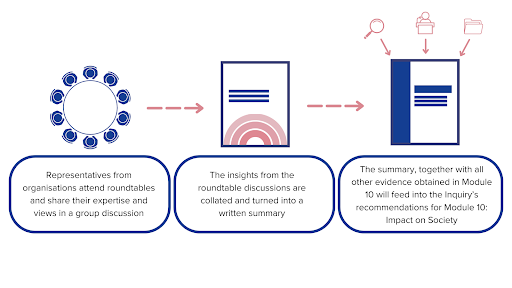
Paano nakakaapekto ang bawat roundtable sa M10: