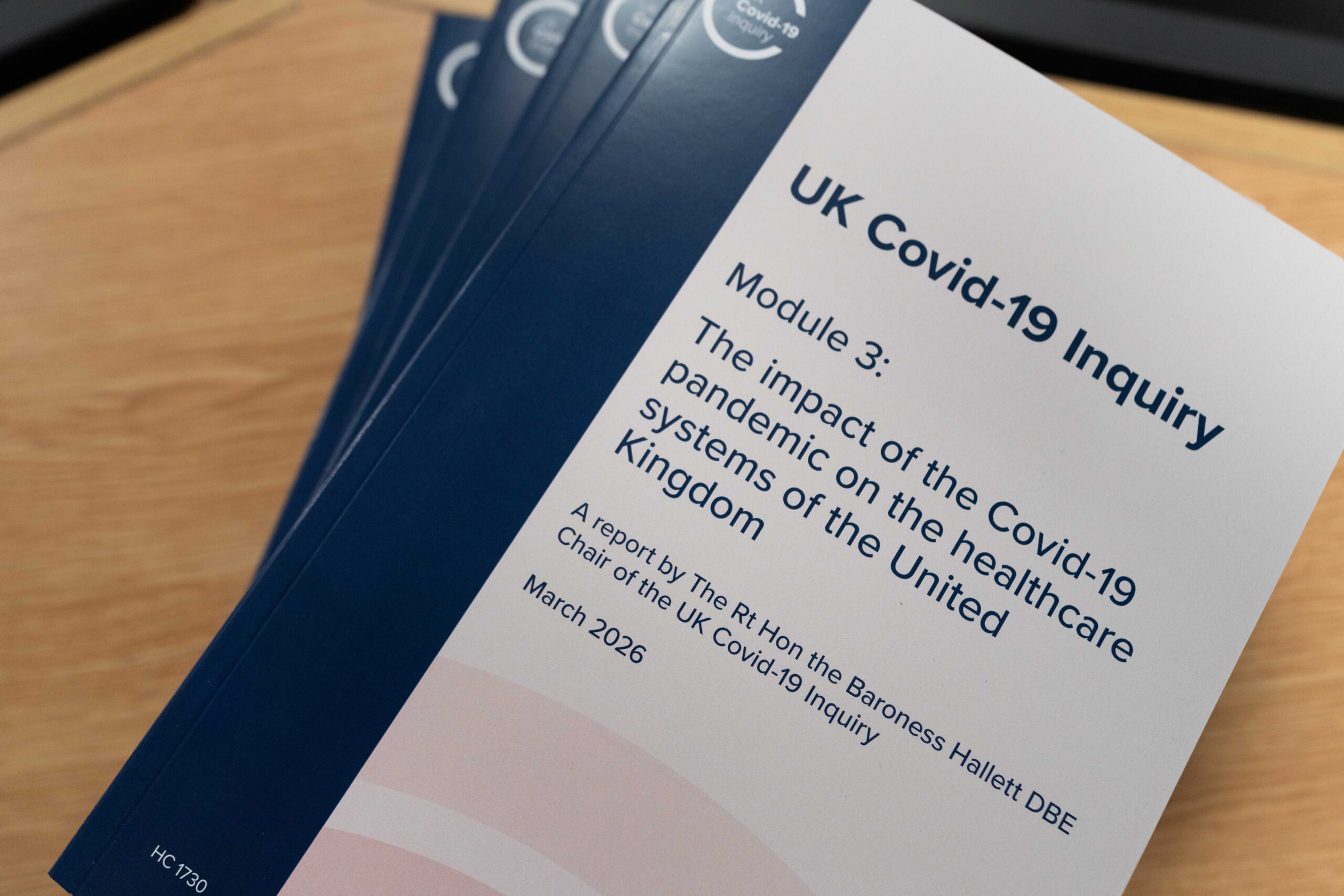
The Chair of the UK Covid-19 Inquiry, Baroness Heather Hallett, has today published her third report which concludes that the UK’s healthcare systems “came close to collapse”. Ultimately it “coped, but only just”.
Module 3, the third of the Inquiry’s 10 investigations, has examined the impact of Covid-19 on healthcare systems across the four nations. It investigated how governments and society responded to the pandemic, the capacity of healthcare systems to adapt and the impact on patients, their loved ones and healthcare workers.
Today’s new report, ‘The impact of the Covid-19 pandemic on healthcare systems of the United Kingdom’ (Module 3), finds that the UK entered the pandemic ill-prepared. Healthcare systems were already overstretched and in a precarious state. This fragility had profound consequences once the crisis hit, especially when the numbers of people seeking treatment for Covid-19 started to increase dramatically.
Healthcare systems were overwhelmed and came close to collapse. Despite the best efforts of healthcare workers, many Covid patients did not receive the care they would otherwise receive and non Covid patients had their diagnoses and treatment delayed. For some this meant their condition became inoperable. Healthcare workers put their lives at risk and the pandemic had a significant and long-lasting impact on their mental health and wellbeing.
In hospitals, visiting restrictions meant some vulnerable patients were left without vital support. Some people died alone. This continues to have a devastating impact on the bereaved.
Baroness Hallett calls for the prompt and thorough implementation of 10 key recommendations. These are necessary to prevent healthcare systems being overwhelmed in the next pandemic.
This third UK Covid-19 Inquiry report concerns the impact of the pandemic on the UK's healthcare systems. I can summarise that impact as: we coped, but only just.
The healthcare systems came close to collapse. Healthcare workers carried the burden of caring for the sick in unprecedented numbers. It came at a huge cost to them, their families, their patients and the loved ones of patients. Collapse was only narrowly avoided thanks to the extraordinary efforts of all those working in healthcare across the UK.
Despite those efforts, some patients did not get the level of care they would usually receive. The enormous strain placed upon the healthcare systems was unprecedented. Those working within it were obliged to work under intolerable pressure for months on end.
We cannot know when, but there will be another pandemic. My recommendations, taken as a whole, should mean that the UK is better prepared for that pandemic. In doing so, we shall avoid some of the terrible human cost of Covid-19. I urge governments across the UK to work individually and collectively to implement these recommendations, in full and in a timely manner.
A four-page brief summary of the report can be found on the Inquiry’s website and is available in a variety of languages and accessible formats.
In total, 95 witnesses gave oral evidence during Module 3 public hearings held in London in autumn 2024. The Inquiry heard from healthcare professionals, policy-makers, relevant experts, groups representing those most at risk from contracting Covid-19 and those who developed Long Covid as a result of catching the virus. The Inquiry also heard from serving and former senior politicians, leading scientists, key medical professionals and civil servants.
Read the full Chair’s statement
Some of Baroness Hallett’s conclusions are as follows:
- While health ministers maintained that the UK never reached a state of overwhelm, “there was clearly overwhelm”. Lower levels of care were provided to patients and patients did not always get the care they needed, notwithstanding the efforts of healthcare workers.
- The pressure was, at times, intolerable and this continued for wave after wave of the virus. Healthcare systems entered the pandemic with low numbers of hospital beds, high bed occupancy, high numbers of staff vacancies and of sickness absences, meaning systems were in a precarious position from the outset.
- Initial infection prevention and control guidance was flawed because it assumed that Covid-19 was spread by contact transmission and failed to consider the extent to which the virus was also spread by aerosol transmission.
- Supplies of Personal Protective Equipment (PPE) were particularly constrained at the start of the pandemic, causing healthcare workers sometimes to work in inadequate and unsuitable PPE and put themselves and their families at risk to care for patients.
- 111 services were not able to cope with the level of demand. Call demand for advice and information about Covid-19 increased dramatically, particularly in the early stages of the pandemic.
- Waiting times for emergency ambulances grew. Waiting times for even the most life-threatening calls grew, with some ambulance services resorting to military aid to ensure there was not a significant risk to life.
- Visiting restrictions meant that many patients died without the comfort of being surrounded by their loved ones, while vulnerable patients such as those with dementia or a learning disability and children in mental health inpatient units, as well as women accessing maternity services were left without vital support.
- The public messaging “Stay Home, Protect the NHS, Save Lives” may have, inadvertently, sent the message that healthcare was closed, contributing to a decline in attendances even for life-threatening emergencies such as heart attacks.
- The mental health of healthcare staff was severely impacted, with many exhibiting signs of post-traumatic stress disorder, while burn-out was common.
The Chair considers that all Module 3 recommendations should be implemented in full and in a timely manner. The Inquiry will monitor the implementation of the recommendations during its lifetime. In summary, the Inquiry recommends:
- increasing capacity in urgent and emergency care and ensuring that hospitals have the ability to implement surge capacity;
- strengthening the body responsible for infection prevention and control guidance, broadening its membership to enhance its decision-making and improving the guidance itself;
- improving data collection, enabling individuals at highest risk of harm from infection to be more easily identified and recording deaths of healthcare workers more accurately;
- promoting a standardised process and documentation for advance care planning, recording patients’ preferences for future care and treatment;
- increasing support for healthcare workers, improving retention and increasing resilience; and
- publishing guidance to assist decision-makers, providing clear criteria for clinical decisions if critical care resources become completely exhausted.
A full list of the Inquiry’s recommendations can be found in the full report.
The Inquiry has published recommendations for Module 1 and Module 2. Baroness Hallett welcomes the action taken by the four governments of the UK to date and trusts that all remaining recommendations will be implemented promptly and in full. Progress on the implementation of recommendations can be tracked on the Monitoring of Inquiry Recommendations page on the Inquiry’s website. The Inquiry expects to receive the next progress update in May 2026.
Module 3 was the first to publish a nagrywać of the Inquiry’s listening exercise, Every Story Matters, which brought together the contributions of more than 32,000 people. The Healthcare Record sets out the personal impact of the pandemic in stark and often distressing terms.
The Inquiry’s next report – focusing on the development of Covid-19 vaccines and the implementation of the vaccine rollout programme (Module 4) will be published next month, 16th April 2026. A further four reports will follow covering Modules 5 to 9, with the final report, Module 10, scheduled to be published no later than Summer 2027.
Przeczytaj full Module 3 report, W skrócie I inne dostępne formaty na naszej stronie internetowej.