The views and reflections presented are those gathered from Every Story Matters contributors. They do not represent the views or findings of the Inquiry, which are set out separately in its Module Reports.
前言
This is the Final Every Story Matters Record for the UK Covid-19 Inquiry. It concludes the listening exercise that has been at the heart of the Inquiry’s commitment to hear from those affected by the pandemic. It draws together and analyses stories people shared with the Inquiry.
This record compiles over 55,000 stories shared through the webform with the Inquiry up until the closure of Every Story Matters in May 2025. It reflects the unique and individual experiences of people from all corners of the UK. These accounts cover the breadth of day-to-day living, and the themes and topics which most affected people’s experience of the pandemic.
The Inquiry produced records on individual topics so they could be published and adduced at the time of the relevant module hearing. This meant that stories that were shared later on the same or similar topics were not included. The purpose of this record is to report on those stories so that all experiences shared are taken into account.
We sincerely thank everyone who has contributed their experience. Your stories of the pandemic have been invaluable in shaping the work of the Inquiry.
This Final Every Story Matters Record is dedicated to everyone who has shared a story and to all those groups and organisations who helped the UK Covid-19 Inquiry to hear from so many people. We are truly grateful for your time and support.
1 About Every Story Matters
The UK Covid-19 Inquiry was set up to examine the UK’s response to, and impact of, the Covid-19 pandemic and to learn lessons for the future. The then Prime Minister, the Rt Honourable Boris Johnson, appointed Baroness (Heather) Hallett, the Chair and set the Inquiry’s very broad Terms of Reference. The Terms of Reference were shaped by extensive public engagement, during which over 20,000 responses were received. Many of the responses provided a clear message from the public: that the Inquiry must listen to those most affected by the pandemic and that their experiences should help shape the work of the Inquiry.
Baroness Hallett knew that it would be impossible to take statements from and/or call as witnesses, all those affected by and still suffering the effects of the pandemic. She asked the Inquiry team, therefore, to develop another way of listening to people across the UK and gathering their experiences. This led to the launch of Every Story Matters.
The Every Story Matters initiative aimed to provide an opportunity for everyone in the UK to share their experience of the pandemic with the Inquiry. It was designed to enable people to share their experience, including the impact on them and their loved ones, in their own way, in their own time and in their own words.
The stories gathered were then analysed to produce a permanent record. The previous records have helped inform the Inquiry’s investigations, the hearings and the work of the Inquiry more generally. They have been invaluable to Baroness Hallett in learning lessons for the future. She hopes that, if implemented, her recommendations will reduce the number of deaths, reduce the suffering and reduce the huge socio-economic cost in any future pandemic.
How Every Story Matters was delivered
Every Story Matters was launched in several stages:
- In November 2022, we launched our online listening platform, where members of the public could tell us about their experience. The Inquiry sought feedback from several stakeholders and made changes, ahead of the full launch of the online platform in May 2023.
- In June 2023, Every Story Matters began its national communications campaign to ensure the public were aware of the opportunity to share their story.
- From Autumn 2023 we also held in-person and online events throughout the UK and with specific people who were directly impacted by the pandemic.
Every Story Matters was open for two and a half years, to give people time to hear about it, and to share their story when they were ready. Over 58,000 stories were shared with us in total, and we are grateful to everyone who took the time to contribute.
The stories and experiences the public shared with Every Story Matters were analysed and summary reports called ‘records’ were produced for each Module. The documents are called ‘records’ as they aim to reflect a record of the pandemic and its impact, in the words of people who were affected.
The records helped to identify trends and themes, and particular experiences which may illustrate systemic failures. Every Story Matters records have been used in the public hearings phase of the Inquiry by the Chair, Inquiry lawyers, by lawyers representing core participants and have been referenced by witnesses in response to questions.
Overall, the Inquiry is basing its findings and recommendations on the totality of the evidence before it, including what was provided by Every Story Matters. This ensures that the Chair’s recommendations are as robust and well-evidenced as possible and should mean they are more likely to be implemented.
The table below outlines the modules where an Every Story Matters record was submitted as part of the legal hearings:
| 模块 | 描述 |
|---|---|
模块 3 - 医疗保健 Published September 2024 |
Focused on people’s experiences of the United Kingdom’s healthcare systems during the Covid-19 pandemic. |
模块 4 - 疫苗和治疗 Published January 2025 |
Focused on people’s experiences of vaccines and therapeutics during the Covid-19 pandemic. |
模块 6 - 成人社会护理部门 Published June 2025 |
Focused on people’s experiences of the Adult Social Care Sector during the Covid-19 pandemic. |
模块 7 - 检测、追踪和隔离 Published May 2025 |
Focused on people’s experiences of the Test, Trace and Isolate system during the Covid-19 pandemic. |
模块 8 - 儿童和青少年 Published September 2025 |
Focused on the impact of the pandemic on children and young people. |
第九单元 - 经济应对 Published November 2025 |
Focused on the economic support for business, jobs, the self-employed, vulnerable people and those on benefits and the impact of key economic interventions during the Covid-19 pandemic. |
Module 10 - Key Workers Published February 2026 |
Focused on the experiences of key workers during the Covid-19 pandemic (excluding experiences of healthcare and adult social care which have been included in the records for Modules 3 and 6 respectively). |
Module 10 - Bereavement Published February 2026 |
Focused on people's experiences of bereavement during the Covid-19 pandemic. |
Module 10 - Mental Health and Wellbeing Published February 2026 |
Focused on the general impact of the Covid-19 pandemic on mental health and wellbeing of those living in the UK. |
Figure 1: Table of Every Story Matters records
Purpose of this Final Every Story Matters record
Every Story Matters was open for two and a half years, to give people time to hear about it, and to share their story when they were ready. During this time, records were published to coincide with the relevant module hearings. It follows that stories shared after each record was drafted were not included.
This Final Every Story Matters record ensures that those stories have all now been analysed and the full breadth of all experiences, views and opinions shared by the UK public with the Inquiry have been listened to and taken into account.
The views and reflections presented are those gathered from Every Story Matters contributors. They do not represent the views or findings of the Inquiry, which are set out separately in its Module Reports.
2 How the Inquiry listened to people across the UK
To ensure that the Inquiry gathered stories from the broadest range of people possible, across the UK, and in a trauma-informed way, people had a choice in how to share their story:
- Online platform: The Inquiry developed an online platform for people to share their experiences, by answering three key questions: ‘What was your experience?’, ‘What was the impact on you and people around you?’ and ‘What are the lessons to be learned?’. Contributors were also able to provide optional demographic information if they wished to do so. In total, the Inquiry received over 55,000 submissions through the webform.
- Additional and accessible formats: Recognising that a digital-first approach may exclude some, the Inquiry offered alternative formats, including large print, Easy Read and in a number of languages, including Welsh. Supporting information in British Sign Language (BSL) and Braille was also provided. A pilot for people sharing their story by telephone was developed in partnership with Age UK, Mencap and RNIB and a British Sign Language (BSL) pilot was also developed and promoted through d/Deaf organisations. In both cases there was insufficient demand to continue past the pilot stage.
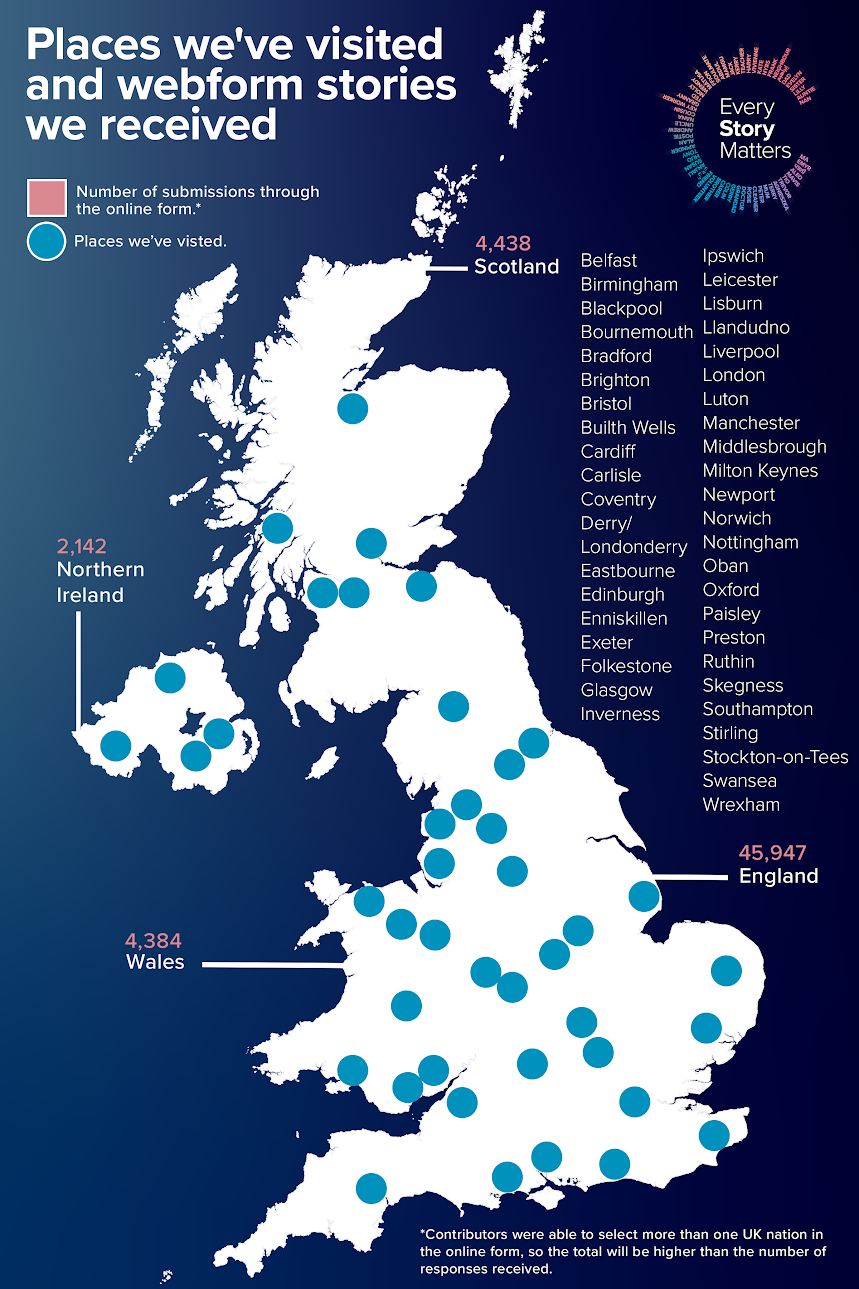
- Listening events: The Inquiry held in-person and virtual listening events across the UK. Every Story Matters public events were piloted in October 2023, with a number of different formats trialled to determine the best way for people to share their story. After evaluating the pilot events the format adopted was holding events where people were able to share their story directly with Inquiry staff. Events served to deepen engagement, offer a supportive environment for sharing and provided a geographical spread to the collected stories.
Figure 2: Every Story Matters listening events across the UK
- Targeted research: The Inquiry also commissioned targeted research, carried out by a consortium of social research and community engagement organisations, to ensure we heard from those most affected by the pandemic. Around 2,200 people were listened to through trauma informed in-depth interviews and discussion groups.
Every Story Matters also focused on reaching seldom heard groups whose experiences are often under-represented. We specifically reached out to people who might feel overlooked, including younger people (18-25) and older people (aged 75+), people from ethnic minority backgrounds, people living with mental health conditions, LGBTQ+ people and those who were not then in employment.
This guided the work of Every Story Matters across its campaign, events and research.
Focusing on Key Findings and Impact
The Final Every Story Matters Record shows the pandemic’s wide-ranging impact, and the details about the people who shared their experiences prove just how diverse their backgrounds are. Key findings include recognition of a high participation rate from women and workers, and the notable fact that one-in-three participants live with a disability or health problem. These profound personal accounts, especially those relating to mental health and family resilience, resonated deeply across all generations and ethnic backgrounds. A full breakdown is provided in the Appendix.
Principles that guided Every Story Matters
Every Story Matters was designed around a set of core principles:
- Awareness and visibility: we adopted a proactive and targeted communications and engagement approach. This increased awareness of Every Story Matters so people knew they could take part.
- Adaptable: we designed Every Story Matters so that it could evolve and adapt as needed.
- Trauma-informed: a trauma-informed approach has underpinned all aspects of the Inquiry’s work especially Every Story Matters, from public-facing engagement to internal processes. This was paramount to ensuring that participants and staff felt safe, respected and supported throughout the process of sharing their deeply personal experiences.
- Therapeutic: we understood that the act of writing or speaking about experiences and having them recorded can support the processing of grief and trauma and designed Every Story Matters in a way which helped to facilitate this.
- Anonymity: we asked that people did not share personal details in their stories and none were used in our published records. This was to protect people’s privacy and ensure they felt safe to share their story.
- Transparent: the Inquiry has been as open as possible with the public about its work and provided clarity on how people’s contributions would inform the Inquiry from the outset. The website provided a central point for the public to learn more about how their responses were being used by the Inquiry. We ran public events that were open to anyone over the age of 18 to attend and share their story in a way that worked for them. Every Story Matters records include the full range of experiences shared with us. While these are the personal perspectives of the public rather than the Inquiry itself, we have worked to ensure that both the challenges and the positive stories shared about the pandemic are represented.
- Robust: experiences were gathered using methodologically robust research approaches to inform high quality evidence records. These were then subject to peer review.
- Ethical: we established an Ethical Advisory Group, to ensure that Every Story Matters maintained the highest ethical standards.
- Inclusive: we aimed to remove barriers to participation, making active efforts to reach communities regardless of background, location, or digital access.
- Seldom heard: where we learned from Every Story Matters demographic data that there was an underrepresentation of certain groups we have sought to remedy this as much as possible via targeted engagement and research.
3 How we analysed webform stories
To understand the different views, experiences and opinions we heard through the webform, we analysed contributors’ responses through an analytical method called ‘natural language processing’ (NLP). This helps organise people’s stories in a meaningful way. Through this method, the information submitted through the webform is organised into ‘topics’ based on terms or phrases.
Another method, called factor analysis, was then used to combine these topics into key themes. The approach looked at how often different topics appeared together and grouped them accordingly. For instance, topics related to GP practices, hospitals and dentists were put into a single theme about experiences of healthcare during the pandemic.
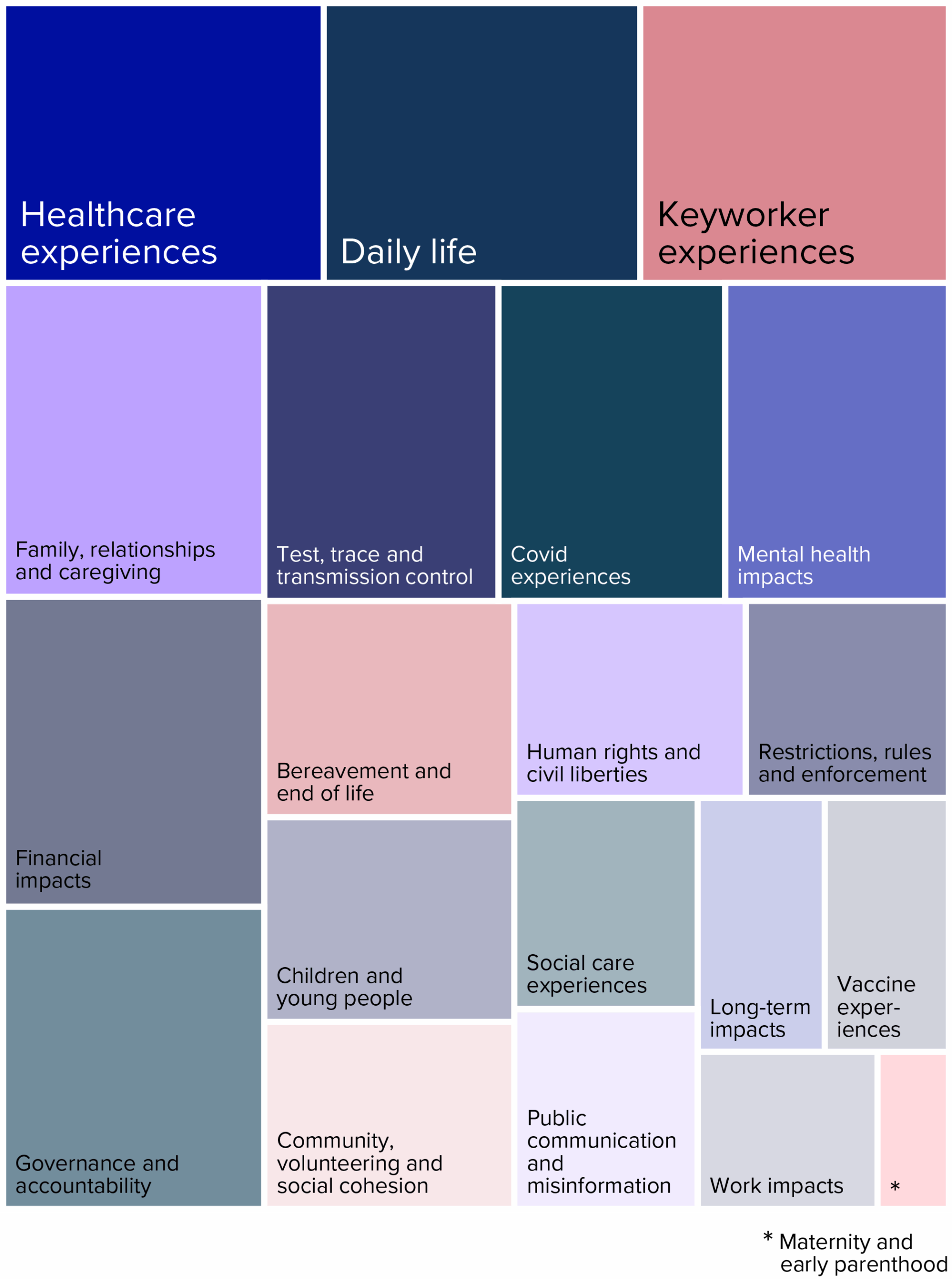
This analysis identified 20 key themes within the stories shared. Having categorised the data in this way, individual stories were manually reviewed to make sure everything made sense and matched the experiences shared. The largest number of topics in each theme are shown in the following visual, where the size indicates how many people mentioned them. People often talked about multiple topics and, where that happened, they were counted more than once.
Figure 3: NLP themes: The diagram illustrates key themes mentioned by contributors in the online form. The largest number of topics in each theme are shown, where the size indicates how many people mentioned them.
4 The different pandemic experiences that people shared
Building on the topic model, we carried out further analysis of the key themes to understand the types of experiences people shared in the webform. Contributors were assigned to one of the groupings shown below based on the language they used to describe their experiences during the pandemic. However, many also discussed other aspects of their pandemic experience. Overall, 50,539 of the webform stories included enough detail about their pandemic experience to be reflected in the analysis. Further details can be found in the 附录.
These groups are another way to capture and summarise pandemic experiences and the impact on people in the UK. The different groupings are listed below and described in more detail over the following pages.
- Clinically vulnerable people and others who were shielding
- Families caring for and supporting children with additional needs
- Families living apart during the pandemic
- Health and social care workers
- New and expectant parents
- Parents and carers supporting learning at home
- People bereaved during the pandemic
- People concerned about lockdowns
- People who contracted Covid-19
- People who expressed concerns about the response to the pandemic
- People whose medical treatment was delayed
- People whose mental health was impacted by the pandemic
- People who shared their experiences of the Covid-19 vaccines
- People who shared positive pandemic experiences
- People who were financially impacted by the pandemic
- People who were unable to travel
Clinically vulnerable people and others who were shielding
People who were clinically vulnerable or shielding shared their experiences of being in clinically vulnerable households and having to shield throughout the pandemic. They detailed their struggles with isolation, challenges accessing health and care services, confusion about taking Covid-19 vaccines and concerns about society opening up when it was still unsafe for them.
Fear, loneliness and isolation
- Many contributors who were clinically vulnerable were alone and felt fearful during the pandemic. Having to shield meant people could not help or support their family and friends, or receive help themselves.
- Many said they experienced low mood and deep feelings of concern about catching Covid-19 and what the future would be like.
| “ | The loneliness and isolation was very difficult … not being with any other family … left me completely heartbroken.” |
Access to health and care
- Some contributors discussed how GPs and other medical appointments moved to telephone or online. Many welcomed still being able to access crucial healthcare and support during a frightening time.
- However, they said booking appointments and accessing care was more challenging. People experienced delays and cancellations, as well as poor quality care.
| “ | I have a long term respiratory condition and get frequent chest infections … I was shielding in the pandemic … however when I tried to get help with a cough through NHS 111 or my GP I was told to stay away (even though it was a flare up of my regular infections and I had booked an appointment) … I was sent from pillar to post, my GP wouldn’t / couldn’t see me, they told me to go to A&E.” |
Covid-19 vaccines
- Some clinically vulnerable contributors were concerned about taking any of the available Covid-19 vaccines. They felt there was contradictory information about whether clinically vulnerable people could take the vaccines and the benefits and risks of having it.
| “ | [There was] a professor from Oxford or Cambridge University on the TV, stating that anyone with an autoimmune disease, was not suitable for the vaccine … straight away I checked the pharmaceutical company’s website, and it stated on there, that the following people should not have the vaccine – People with an autoimmune disease.” |
- Others were concerned that not enough people were taking the vaccines, leaving them at risk in public places.
Easing of restrictions
- Clinically vulnerable people told us how frustrated they were when restrictions eased. They felt forgotten and at greater risk, and in some cases this created a sense that the wider public was eager to “move on” while they continued to be concerned about their own safety.
- Many continue to feel frustrated and have been forced to adapt their lives to manage the risk of infection. This has reinforced their sense of isolation and prevented people from accessing health and care services
| “ | I thought everyone was going through the same thing. We were all stuck inside. But then things started opening up, and I realised people like me weren’t included in the ‘return to normal’. I was still stuck inside while everyone else got their lives back.” |
Families caring for and supporting children with additional needs
Some contributors shared the challenges of finding support for children with additional needs, the mental health impact of the pandemic on children and the long-term impact on their access to support, education and overall development.
The impact on the mental health of children with additional needs
- Contributors described the impact of the pandemic on their children’s mental health. Extended periods of isolation and disruption to routines led to increased levels of anxiety, worry and depression. Some children became increasingly concerned about germs and death, and what would happen once lockdown ended.
| “ | My son is high functioning autistic … the enforced isolation of Covid became a driver for his downward spiral. His fear of germs became uncontrollable, he could not touch any surface unless I had cleaned it, his constant handwashing meant he damaged his skin up to his elbows and is even now obsessively washing his hands for up to an hour at a time. Social Services, mental health services and his special school completely shut down, abandoning us for the whole period.” |
Lack of support
- Parents of children with additional needs discussed how the closure of schools and the move to online learning often did not meet their children’s needs. Some children were able to attend school at times, while others had to remain at home.
| “ | My son is on the autistic spectrum, has moderate/severe dyspraxia and significant sensory processing disorder and attends a mainstream secondary school with an EHCP plan … For the first 3 months of lockdown my son received no formal education or online learning and was sent 30 page PowerPoints to “learn” from. He was expected to read and teach himself.” |
- This put pressure on parents who were isolated from extended family and often had to take time off work to care for their children. Many families struggled to cope and did not have enough support.
| “ | During this time, our older son’s SEN needs were becoming very apparent. He was given no support by school at all, even though they should have had him on a SEN register, and the change in routine was affecting him greatly. By May 2020 he said he wanted to be dead. He was 6. It broke our hearts.” |
- There were also concerns about difficulties accessing specialist services, including physio, speech and language therapy and occupational therapy.
Long-term impact
- Some families said long periods out of school and limited access to services meant delays in identifying their child’s needs and putting good support in place.
- Many children with special educational needs struggled when lockdown ended. They often did not want to go back to school and found it difficult to adjust.
| “ | When [my son] finally returned to in school teaching, it became apparent he had special educational needs. I feel he missed so much early socialising and his needs would have been identified even sooner if he’d been in school the whole time.” |
| “ | When the children went back to school after the pandemic, things never truly returned to how they were … By March 2022, it felt like the beginning of the end for my son’s education. He had a complete mental breakdown, and since then, he has been out of school. His struggles were partly due to unmet special educational needs, but also because the school had transformed into a place he no longer felt was safe … The school environment, once a place of learning and growth, became a source of fear and distress for him.” |
Families living apart during the pandemic
Contributors shared their experiences of being isolated from their friends and family during the pandemic. They discussed the difficulties of being separated from those they loved during significant life events, particularly through bereavement. They also gave examples of how pandemic isolation damaged relationships.
Families missing out
- Contributors described the pain of being separated from family during significant life events, including births, weddings and birthdays.
- Many spoke of the sadness they felt at not being able to see family who had young children and missing out on quality time they would never get back.
| “ | I’m also a human with my own family. We missed my dad’s 80th birthday, I didn’t see my grandchildren for months. My daughter graduated as a doctor, being in the cohort of final year medical students who were pushed into early graduation to go straight into the firing line. I couldn’t hug her to say congratulations. It seems such a little thing, but it felt so difficult at the time.” |
紧张的关系
- Long periods of time apart put a strain on many relationships. We heard how some people felt abandoned by their loved ones when they were unable to visit them at home or in healthcare settings.
| “ | Care homes shut down in March 2020 and I couldn’t get window visits as [my mum’s] room was not on the first floor and she didn’t understand FaceTime. When I eventually got [to see her] in August, she cried because (her words) you abandoned me! She thought her only child had died.” |
| “ | I lost my husband just before Covid. I have 2 sons. I didn’t want to make the decision as to which one I would spend time with, so I asked them to sort it out. It was decided I would spend time with my younger son and his family. Meanwhile my other son and his wife had a baby girl during lockdown. Although it was a joint decision between my sons, it has caused a lot of resentment from my older son and his wife and is still ongoing.” |
Bereavement in isolation
- Many bereaved people described how painful it was being separated from family and friends when their loved ones died.
| “ | We had the trauma of organising a funeral under Covid restrictions. We had a very small funeral … family and friends were too scared to attend … my overwhelming emotions are regret, anger and loathing.” |
- They shared the pain of not being able to say goodbye in person, attend funerals and end of life ceremonies, or be with others as they mourned. The isolation they felt added to their grief.
| “ | During this period, we lost my husband’s grandad due to Covid-19 which was awful. None of us could see or support his family. We couldn’t even visit him. He never got to meet our daughter. His funeral, we couldn’t attend we watched the hearse from a distance. It was awful.” |
Health and social care workers
Health and social care workers shared how they responded to the pandemic, adapting their job roles and working patterns. Many emphasised how stressful it was working throughout the pandemic and the lasting impact it had on their mental health and wellbeing.
Initial response to the pandemic
- The beginning of the pandemic was a very anxious time for many. Initially, the impact of Covid-19 was unclear, with workers planning for different scenarios and having to adapt.
| “ | When the pandemic first hit it was terrifying. The lack of an action plan for so long meant that by the time the first lockdown began, it was too late.” |
- Some began working from home, while those delivering care on the front line continued to do so in person. This created some tensions between colleagues because of the different levels of risk they were taking.
- Other health and care professionals started to work extra shifts. Some moved out of their homes to avoid spreading the virus to family members.
- Public support for health and care workers was greatly appreciated by many.
Problems with PPE
- PPE shortages were a key challenge early on. Health and care workers told us about reusing equipment or being provided with PPE that was poor quality or did not fit properly. Some said PPE improved as the pandemic went on.
| “ | I was a nurse manager responsible for service delivery with a team of around 20 nurses … We had no PPE at the start. All our orders were intercepted at the local hub and diverted to hospitals. We would be out visiting in a plastic apron and basic masks … Our practice manager was left trying to source masks and gloves with her own credit card … although it did get better.” |
- Some health and care workers felt extremely uncomfortable in gowns, face masks and visors. PPE also led to problems communicating with patients, building relationships and delivering compassionate care.
| “ | We were now only identifiable by our eyes [because of the PPE we were wearing], we lost the ability to be fully personable to our patients and to each other.” |
| “ | We were asked to care for patients without the proper PPE, relying on makeshift solutions that left us feeling exposed and vulnerable.” |
压力和倦怠
- There was huge pressure on many health and care workers during the pandemic. They often worked long hours, under immense pressure to care for patients. There was added strain because of reduced staff numbers due to sickness or colleagues self-isolating.
| “ | It was horrendous, 4 staff for 20 covid positive patients 4 of who were extremely unwell … no break, nowhere to eat our food as we were not allowed to leave the ward.” |
- Health and care workers experienced distressing situations, with much more death and bereavement than they were used to.
- Staff told us about the lasting impact of working in health and social care. Many said they have experienced burn out and poorer mental health, with examples of relationship and family breakdowns.
- Some decided to leave their profession or stop working because of the impact on their mental health and wellbeing.
| “ | I was a care home manager … I ran a care home for young people with learning disabilities … it was such a difficult and exhausting time … [I] left in 2022 after 30 years I decided to walk away.” |
New and expectant parents
Many women told us about feeling unsupported and alone, particularly when their partners could not be present for appointments or the birth. Others described the challenges of having a baby in the pandemic, including experiencing postnatal depression.
Isolation and accessing care
- Women told us how fearful they were about being pregnant during the pandemic – they felt unsupported and alone. Many said they did not have the opportunity to build supportive relationships with other women preparing for motherhood.
- Healthcare appointments often happened online or by phone. There were confusing and differing rules and restrictions across GP practices and hospitals. This had a negative impact on many women’s experience of pregnancy and giving birth.
| “ | I had no support at antenatal appointments, no antenatal classes and no socialisation for months … when I was 30 weeks pregnant, I had a mental breakdown, facing the prospect of appointments alone and the possibility of giving birth alone.” |
| “ | I felt like I was just surviving and had no midwife support. They were just totally unavailable to me, I didn’t hear from them.” |
Partners unable to provide support
- Many pregnant women and their partners felt isolated because they could not be together. They felt they were missing out on key appointments and were less involved.
| “ | The day before my six week scan I called EPU to check my husband could attend. It was confirmed he could. On the day of the scan EPU called me to say he couldn’t attend – I was very upset and so was the poor nurse having to make all the calls to upset and scared pregnant women. My husband wasn’t able to attend a single scan throughout the pregnancy.” |
| “ | When my wife had a baby, I was refused entry to the hospital to accompany her, even though I kissed her goodbye at the door and she slept on the same bed as me the night before … I missed the birth of my child and could not be on the maternity ward … completely barbaric.” |
- Guidelines on the presence of birthing partners were inconsistently applied and changed as the pandemic progressed. This meant some women could not have the birthing partner they wanted or were upset when they heard about other women who were allowed someone to support them.
Having a new baby
- Many women said they felt anxious and low after the birth of their child. Having a newborn child without the support of family and friends was stressful and overwhelming for some.
| “ | Staying at home completely alone … no visitors. Isolating. Health visitor care also lacking. I should have been referred back to the hospital regarding my scar issues, but this did not happen … I ended up with postnatal depression. Again, care lacking. It took a long time to get help. I wanted to end my life on many an occasion. I was exhausted and lonely. My child never slept.” |
- Other women told us about feeling a sense of unease and confusion about having a baby during the pandemic. They said they worried about their child’s future and how the pandemic would impact their social development.
Parents and carers supporting learning at home
Contributors who were parents or carers for children and those who were students during the pandemic shared how the pandemic both strengthened and strained family relationships.
家庭关系
- For some, increased time with family during lockdowns and school closures helped them bond and form stronger relationships. For example, families spent more time cooking, playing games and watching TV.
| “ | During lockdown … we had a lovely family time – dinner around the table, spending time together in the garden, cooking, playing games – things we didn’t always have time for normally. When school went back, we noticed our youngest being reluctant to go.” |
- On the other hand, increased time together also led to arguments in some families, with more conflict than usual and increased stress for parents and children.
- Parents and carers also told us how difficult it was to maintain a work-life balance at home, with their responsibilities becoming blurred and overlapping.
| “ | I think my children would have had a better education if it wasn’t so rushed and distracting at home and there was more structure. I found it hard to balance [home schooling] on top of work and household chores.” |
Social interactions, development and wellbeing
- Many parents and carers with young children worried about them missing out on socialising with other children. Parents described how older children found it hard to maintain friendships due to school closures.
- Contributors also described how the pandemic impacted young people’s mental health, with parents worrying about their children’s low mood and anxiety, and a reluctance to go back to in-person activities as the pandemic came to an end.
| “ | This hit our child just at the age he was beginning to mix with friends outside of school and of course it all had to stop and he’s never recovered. Now years later and hasn’t still mixed much outside school.” |
- Parents and carers also said it was difficult to know how best to support their children while trying to manage their own mental health and relationships.
| “ | One child is so full of anxiety I gave up my full-time job to do a part time cleaning job with her because she is terrified to go out the house. I feel completely shattered and overwhelmed. I have lost people, and my kids are damaged.” |
教育和学习
- Many parents had to get more involved in their children’s education during the pandemic, taking on extra roles they did not always feel equipped for.
| “ | I had to home school my son, which caused tensions as I am not a qualified teacher and struggled with the work that was set. I asked if I could work from home but I was told no. My mental health deteriorated.” |
- Parents told us how their children struggled to concentrate and learn without continued support, encouragement and monitoring.
- We also heard about the challenges of not having access to digital technology. For example, some families could not afford a laptop or tablet for each child.
- Young people at university said they lost out on key life experiences, struggled to form friendships and could not develop their careers due to the pandemic.
| “ | University, overall, was a socially isolating experience and basically made me feel like it was a waste of time and money, as I have gotten nothing out of it at all.” |
People bereaved during the pandemic
We heard from many people who experienced traumatic bereavement during the pandemic. They shared the lasting impacts these experiences have had and emphasised their anger, guilt and regret that they could not be there for dying loved ones as they wanted to. Bereaved people also shared how painful it was that restrictions prevented them from honouring their loved ones in line with their wishes or culture.
长期影响
- Many bereaved people continue to feel isolated because their loved one died during the pandemic. They often described ongoing, damaging impacts on their mental health.
- Bereaved people also shared how they continue to experience profound feelings of anger, sadness and regret, alongside frustration that others in society want to ‘move on’ from the pandemic.
| “ | We could not give my partner the send off he wanted … I feel so alone, even now when people are around. I don’t think I have really been able to mourn. I feel so guilty of not being there … not sure how I will get over it or what could of be done differently as we followed all the advice at the time.” |
临终关怀
- Pandemic restrictions also meant that many people could not be with their loved one at the end of their life.
| “ | I feel devastated that I could not care emotionally and physically for my husband. I should have been able to hold his hand and sit at his bedside, even if he was not allowed out of the home. I feel wracked by guilt that I was not able to help and comfort him in his hour of most need when he eventually died.” |
- Not knowing how their loved one spent their last days and hours left bereaved people with a deep sense of guilt and sadness. Some contributors felt they let their loved one down by not being with them at the end.
| “ | They called us at 9am to tell us she was deteriorating, and that as she was only now ‘end of life’ … She died before we got there. The greatest of women, loved by so many. She didn’t deserve that.” |
Funerals, burials and ceremonies
- Planning funerals, burials and end of life ceremonies was frustrating and painful. There were delays with death certificates and problems with mortuary capacity.
- Restrictions on attendance and social distancing at funerals, burials and end of life ceremonies meant many bereaved families could not honour their loved ones in line with their wishes. Many cultural and religious practices that were deeply significant to some families could not take place.
- Bereaved people also felt isolated during funerals, burials and end of life ceremonies, adding to feelings of grief and sadness.
| “ | Only six people could attend my grandad’s funeral … his girlfriend and my other grandad couldn’t attend because they were high risk … we were all so upset we couldn’t say goodbye properly.” |
访问限制
- Many bereaved people were unable to visit unwell loved ones in hospitals or care homes, with some relying on phone or video calls, and others having no contact. This left them feeling incredibly anxious about the healthcare and other support being offered to their loved one.
- Later in the pandemic, visits were allowed in health and care settings. These were often very upsetting, with PPE and social distancing making the experience feel cold and inhumane.
| “ | The hardest thing I had to deal with was the death of my grandfather. He was in a care home when Covid began. He had been isolated with pneumonia yet still caught Covid-19. When my grandfather was diagnosed, my family were denied access to him. He spent his last few days alone. We never had a chance to say goodbye.” |
People concerned about lockdowns
- Contributors often felt strongly about the impact of lockdowns during the pandemic and wanted the Inquiry to capture their concerns. This included contributors with different views on government restrictions and decision making during the pandemic. Some felt the UK should have locked down sooner, while others said that lockdowns should never have happened. Many contributors felt a sense of anger about high profile rule breaking.
Early lockdown advocates
- Some people shared how they felt an earlier lockdown would have reduced the spread of Covid-19 and prevented more deaths.
- Many of these contributors had family or friends who died during the pandemic, something they felt might have been avoided had lockdowns started earlier.
| “ | I felt the decision of whether to go into lockdown or not was made without the best interests of the population at heart. There seemed to be a desire to keep going, with herd immunity considered to be a strategy as well as unnecessary thinking about the economic impact it might have. My dad followed all of the rules … and very sadly due to the government delay in announcing lockdown he had already contracted coronavirus … After several weeks of being on a ventilator his condition deteriorated and it was decided that support should be withdrawn. I was unable to visit him to say goodbye.” |
Lockdown opposers
- Some believed the health risks of Covid-19 were overstated and that lockdowns were unnecessary.
- Others discussed the threat that Covid-19 posed to older and clinically vulnerable people but thought protective measures should have focused on that group rather than the whole population, in order to maintain economic stability and social contact.
- Some also opposed lockdowns in principle because they felt they infringed human rights and freedoms.
| “ | Lockdowns … isolated people and caused catastrophic long-term impacts on society and the economy which caused more damage than Covid ever did.” |
| “ | Those at risk were an identifiable group who could have been informed of their risk, and who could have protected themselves. Instead, the whole population was punished, including the young and healthy, who were at virtually nil risk from serious effects.” |
Shared anger
- Whatever their views on lockdowns, contributors gave examples of reading about or hearing on the news that high-profile public figures did not follow the rules.
- Seeing public figures breaking the rules left many contributors feeling angry and frustrated, particularly because of personal sacrifices they made to follow the lockdown guidelines.
| “ | People were isolated to protect the NHS, yet news reports showed MPs going out breaking their own lockdown rules, MPs having parties were reported, it was like slapping people in the face.” |
| “ | Double standards are immensely frustrating… This caused many people to treat the laws as optional.” |
People who contracted Covid-19
People described their experience of contracting Covid-19 during the pandemic, including some who went on to develop Long Covid and continue to live with it today. They described their experiences in seeking a diagnosis and access to treatment and support for their symptoms.
Infection with Covid-19
- Some people were unaware they had Covid-19 until they were tested. Others had obvious Covid-19 symptoms, such as a continuous cough or sore throat, headaches, continuous aches and pains, fatigue or ‘brain fog’.
- For some people who caught Covid-19, their symptoms lasted much longer than expected or became more serious. Many described having difficulties breathing and low oxygen levels, reduced mobility, cognitive issues and problems with their eyesight, as well as many other issues.
- As the pandemic progressed, these longer lasting symptoms became known as Long Covid.
| “ | I’ve had severe fever, severe fatigue, disabling brain fog, racing heartbeat, red eyes … my immune system is hyperactive … From being fit enough to cycle 500 miles I now rarely leave the house.” |
Living with Long Covid
- Many people who continue to live with Long Covid said they were or are unable to do simple daily tasks like getting out of bed or going for walks.
- Some with Long Covid described times when their health improved and then got much worse again, with this pattern often repeating as their illness changed.
- Long Covid has been, and continues to be, very damaging for contributors’ mental health. They described feelings of exhaustion, frustration and feeling demoralised as their physical health drastically changed compared to before the pandemic.
- This also meant many have had to rethink how they live, what work they can do and what the future might look like as they deal with the ongoing impact of Long Covid.
| “ | I was very ill with headaches and extreme fatigue for the first six weeks of lockdown … I even struggle to walk sometimes … I have permanent chronic fatigue, mild breathlessness, migraines for months … I can barely work some days.” |
Treatment and support for Long Covid
- Many people with Long Covid said they felt anxious and stressed because they could not get any support with their symptoms.
- Some feel dismissed by healthcare professionals. They were sent for tests and treatments which were unsuccessful or inconclusive. People were frustrated and exasperated by the process of being referred to different health services.
- Contributors described how Long Covid clinics were established over time and there is now more understanding of the condition. However, contributors said the clinics often focused on managing symptoms rather than relieving them which can be frustrating.
| “ | I saw a nurse at the Long Covid service who listened to all my symptoms and experiences for 70 minutes. This felt really incredible, and I cried a few times just because I was finally being listened to and was receiving some constructive advice and referrals.” |
People who expressed concerns about the response to the pandemic
Some shared concerns about key policy decisions and felt there were missed opportunities in government communications. Contributors expressed feelings of regret and disappointment, linking many different negative experiences to decisions that were made. They also reflected on the long-term and often damaging impacts this has had on them and others.
Government decisions
- Many contributors criticised decisions made by government during the pandemic. For example, some felt the initial lockdown should have happened quicker and this would have avoided further lockdowns later in the pandemic.
- Others discussed how they thought the UK government missed opportunities to communicate about the importance of using face masks or to secure supplies of the right type of PPE.
| “ | The country should have closed its borders at the beginning to prevent it getting in as much and then we should not have had as many lockdowns or for as long.” |
| “ | A far more pragmatic and flexible approach was required, one that would have provided far greater dignity, care and understanding of how these situations may be better catered for and managed.” |
| “ | The government’s response struck me as lacklustre and ineffective. Lockdown was put off, masks we were told were ineffective despite their widespread use across the world.” |
Disappointment and regret
- Many shared disappointment and regret about the pandemic response, blaming the government for the damaging consequences they and others experienced during the pandemic.
- Contributors discussed many different damaging experiences they linked to government decisions, including the death of loved ones, poorer mental health, reduced income and the breakdown of relationships.
| “ | Over the last three and a half years since the start of the Covid shutdown … [the government] strategy could have saved my son from the unbearable suffering he has had to endure and kept the economy from crashing, never mind reducing the overall cost of dealing with the pandemic … they didn’t have any thought of the damage being caused, particularly to our young people and children.” |
Long term impact on people’s lives
- Contributors often focused on how the decisions and missed opportunities of the pandemic are having an ongoing impact on them and others.
- Many said that their education, work and personal relationships continue to be impacted by the pandemic. They believe people’s lives during the pandemic could have been better and look back on the pandemic with frustration and regret.
| “ | I spent my entire first year [at university] 2020/21 in and out of lockdowns. It was really difficult living in halls and not being allowed to socialise with those outside our 6 people flats. Also being forced to study online from my dorm, I found it a really unpleasant way to learn and didn’t feel I had the correct support to achieve. It affected my mental health, I become anxious which made focussing on my studies really difficult and I struggled to keep my finances in order. Eventually I had to leave university towards the end of first year as I was behind and couldn’t afford to stay any longer. I feel that had it been ordinary times, my university experience would have been entirely different. I’ll never have the chance to study and enjoy university life age 21 again. It’s sad to think how different my life could have been if I was able to finish my degree.” |
People whose medical treatment was delayed
Contributors shared the problems they had with healthcare during the pandemic and the impact these had on them. They gave examples of difficulties accessing GP appointments, as well as long waiting times for emergency care. Others experienced problems with delays to hospital referrals, cancelled appointments and poor experiences of NHS care.
Problems with GP access
- Contributors described how difficult it was to book GP appointments, with long waits for telephone appointments leaving patients unable to access care when they needed it.
- Many described how remote appointments were not suitable to assess symptoms, sharing frustration at how long it took for GPs to switch back to face-to-face appointments.
| “ | My GP was completely shut down for several weeks at the start of the lockdown – nobody there at all. Then when they did open again, they refused to provide appointments to the vast majority of patients. I was dismissed and sent away four times before I finally refused to leave and finally got an appointment.” |
| “ | Trying to get hold of a GP was impossible and it is still incredibly difficult to see a GP at my local surgery. They have yet to switch back to face-to-face appointments. Most are made on the phone.” |
Healthcare delays
- Contributors endured long delays in accessing emergency care, including waits for ambulances and being admitted to hospital.
- Those seeking non-Covid care, including those with long-term conditions, experienced long delays to treatment.
| “ | I can’t fault the care I got when I was ill with Covid. The problem was getting access to care. I waited and waited for an ambulance that never came, all the while struggling both to breathe and stay conscious.” |
| “ | As I have health issues I used to have regular appointments with different hospital departments. All appointments were put on hold during Covid and now there is such a backlog and the NHS has been so under strain that I have not seen a consultant since before lockdown.” |
Poor experiences of care
- When contributors were able to access hospital care, some reported poor aftercare experiences. These included appointments being cancelled or surgeries delayed for many months and years.
- Others told us how poor administration caused delays and frustration. Contributors said there was confusion between GPs and hospital consultants, with no follow up after appointments.
- In some cases, contributors became so frustrated they sought out private healthcare services instead.
| “ | I had finished treatment for breast cancer in December 2019. I was therefore regarded as being at high risk, I had instructions to live in the spare room, cook separately etc … I had one follow up appointment in January 2020 and have had no other face to face appointments since.” |
| “ | I felt forgotten. The GPs, the hospital didn’t know what to do with me and I was passed from pillar to post whilst being on the sick worrying whether I’d be able to do anything normal again … I ended up going privately for help and I paid over 10k to get to the bottom of what was going on.” |
People whose mental health was impacted by the pandemic
- Contributors reflected the profound impact the Covid-19 pandemic had on their mental health. Many shared feelings of isolation and disconnection, the challenges of managing their mental health throughout the pandemic and the impact of news and media on their mental health and emotions.
News and media
- The frequency and negative tone of news updates and government briefings also added to people’s fears, worsening their feelings of stress and exhaustion.
- Many said being overwhelmed by information about the pandemic contributed to their feelings of anxiety, worry, low mood and depression.
| “ | Very quickly, I became totally consumed with the news – how many new cases, how many deaths – and the messages from the government … quite quickly I had to stop watching the news – it kept me awake for hours.” |
| “ | I was fixated on the numbers, how many in hospital, how many had died … I retreated completely from the world … I would get stuck in spirals of anxiety, tears in my eyes and cleaning, keeping everything clean.” |
Challenges managing mental health
- We heard how feelings of worry and low mood increased during the pandemic, with many sharing about how they developed mental health conditions, such as anxiety and depression.
- Some found it difficult to cope with the lack of structure or purpose in their days. Others tried to manage their feelings by keeping as busy as possible.
| “ | I went from being an active guy to sitting around not doing much due to the doom and gloom. Not being allowed out to meet people and socialise, I felt the start of depression for the first time in my life.” |
- We also heard from people with pre-existing mental health conditions about how their mental health often deteriorated because the pandemic added new pressures and disrupted routines. Many found it harder to access mental health support services.
| “ | I live alone in a one-bedroom flat and suddenly being trapped in one room all day with nothing but an incredibly stressful job (healthcare logistics) and the news to keep me company absolutely shattered my mental health. I already struggled with anxiety and depression, but now I had panic attacks daily and became unbearably afraid of everything.” |
Isolation and disconnection
- Many contributors reflected on how isolated and lonely they felt during the pandemic. Lockdowns and social distancing restrictions meant people were cut off from their family, friends and support networks, resulting in a decline in their wellbeing and damaging relationships.
| “ | Layer by layer my whole world was falling apart. There felt like there was no order, no routine, time did not matter anymore … I drank far more alcohol than I normally do. I lost touch with friends … I turned into a nervous wreck.” |
- People were also worried about catching Covid-19 and spreading it to their loved ones, further reinforcing isolation and worry.
| “ | My mental health deteriorated during the pandemic … I felt isolated and cut off from friends and neighbours. I tried to keep in touch with friends and family by phone and email, but I prefer face to face contact where you see the person. People became frightened of getting ill and catching Covid. [There was so much] stress and anxiety.” |
People who shared their experiences of the Covid-19 vaccines
Contributors shared a range of views on the Covid-19 vaccines. As with all the views and experiences summarised in this record, this section reflects what members of the public told Every Story Matters, rather than the views of the Inquiry.
Stories shared by the public via the webform included positive reflections about the vaccines. Many described feeling better protected and that progress was being made when the vaccines were introduced.
Reassurance and pride
- Some contributors shared how the vaccines made them feel much safer and confident to begin mixing with other people again.
| “ | I felt a lot safer, when the vaccines were introduced … I’m glad I had both vaccines, they made me feel safe enough to re-enter society.” |
- Many had positive experiences of the vaccine rollout and said how proud they were of how the process was managed, describing clear communications and the vital role of staff and volunteers.
| “ | The vaccination programme and testing was run efficiently and with military precision.” |
| “ | The immense efforts of the staff and volunteers involved in the vaccination programme is a testament to the strength of the people in this nation when the chips are down.” |
- There was a strong sense of relief that the vaccines offered people and their loved ones better protection from Covid-19.
| “ | Vaccinations were brilliant, and I was proud that we were the first country to roll them out on mass scale. I was extremely happy that dad was able to get his as soon as possible.” |
- Other contributors expressed concerns about the safety of the vaccines, public messaging and the pressure they felt to be vaccinated. Some told us about their experience of adverse side effects, which in some rare cases has had life changing impacts, following vaccination.
Public messaging
- Some felt public messaging about the vaccine relied on fear to encourage uptake. People also felt that it was unclear what information was reliable and correct about the benefits and drawbacks of the vaccine.
- They were concerned that people were repeatedly told to ‘do the right thing’ and protect others although some had safety concerns.
| “ | The government have used scare monger tactics to force people into thinking having [the vaccine] is the right thing to do.” |
| “ | Vaccines’ – where do I begin? Where was the information to the public to give ‘Informed Consent’? There wasn’t any! Just a barrage of propaganda to “roll up your sleeve, get jabbed to save Grandma”, “stop the virus, do the right thing.” |
Pressure to be vaccinated
- Some described how difficult and isolating they personally found societal pressure to receive a vaccine when they had decided not to.
- This included those who would lose their job if they were not vaccinated, as well as many who felt uncomfortable because of pressure from friends, family and wider society.
| “ | I was also forced to accept the covid vaccine or I would lose my job.” |
| “ | Society became quickly divided and quick to judge each other deeply. People like myself were called “vaccine hesitant” at first and then quickly became “anti-vacc”. People harassed me for my choice … and this quickly sent me into a spiral of depression, fear and loneliness.” |
Safety concerns
- Some contributors were very concerned by the speed at which the vaccines had been developed. They pointed to what they believed was a lack of long-term evidence about the impact.
- Some who shared their story were reluctant or unwilling to be vaccinated for reasons of safety and efficacy.
| “ | The speed of the development of the ‘vaccines’ was troubling from the beginning. Everyone was aware that these things take a very long time to create and test to ensure the highest levels of safety and efficacy. Now, here, suddenly the vaccine programme was being rolled out.” |
Vaccine injury and bereavement
- Some contributors reported adverse side effects, which in some rare cases were life changing, after receiving the vaccine.
- We heard from those who experienced negative reactions personally, as well as accounts of family and friends who had been affected. This included a wide range of symptoms which caused much pain and could be difficult for people to live with.
| “ | Within 4 weeks of having a vaccination, I was having emergency appointments. I was subsequently diagnosed with a neurological condition.” |
People who shared positive pandemic experiences
Lockdown offered some people a chance to slow down and spend time with family. Contributors described taking up hobbies or focusing on developing new skills. In some cases, this led to a bigger change in their life, such as a new career. Many in this group looked back on the pandemic as a positive time for them personally, despite the disruption and huge challenges other people faced.
Time with family
- For some, lockdowns gave them quality time with family they would not otherwise have had. Those who were happy being at home had more time to spend together doing activities they enjoyed.
| “ | We are a family of five … when we went into lockdown, we missed friends and family, but if I’m honest it was the only time that we had time to just be together, no time keeping, no long hours at work. We painted, we played, we cooked and just enjoyed being together as a family.” |
| “ | My husband and I decided to lockdown two weeks before the official lockdown as I was getting increasingly concerned. We had the most lovely time. I feel truly blessed to have had him to myself for all those weeks without outside influence … I lost him to cancer in 2022. Our Covid experience was a blessing for the special time we had and the wonderful memories I now have of those days.” |
Finding their purpose
- Some contributors took up hobbies during the pandemic such as reading, baking, and learning new languages. They shared how these gave them great fulfilment.
- Others reflected more broadly on their lives, which sometimes led to bigger changes, for example to their work or where they live.
| “ | I read a lot of books and began to learn French; I am still learning French now and wouldn’t have done this if it wasn’t for lockdown.” |
| “ | When the pandemic began, I was working as a receptionist in a hotel in my local town … There was talk of furlough and I was terrified. Then, the Everyone In initiative started and the government needed hotels for rough sleepers. It meant I could go to work. I was thrown in at the deep end, but I wanted to provide a supportive service to the individuals we was now housing. I worked 45+ hours a week, alongside studying for qualifications in substance misuse and mental health. The pandemic opened a door that began my career. I realised that I was good at this!! … I managed the hotel as temporary accommodation for almost 2 years and I now work as a family practitioner in children’s services. If the pandemic hadn’t happened, I never would have known my path.” |
Life since the pandemic
- Many people said they missed the slower pace of life during the pandemic and the opportunity this gave to focus on their wellbeing. Some were sad and frustrated at how quickly routines returned to normal after lockdowns ended.
| “ | Frankly, the time surrounding the pandemic was the best of my life. Not having to travel to work everyday improved my life immeasurably. Now I am back in the office full time I do not have the time or energy to exercise like I did before lockdown … during lockdown I was the happiest and healthiest I’ve ever been and it felt great.” |
| “ | I have not felt so stress free my whole adult life as I did during the pandemic, and like many I have questioned why I am spending my one life doing a job that makes me unhappy to pay bills to live in a house to work until I’m 67 to die, it makes no sense why so many of us do this.” |
People who were financially impacted by the pandemic
Some contributors described a significant financial impact as a result of the pandemic. Many lost their jobs or were put on furlough. We also heard from self-employed people and small business owners who saw their income reduce and went on to face financial insecurity.
Experiences of furlough
- Many contributors discussed being put on furlough during the pandemic. This left some concerned about a drop in their wages and their job security.
- Others described how furlough gave them the opportunity to spend time with family and take time for themselves.
| “ | I personally was furloughed at the end of March 2020, this gave me an awful amount of worry for the future of my career and earning capacity.” |
| “ | I was forced to take a month furlough which I enjoyed as the weather was lovely and I live in a rural area so went for many walks with family and friends.” |
Job losses
- Many contributors lost their jobs during the pandemic, leaving them struggling financially.
- Contributors who were between roles when the pandemic began had job offers withdrawn.
- Some people became too ill to work. For example, some struggled with Long Covid symptoms while others found it challenging to manage their mental health.
- People often faced prolonged periods out of work and found it difficult to find new jobs because of pandemic uncertainty.
| “ | I had a verbal job offer the week that the UK went into lockdown and the offer was withdrawn. The job market completely dried up and I was unemployed. The country was in lockdown and I started to become extremely stressed about my finances and my future.” |
| “ | By March 2022 my partner (the main breadwinner) lost his job due to Long Covid (IT engineer). His work were not prepared to take him on a phased return or reduce his hours. Said they needed guarantee he could work full time or nothing … He has been unable to work since. I don’t earn enough money to cover all the bills and expenses we have. We had to sell my partners car. My parents pay my mortgage.” |
Self-employed and small business struggles
- When lockdown restrictions were announced, many self-employed people and small business owners experienced an immediate loss of work and income. This caused significant financial insecurity.
| “ | I am a freelance graphic designer, so I wasn’t unduly worried about government advice to stay at home … until after three days when all my clients cancelled or postponed jobs. Some work resumed over the next two years, but not enough to cover bills and mortgage.” |
| “ | I had to close my business because it was customer facing. I lost my livelihood overnight and received no compensation. I had invested all of my savings and many hours into my business.” |
People who were unable to travel
Contributors told us how they were impacted by travel restrictions during the pandemic. They shared their experiences of disruptions to travel and the challenges they faced around testing requirements and quarantine. Some discussed how travel restrictions meant they were separated from family for long periods.
Disrupted travel plans
- Many contributors had to cancel pre-booked holidays when initial lockdown restrictions were introduced, often losing deposits or payments. Some also booked travel when restrictions were temporarily lifted which they then had to cancel when reimposed.
- Those who were already abroad when the pandemic began described struggles to return home as borders began to rapidly close, facing flight cancellations and increased travel costs.
| “ | We cancelled the 2020 holiday but lost our deposit as flights had resumed operation.” |
| “ | My father was diagnosed with lung cancer and again due to government ruling I could not travel. Restrictions were lifted in November 2021 so I booked a flight but had to cancel when restrictions came back into force in December 2021.” |
Testing requirements and quarantine
- As travel gradually resumed, we heard how some had travelled to countries that were unexpectedly and suddenly placed on the ‘red list’. This left many with no option but to adjust their plans or quarantine on their return to the UK.
- Contributors also discussed the financial impact of paying for tests and stays in quarantine to meet travel requirements.
| “ | I was living in Canada, visa expired so I had to come home. I had to pay over £400 for 3 PCR tests to enter my own country. These cost more than my flights home.” |
| “ | Three days before our return flight, the UK Government re-listed Zimbabwe to Red, giving only two days’ notice. This short notice period proved insufficient to find seats on any international flight … to arrive in the UK before the cut-off date/time. In terms of official advice, our return home to the UK qualified as “essential”, which left us with no choice but to adhere to our pre-booked flight. On arrival at Heathrow, we were required to pay in advance for mandatory detainment at a quarantine hotel at Heathrow that cost, for the two of us, £3,715.” |
Family separation
- Some discussed not being able to see family due to differing restrictions across different regions and UK nations. This meant some had to spend lockdowns on their own without their support networks.
- Travel restrictions also meant some could not spend time with or support their loved ones when they were ill or at the end of life.
| “ | My parents are in Wales so when bubbles came in, I had no bubble, all my friends bubbled with their own family. When we could travel, I couldn’t cross into Wales because the law was different there.” |
| “ | My mum and dad were living in London, my brother and I live 150 miles away in Cardiff … We were trying to interpret two sets of lockdown rules which seemed to toggle on and off with the exact timing that when we would have been allowed to leave Wales we were not allowed to travel within England … October half term 2020 we had planned to take the children down to see my mother for what would have been the last time. Then the Wales firebreak was announced and that chance was taken … They never saw her again.” |
5 Appendix
How every story was analysed for this record
For this record, we analysed responses to the webform through a process called topic modelling, which is a machine learning method. This method helps to organise free-text data (in this case the responses provided in the webform) in a meaningful way. The responses are then explored further using both algorithmic analysis (natural language processing) and human review.
Topic modelling identifies repeated language patterns within free-text data by splitting the data into separate sentences and then grouping sentences with similar meanings into ‘topics’. For example, sentences about doctors’ waiting times, difficulty getting GP appointments and hospital waiting times would all be grouped into a single topic about health care access.
This is known as a ‘bottom up’ approach to analysis as it approaches the data with no preconceptions and allows topics to emerge based on the contents of the text.
The process for running the topic modelling was as follows:
- All 55,362 stories shared with the Inquiry through the webform were included in the analysis.
- Stories that contained fewer than two valid words or that were entirely blank were removed prior to beginning the topic modelling. This left 55,191 stories.
- Stories were broken down into sentences to ensure topics were not ‘lost’ within a lengthy response that touched on multiple topics.
- Sentences were converted into numerical values using a process called text embedding. Text embeddings assign codes to data based on its meaning. Similar words have similar codes. For example, ‘doctor’ and ‘nurse’ will have similar, but different codes. However, ‘doctor’ and ‘table’ will have different codes as their meaning is very different. This helped to group data into broader groups of similar topics for the cluster analysis.
- After running the topic modelling, 54,021 stories had at least one part of their response classified into at least one topic. This meant 1,170 stories were not assigned to a topic. This happened when:
- The story was unique or distinctive. This meant few or no other contributors spoke about their experience in a similar way, which meant the algorithm did not identify it as a ‘topic’. When running topic modelling the algorithm needs a number of similar responses to create a topic. Where a story could not be assigned to a topic, this was manually reviewed by the research team to ensure no topics were missed from the broader analysis.
- Sentences sat between topics. This happened when sentences covered several different themes and experiences at once. Instead of ‘forcing’ these sentences into a topic we left them unassigned. In some cases, a contributor’s story contained only sentences treated in this way, which meant the entire story was not able to be analysed as part of a topic.
97.6% of contributor stories provided enough detail for at least one sentence to be classified into a topic. All stories not classified into a topic were manually reviewed by the research team to ensure no topics were missed from the broader analysis.
Following the topic modelling, a cluster analysis was conducted. The purpose of this analysis was to group contributors into ‘clusters’ based on the experiences they shared in the webform. This is another way to capture and summarise pandemic experiences and the impact on people in the UK.
Cluster analysis is a method that sorts data into groups based on similarities in experience. It aims for groups that are similar to each other and different to the other groups in the analysis.
We used two types of information for the cluster analysis – the topics identified from the text, and background information about the people who contributed. Before running the analysis, we removed ‘miscellaneous’ topics. This included topics of connecting phrases (e.g., ‘and then another thing happened’, ‘but then’), references to dates, and content in languages other than English. For example, a small number of contributors wrote only in Latin.
A statistical factor analysis was then run to map relationships between topics and group them into ‘themes’. As a part of this process some topics were mentioned too infrequently to be included in the analysis. Using this approach, 50,539 contributors were assigned to a cluster and included in this part of the analysis.
The information from this analysis was then used to write this record.
Other ways people shared their story with Every Story Matters
Throughout the two and half years Every Story Matters was open, people were also able to share their story through Listening Events and Targeted Listening. See below for a summary of both listening approaches.
聆听活动
In some of the first listening events, short summary reports were written highlighting key themes shared with Every Story Matters. Later we moved to recording each person’s story directly in the online webform. Through the summary reports and online webforms, quotes were included in the module records.
| 利物浦 | 米德尔斯堡 | 莱斯特 |
| 贝尔法斯特 | 斯凯格内斯 | 格拉斯哥 |
| 伯明翰 | 米尔顿凯恩斯 | 因弗内斯 |
| 卡莱尔 | 伯恩茅斯 | 奥本 |
| 雷克瑟姆 | 布莱顿 | 曼彻斯特 |
| 卡迪夫 | 布莱克浦 | 考文垂 |
| 鲁辛 | 利斯本 | 南安普敦 |
| 埃克塞特 | 纽波特 | 诺丁汉 |
| 爱丁堡 | 兰迪德诺 | 斯旺西 |
| 伦敦 | 普雷斯顿 | 布里斯托尔 |
| 佩斯利 | 福克斯通 | 牛津 |
| 恩尼斯基林 | 卢顿 | 斯特灵 |
| 德里/伦敦德里 | 比尔斯韦尔斯 | 伊斯特本 |
| 布拉德福德 | 伊普斯维奇 | |
| 蒂斯河畔斯托克顿 | 诺维奇 |
In some of the first listening events, short summary reports were written highlighting key themes shared with Every Story Matters. Later we moved to recording each person’s story directly in the online webform. Through the summary reports and online webforms, quotes were included in the module records.
有针对性的聆听
A consortium of social research and community experts were commissioned by Every Story Matters to conduct in-depth interviews and discussion groups to understand the experiences of those most affected by the pandemic. In total, around 2,200 people across England, Scotland, Wales and Northern Ireland contributed in this way between February 2023 and June 2025.
Interviews were audio-recorded, transcribed, coded and analysed via human review to identify key themes relevant to each module. Qualitative analysis software (NVivo) was used to manage and code the data into themes. Each part of a transcript could be coded multiple times to reflect one or more topic themes.
To find out more or to see other Every Story Matters records, visit https://covid19.public-inquiry.uk/every-story-matters/records/.