Some of the stories and themes included in this record contain descriptions of bereavement, verbal and physical abuse, mental health impacts, and significant psychological distress. These may be distressing to read. If so, readers are encouraged to seek help from colleagues, friends, family, support groups or healthcare professionals where necessary. A list of supportive services is provided on the UK Covid-19 Inquiry website.
মুখপাত্র
Module 10 is the final of the Inquiry’s modules examining the pandemic’s impact on society. Three Every Story Matters records have been produced for the Module 10 investigation:
- this record covering the experiences of bereavement during the pandemic;
- a record on the impact of the pandemic on mental health and wellbeing; and
- a record on experiences of key workers during the pandemic.
Every Story Matters closed to new stories in May 2025, so records for Module 10 analysed every story shared with the Inquiry online and at our Every Story Matters listening events up until this date. These records represent the totality of what we have heard on these topics.
Throughout the Inquiry, we have been listening to bereaved people about their experience of the pandemic. For this record, we ran a series of listening events to enable bereaved people to further discuss the impact of their loss with us and each other. This record has been shaped by the stories, thoughts and reflections from those events. These are signalled in pink boxes throughout the document. We are grateful to everyone who took part in these events or who shared their experiences online.
In the huge numbers of stories that we heard, people across the UK told us of the immense suffering they experienced in losing a loved one during the pandemic. Many were denied the chance to say goodbye. Initial feelings of shock and disbelief gave way to guilt and anger because they had not been able to be with their loved ones during their final moments.
The anguish felt by bereaved people was made worse by the restrictions on funerals, burials and end of life ceremonies. This often meant not being able to hold a funeral according to their loved one’s wishes or according to their customs.
Bereaved people were cut off from friends and family at the time when they needed their support the most. Many continue to feel guilty about whether they did enough for their loved ones at the end of their life. They were left alone to dwell on these thoughts, leading to long term, traumatic grief.
It was particularly upsetting for those who abided by the rules and denied themselves the opportunity to say goodbye as their loved one would have wanted, to then hear of lockdown breaches reported in the media. Bereaved people told us about how angry this made them feel, adding to their grief.
Many bereaved people continue to suffer. While they see the world moving on from the pandemic, some feel abandoned and forgotten. Many sought support in others with shared experiences, with such groups helping people to process their loss. For some, those groups gave them the strength they needed to press for accountability and change – so that people in the future do not have to suffer in the same way they did.
We know that sharing stories of loss and grief can be extraordinarily hard and we thank those of you who did so, whether online or at events. Your stories and reflections have been invaluable for this record of pandemic bereavement and will support the Chair of the Inquiry in making her findings.
স্বীকৃতি
The team at Every Story Matters would also like to express its sincere appreciation to all the organisations below for helping us capture and understand the voice and experiences of people who were bereaved during the pandemic. Your help was invaluable to us reaching as many communities as possible. Thank you for arranging opportunities for the Every Story Matters team to hear the experiences of those you work with either in person in your communities, at your conferences, or online.
To the Bereaved, Mental Health and Wellbeing, Key Workers, Equalities, Wales, Scotland and Northern Ireland forums, we truly value your insights, support and challenge on our work. Your input was instrumental in helping us shape this record.
কেয়ারার্স ইউকে
বিচারপতি সিমরুর জন্য কোভিড-১৯ শোকাহত পরিবার
Covid19FamiliesUK
অক্ষমতা অ্যাকশন উত্তর আয়ারল্যান্ড
Disability Equalities Scotland
হসপিস ইউকে
Members of Covid-19 Bereaved Families for Justice UK
মুসলিম মহিলা পরিষদ
উত্তর আয়ারল্যান্ড কোভিড-১৯ শোকাহত পরিবার বিচারের জন্য
স্কটিশ কোভিড শোকাহত
দক্ষিণ এশীয় স্বাস্থ্য কর্মকাণ্ড
WAY Widowed and Young
ওভারভিউ
This short summary provides an overview of the themes from the many stories we heard about bereavement during the pandemic.
গল্পগুলি কীভাবে বিশ্লেষণ করা হয়েছিল
Every story shared with the Inquiry is analysed and will contribute to one or more themed documents called records. These records are submitted from Every Story Matters to the Inquiry as evidence. This means the Inquiry’s findings will be informed by the experiences of those most affected by the pandemic.
In this record contributors describe their experience of bereavement during the pandemic, how this has affected them and continues to impact their lives. All contributors to this record had a loved one, family member or friend die during the pandemic.
The Inquiry team and researchers have:
- Analysed 55,362 stories shared online with the Inquiry, using a mix of natural language processing and researchers reviewing and cataloguing what people have shared.
- Conducted 66 in-depth interviews with people who were bereaved during the pandemic.
- Hosted six listening events and six consultative workshops with bereaved people to design these events. This included three reflective workshops to understand which experiences people wanted us to emphasise in this record.
More details about how contributors’ stories were brought together and analysed for this record are included in the Introduction and in the Appendix. This document reflects different experiences without trying to reconcile them, as we recognise that everyone’s experience is unique.
Some stories are explored in more depth through quotes and case illustrations. These have been selected to highlight specific experiences. The quotes and case illustrations help ground the record in peoples’ own words. Contributions have been anonymised.
What we heard from bereaved people
Pandemic restrictions meant many people were unable to be with their loved ones at the end of their life. In some cases, this meant the last time they saw their loved one was when they were taken away in an ambulance or before they went into hospital or a care setting. Many bereaved people experience ongoing and profound feelings of anger, sadness and guilt that they could not be with or comfort their loved ones at the end of their life. The pandemic impacted the ability of families and friends to conduct funerals, burials and end of life ceremonies in line with their wishes, including cultural and religious practices. Contributors told us how the uncertainty about what happened to their loved ones in their final days was heartbreaking, often leaving them with many questions about their death.
| " | The pain and stress we are still going through … I can’t live life not knowing how our mum died or knowing how we can find out those answers. It’s hell not knowing why she died … It’s frustrating and soul destroying not knowing answers to questions we have and we can’t even grieve properly for her.”
– Bereaved daughter, Wales |
As the pandemic continued, other bereaved family members were able to visit loved ones in hospital or in care settings to be there at the end of life. However, the pandemic restrictions meant they could not spend as much time with their loved one as they would have liked or be close to them to offer comfort.
Many contributors said they felt like they had let their loved one down because they could not speak up for them and support them in the way they normally would. They described replaying decisions in their mind and asking themselves whether they could have done something differently at the end of their loved one’s life. This guilt and regret has made it incredibly difficult for many bereaved people to process their grief.
| " | My sister and I will always have to live with the guilt … that a vulnerable elderly person should be allowed to die alone, to be deprived of her daughters, the only people that she still recognised and that she relied so heavily on for her daily care … we thought the hospital was the safest place for her but it wasn’t … we still struggle with the [guilt and grief] every day. I am so sorry that we let her down.”
– Bereaved daughter, Wales |
Family members told us that the complex and often traumatic nature of bereavement had a profound impact on their mental health. Some whose loved ones died because of Covid-19 described developing an ongoing fear that they, or other family members, might also become ill and die. Others shared experiences of deep sadness, worry and depression. Many continue to struggle with their mental wellbeing, living with painful memories and vivid recollections of what happened to their loved ones.
Bereaved people also faced practical and administrative challenges after the death of their loved ones, at a time when many organisations were struggling to manage the effects of the pandemic. This added further distress and difficulty to an already painful period of bereavement. Some told us how insensitive they found the collection of personal items from hospitals, care homes or hospices, often receiving them in bin bags or missing treasured items.
After their loved one died, family members had to manage processes like closing bank, utility and other accounts while struggling to accept that their loved one had actually died. Some contributors faced practical problems finding or getting access to the right information and finding the right person to speak to for help after their loved one died. Contributors also discussed how companies and organisations did not adapt their processes to take into account how upsetting their loss was in the circumstances of the pandemic.
| " | Banks, building societies, offices … all of them were working from home on limited hours. I spent days on hold … I repeat that only those who suffered a bereavement at the time know how difficult it was … I wanted peace, and all I got was frustration, obstacles, excuses from these companies.”
– Bereaved daughter, Northern Ireland |
Impact on funerals, burials, cremations and other end of life ceremonies
Family members described painful and challenging circumstances when planning funerals, burials, cremations and end of life ceremonies. There were delays in certifying deaths and reduced capacity in mortuaries, leaving families unsure when they would see their loved ones or mark their deaths.
Pandemic restrictions placed severe limits on funeral attendance and social distancing measures kept mourners apart. Many people were deprived of the comfort that comes from being close to family and friends and from receiving support through simple but powerful gestures of care and human touch. As a result, funerals often felt more isolating, with the absence of these essential support networks compounding people’s grief. The limits on who could attend funerals, cremations and burials also created painful choices and in some cases, tensions within families. During the pandemic, frequent changes in restrictions and inconsistencies in local guidance about attendance rules caused further stress, leaving families scrambling to make difficult last-minute arrangements.
| " | When my dad died, various restrictions had come in. I discovered that he had a funeral plan and because of the restrictions, we couldn’t use everything in the plan … We couldn’t use the crematorium that we would have done because it was limited to 10 people.”
– Bereaved son, England |
Over time, easing guidelines meant that families could follow more of the cultural and religious practices that were deeply significant to them and their loved ones who had died. Despite obstacles, some funeral directors showed immense empathy, ensuring funerals and end of life ceremonies were carried out in line with the families’ wishes wherever possible.
| " | We were so overwhelmed with grief and sadness [at the funeral] … but the minister and funeral director were very supportive … and extremely kind.”
– Bereaved daughter, Scotland |
Friends and family members said they lost the opportunity for gatherings to honour their loved ones and to celebrate their life, even after restrictions had begun to ease. They reflected on the pain they felt because they would never get those opportunities back. For some people from different religious and cultural backgrounds, not being able to conduct their traditional ceremonies left many feeling anxious about their loved one’s spiritual journey.
| " | We [normally] have a gathering at the mosque where we sit and we read a lot of prayers. So, like, the ladies, we have a three-day funeral at the mosque where they pray, and then we have, it’s called a little prayer at the end where we have food, put food on it and we make a prayer. We believe that the soul comes and sees the food that they have, and we couldn’t have that.”
– Bereaved daughter-in-law, England |
Many bereaved families also told us how angry and let down they felt about the alleged rule breaking by politicians and other public figures. The bereaved followed the rules and could not honour or say goodbye to their loved ones as they would have wished, yet those who made the rules broke them. This increased their pain and distress.
| " | I think the whole thing with Partygate, for so many people, that tied into what they were doing on that date. How they were adhering to the rules because of a loved one’s funeral … and they were being flouted by the government on the same day. And the raft of the denial, there would be excuses about, you know, ‘Well, we were under so much pressure. We deserved it.’, and you kind of think, ‘Well, what kind of pressure do you think the families were under?’”
– Bereaved person, England |
শোক সমর্থন
Bereaved people found it difficult to access bereavement support services during the pandemic. Many had little information about what was available or found it hard to get in contact with services. Contributors said they often found support through searching online, social media and friends and family. Hospitals, hospices, funeral directors, and GP surgeries sometimes provided information, but this was often signposting to other services.
When people did get in contact with support services, they often encountered delays, with long waiting lists as support organisations tried to respond to increased demand for their help. Some contributors who accessed online services found them helpful, but others felt they lacked personal connection. They also felt that support services struggled to understand the specific experience of bereavement during the pandemic, which meant support was not helpful for some.
| " | When I contacted them, basically I was just on a waiting list for, I don’t know, it must have been about a year. And then I had Zoom sessions with this lady, and she was a lovely lady, but I felt that I didn’t really get that much out of it because I was that much further on and she was more about the basics of grief and that type of thing. And I probably needed more than that by that stage.”
– Bereaved wife and daughter, England |
Some bereaved contributors accessed support through workplace schemes, while others were reluctant to seek support as they did not want to put more pressure on services or they felt they could cope alone.
| " | I was aware of support services, but I felt I’ve never used them. I’ve had so much bereavement [in my life] … and I’ve always coped. So, I looked at it, like, you’re just going to have to cope.”
– Bereaved friend, England |
Many contributors discussed how important and helpful peer support groups were. These groups allowed people to share their experiences with other people who knew what they were going through. This helped many to process their grief and help them feel less alone.
| " | I found peer support, people who understand because they’ve been through something similar or even the same situation sometimes, but there’s that general overall understanding of the emotions, the guilt, the whole thing and I think that is really important. I mean … think, yes, until you’re in it, you don’t know about it.”
– Bereaved wife, England |
Long term impact of bereavement
Bereaved contributors shared how pandemic restrictions left them feeling isolated and alone, cut off from family, friends and support networks. Many described how this deepened their trauma and sorrow as they tried to process their grief. The isolation took a toll on their mental health, heightening feelings of sadness, worry, anxiety and depression. For some, the strain affected family relationships, making it harder to communicate and reach out for help when they needed it most.
For some contributors, their loved one’s death had a financial impact, especially when their deceased loved one was the main earner in the household. Individuals found that Bereavement Support Payments1 were inadequate. They also found the extra pressure of additional responsibilities of caring for children, parents and friends during the pandemic led to further economic pressure.
| " | [When my partner died] I had to go back to work straight away. I didn’t even get to have proper bereavement … I had to support [my mum] until we found out she could have some benefits, to apply for her. So, we started to apply for Universal Credit [and] find out what was available.”
– Bereaved wife, England |
When pandemic restrictions were lifted and society started to open again, some contributors said this worsened their grief and they found themselves revisiting the trauma of their loved one’s death. The constant media coverage of the pandemic and the sense that others wanted to move on were painful and upsetting for many bereaved people. Some felt that others wanted to forget about the devastating loss they had experienced.
| " | It doesn’t help that you come across people and the media and everyone, it feels like they are saying ‘Well you’ve got to move on. [The pandemic] is done now … it’s time to forget about this’ … or they don’t believe it was real.”
– Bereaved wife, England |
Lessons to be learned
Bereaved people told us it is very important the UK Covid-19 Inquiry leads to justice and accountability for the decisions that were made and the resulting impacts during the pandemic. They want to see honesty about what went wrong so that lessons can be learned about what should be done differently in the future.
| " | There has to be accountability, some terrible decisions were made and we need to know why … what is left is the actual truth, and the actual facts.”
– Bereaved person, Wales |
Many contributors would also like to see a greater focus on care and compassion when designing restrictions and guidelines around funerals, burials and end of life ceremonies. They felt restrictions should be more compassionate, allowing larger numbers of family and friends to attend so people do not feel so alone. When looking to the future, contributors also highlighted the importance of remembrance and commemoration for their loved ones.
| " | [Our loved ones] didn’t have dignity in death so we must make sure that they have dignity now in remembering … we need to look at ways in which it can be remembered, you know, in a beautiful way for us, for them, and make sure they’re not forgotten and what they went through.”
– Bereaved daughter, Wales |
Bereaved family members and friends would like to see meetings with healthcare professionals prioritised so they can ask questions and understand how their loved one was treated at the end of their life. This would help bereaved people process their grief.
In terms of bereavement support, contributors said that in future pandemics there should be better guidance and signposting to support services. They also emphasised the importance of organisations taking a more proactive approach. For example, healthcare services, care homes or hospices reaching out to bereaved individuals to offer support. Contributors would also like to see more in-person support sessions wherever possible. They felt this would be much more effective in helping build relationships and trust with support providers.
Bereaved people also felt the importance of peer to peer support should be reflected in future pandemics. They would like to see support from healthcare organisations, bereavement organisations and national and local government in the form of funding and facilitation to ensure peer support can continue.
| " | In our local area now there are bereavement cafés, so, people that are bereaved can go and meet up, just have a coffee and there are a couple of [bereavement] professionals there at the same time … I think people often find just chatting and listening to other peoples’ stories makes you feel less alone, because it is a very lonely experience … maybe having certain services that you can contact, just people who will understand a bit more and that you’re perhaps not going to have to pay for.”
– Bereaved wife and daughter, England |
- Bereavement Support Payments give financial support to people for a period after the death of a partner, made up of a lump sum followed by monthly payments over 18 months.
1 Introduction
This document reflects the stories which contributors have shared with the UK Covid-19 Inquiry about the death of someone close to them during the pandemic, highlighting the deep emotional and practical challenges that continue to affect their daily lives.
পটভূমি এবং লক্ষ্য
Every Story Matters is an opportunity for people across the UK to share their experience of the pandemic with the UK Covid-19 Inquiry. Every story shared has been analysed and the insights derived have been turned into themed records for relevant modules. These records are submitted to the Inquiry as evidence. In doing so, the Inquiry’s findings and lessons to be learned will be informed by the experiences of those impacted by the pandemic.
The record brings together what contributors told us about the impact of the pandemic on their experience of bereavement.
Some topics have been covered in other Module 10 records or the records from other modules. Therefore, not all experiences shared with Every Story Matters are included in this document. You can learn more about Every Story Matters and read previous records at the website: https://covid19.public-inquiry.uk/every-story-matters.
লোকেরা কীভাবে তাদের অভিজ্ঞতা ভাগ করে নিয়েছে
There are several ways in which we heard from different types of people about their experiences of bereavement during the pandemic.
Stories shared via the Inquiry website
We invited members of the public to complete an online form via the Inquiry’s website (paper forms were also offered to contributors and included in the analysis). This asked them to answer three broad, open-ended questions about their pandemic experience. The form asked other questions to collect background information about them (such as their age, gender and ethnicity). This allowed us to hear from a very large number of people about their pandemic experience. All of the responses to the online form were submitted anonymously. For Module 10, we analysed the final set of stories submitted to Every Story Matters online. This consisted of 55,362 stories with 45,947 from England, 4,438 from Scotland, 4,384 from Wales and 2,142 from Northern Ireland (contributors were able to select more than one UK nation in the online form, so the total will be higher than the number of responses received). The responses were analysed through natural language processing (NLP), which helps organise the data in a meaningful way. Through algorithmic analysis, the information gathered is organised into ‘topics’ based on terms or phrases. These topics were then reviewed by researchers to explore the stories further (see Appendix for further details). These topics and stories have been used in the preparation of this record.
We commissioned researchers to conduct 66 interviews with people who were bereaved during the pandemic across England, Scotland, Wales and Northern Ireland. These interviews took place between April and June 2025.7 In-depth interviews were recorded, transcribed, coded and analysed to identify key themes relevant to Module 10.
Bereaved Listening Events
We took a consultative approach to listening to bereaved people so that they were able to shape how the Inquiry listened to and learned from experiences of bereavement during the pandemic.
Figure 1: Summary of consultative workshops
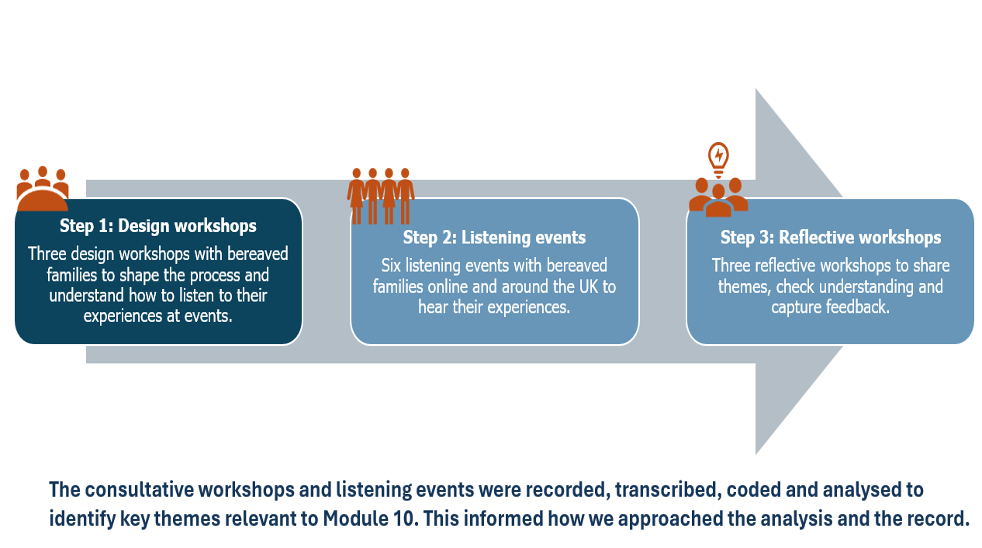
In January 2025, we held three design workshops with bereaved people who helped us develop a series of Listening Events. Contributors who attended these workshops included members of the Inquiry’s Bereaved Forum.2 They shared their views on the length of the events, the best place to host the events, how to create a safe and comfortable space for people to share their experience, the language we should use, and who we should invite.
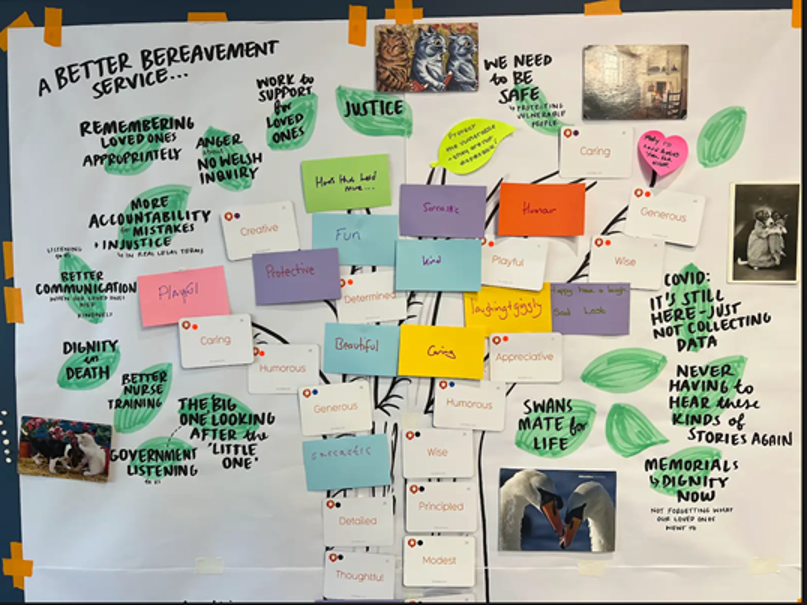
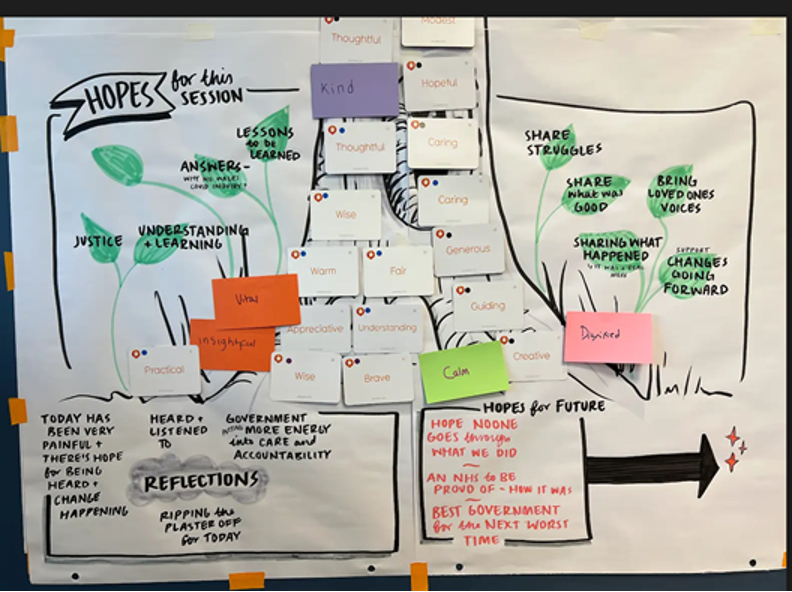
Feedback from the consultative workshops was used to design six Listening Events held with bereaved people between May and June 2025, three online and three in-person events in Brighton, Glasgow and Cardiff. These events were advertised via the Inquiry newsletter and through peer support groups for people who were bereaved during the pandemic. These allowed bereaved people to share their experiences of bereavement during the pandemic, the impact on burials and end of life ceremonies, accessing bereavement support and learning for the future. These events were designed to recognise the trauma that people had experienced and were still experiencing, to be engaging and interactive, and to enable peer support. We worked in small groups to explore people’s experiences and to think about themes and identify learning for the future. There were counsellors available to support people in each of the small groups, as well as expert, trauma trained facilitators. We used visual and interactive tools and resources to support the conversations. Throughout the sessions, contributors at the listening events were encouraged to add their thoughts, views, reflections and memories of their loved ones to an event ‘tree’. The purpose of the tree was to provide participants with the opportunity to acknowledge their loved ones by adding words to describe the person that they were remembering. It was also used for activities that invited participants to add key reflections about their hopes for the session and learning for the future. See Figure 2 below.
After the listening events, a further three reflective workshops were held in July 2025 and attended by bereaved people, some of whom had taken part in previous events. Similarly, opportunities to attend the reflective workshops were advertised via the publicly available Inquiry newsletter and through peer support groups for people who were bereaved during the pandemic. We shared with contributors what participants had told us at the Listening Events and sought their views on the best way to represent these themes throughout this record. Contributors had the opportunity to hear from each other and discuss which themes they felt were most important to emphasise in the record.
Figure 2: Example of listening event tree
Reflections from bereaved listening events
We have drawn out the themes and reflections from these workshops in this record. They are in boxes titled ‘Reflections from Bereaved Listening Events’ and summarise the points that workshop participants collectively told us they want to be emphasised in this record.
Public listening events
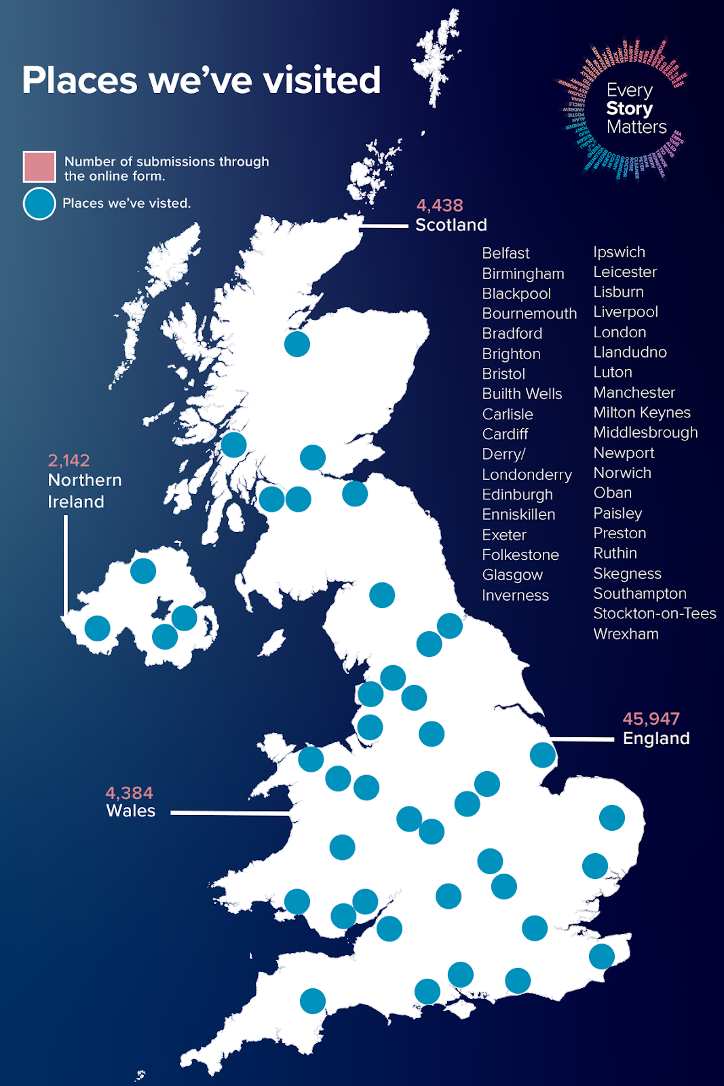
The Every Story Matters team went to 43 towns and cities across England, Scotland, Wales and Northern Ireland to give people the opportunity to share their pandemic experience in person in their local communities. We worked with many charities and grassroots community groups to speak to those impacted by the pandemic in specific ways. Short summary reports for each event were written and used to inform this document. While these events were not specifically designed for those who had experienced bereavement, many individuals whose loved ones died during the pandemic still chose to share their stories there.
In addition, the Chair of the Inquiry, Baroness Heather Hallett, met with bereaved individuals at listening events in each nation of the UK. We would like to thank the following organisations for helping to organise this:
- Covid-19 Bereaved Families for Justice UK
- বিচারপতি সিমরুর জন্য কোভিড-১৯ শোকাহত পরিবার
- উত্তর আয়ারল্যান্ড কোভিড-১৯ শোকাহত পরিবার বিচারের জন্য
- স্কটিশ কোভিড শোকাহত
The locations where Every Story Matters listening events were held is shown below:
Figure 3: Every Story Matters listening events across the UK
গল্পের উপস্থাপনা এবং ব্যাখ্যা
It is important to note that the stories collected through Every Story Matters are not representative of all experiences of bereavement in the pandemic. We are more likely to hear from people who wish to share a particular experience with the Inquiry. The pandemic affected everyone in the UK in different ways and while general themes and viewpoints emerge from stories, we recognise the importance of everyone’s unique experience of what happened. The record does not represent the views of the Inquiry. It aims to reflect a range of experiences shared with us, without attempting to reconcile differing accounts.
We have tried to reflect the range of stories we heard about bereavement, which may mean some stories presented here differ from what other, or even many other, people in the UK experienced. Where possible we have used quotes to help ground the record in what people shared in their own words.
Some stories are explored in more depth through case illustrations within the main chapters. These have been selected to highlight the different types of experiences we heard about and the impact these had on people. Contributions highlighted in case illustrations have been anonymised and written to expand upon the main themes from our analysis of the stories shared with the Inquiry. Stories were collected from 2022 to 2025 and analysis took place in 2025, meaning that experiences are being remembered sometime after they happened.
রেকর্ডের কাঠামো
This document is structured according to the scope of Module 10, which is investigating the impact of the pandemic on society, including the most vulnerable, with a particular focus on the bereaved, key workers and mental health and wellbeing.3
It starts by outlining bereaved people’s experiences of a loved one dying during the pandemic (Chapter 2). It then explores the impact of the pandemic on funerals, burials and end of life ceremonies (Chapter 3). It describes experiences of accessing bereavement support (Chapter 4) and the long term impacts of bereavement (Chapter 5). Finally, it sets out the lessons contributors think can be learned for the future (Chapter 6).
- A mailing list that is maintained by the Inquiry of bereaved volunteers who wish to participate in opportunities to shape the Inquiry’s work.
- The full scope of Module 10 is outlined in the appendix of this document.
2 The death of a loved one during the pandemic
This chapter covers what family and friends told us about the death of a loved one during the difficult and often isolating circumstances of the pandemic. Many described the heartbreak of not being able to be by their loved one’s side when they were dying. For some, the last time they saw them was as they were taken away in an ambulance, or just before they entered hospital or a care home.
People spoke about the pain of knowing their loved one was alone at the end of their life, without the comfort of a familiar face, a hand to hold, or able to say the words they wanted to say. They described feeling helpless and unprepared, the suddenness of events leaving them in shock and disbelief. The distance imposed by restrictions added another layer of sorrow to an already devastating bereavement.
The pandemic restrictions meant many family members and friends were unable to be with their loved ones at the end of their life. This meant that the last time they saw their loved one was when they were taken away in an ambulance or before they went into a hospital or care setting. Many bereaved people said they felt completely unprepared and shocked when their loved one died.
| " | You never prepare yourself for somebody passing on, especially if you see them today, and then they’re coughing tomorrow. The next day, they can’t breathe. Do you know what I mean? It was so, so quick. I remember, we didn’t have a chance to even say goodbye, because the moment that she left the house, and went to the hospital, we couldn’t visit her. I think, from the day that she knew, she passed on within five days.”
– Bereaved niece, England |
| " | I begged for me and my sister to be with Daddy when he died, we weren’t even given that. Different trusts had different rules, some were allowed with them, and we weren’t, it was absolutely horrendous.”
– Bereaved daughter, Northern Ireland |
| " | Mum was left without oxygen for four days, they didn’t expect [her] to live as long. We were only allowed in one at a time, each day it was a different family member. After she died Dad was still in ICU, he’d just lost my mum and we were not allowed to see him.”
– Bereaved person, Scotland |
Contributors experienced ongoing and profound feelings of anger, sadness and guilt that they could not be with or comfort their loved ones at the end of their life. Many are devastated that their loved one may have felt abandoned at the time they most needed support and love from family and friends.
| " | The more I reflect on the fact that I was unable to visit for the last 10 months of her life, I feel increasingly guilty that she died believing she’d been abandoned. I feel robbed of being able to say goodbye and I’m aware that my mental health has been affected by my feelings of guilt, anger and sadness which I will have to live with forever.”
– Bereaved person, England |
The uncertainty about what happened to their loved ones in the final days has left many family members heartbroken. These unanswered questions about the death of their loved one have often had a detrimental impact on mental health and complicated their grieving process.
| " | We lost our daddy early January 2021. He was 68, life and soul of the party … it was the most surreal experience and over three years on I have nightmares, did he suffer? Was it him in the coffin? Did we cremate the right person? Amongst a dozen more questions we will never get the answers too.”
– Bereaved daughter, Northern Ireland |
| " | I think the most heartbreaking thing for us was that he passed away on his own, alone, and we don’t know if he was in pain, if he wasn’t in pain, or what was happening. I mean, it just feels unknown, and it has affected us a lot, to be honest. My mum, especially, she went through depression after.”
– Bereaved niece, England |
Many bereaved people said they feel unsure as to whether they did everything they could for their loved ones at the end of their lives. They described replaying decisions in their mind and asking themselves whether they could have done something differently at the end of their loved one’s life. This guilt and regret has made it incredibly difficult for many people to process their grief.
| " | On the day dad died I received a phone call in the afternoon to say he was very unwell. At this point I wanted to come in and be with him but was told that would not be allowed …. I have not really come to terms with this and feel extremely guilty that my brother and I were not there to comfort him in his passing.”
– Bereaved son, Scotland |
Reflections from Bereaved Listening Events
When we discussed bereavement themes with people at the bereaved listening events, they echoed the complex feelings of anger, shock and sadness felt by others, and with which they continue to live.
Contributors said it was important that governments and the wider public understand what happened when their loved ones died and how it impacted them and their families, so future generations do not have to go through such difficult experiences again.
“For me, I think the guilt, the regret, the broken trust, I think that resonates highly with me … I think that was the really significant thing.” Bereaved daughter, Wales
“My inability to have spent any time with my sister at the end of [my niece’s] life or after she died, to actually see her, for me personally, that was very, very distressing. I still don’t feel like I was able to say goodbye in any shape or form, and still 5 years on, I am so emotional about that … I think others, they have very quickly forgotten the things that we weren’t allowed to have available … when I say to people now, it’s like, ‘Oh, I didn’t realise. Oh, I’d forgotten that.’ And I think that’s the danger [if] we don’t capture these things … we must never, ever put people in that position again.” Bereaved aunt, England
Bereaved people said their inability to visit dying loved ones meant that they carried long term guilt about not being able to do more for their loved one.
| " | She died without me seeing her and I could not go to her funeral. She must have felt abandoned and I am sure the isolation contributed to her rapid decline.”
– Bereaved friend, England |
As the pandemic went on, some bereaved people were able to visit their loved ones in hospitals, hospices and care settings before they died. Visits were often through a window, or while wearing PPE. This was heartbreaking for both loved ones and visitors. It felt impersonal and cold and often added to feelings of anger and guilt for contributors.
| " | I was then not allowed to visit until they felt she was imminently about to die and to visit once to say goodbye. She was barely conscious and didn’t recognise me with all my double mask on etc. I ended up actually seeing her twice as she lasted longer than they thought, but basically, she was dying in a room on her own for 3 weeks with no one she loved there to hold her hand and talk to her. I really struggle with this and the guilt even though I had no power to change the rules, I feel a lot of anger that this was allowed to happen. It is not humane. And not logical as if I was all masked up why couldn’t I go in every day.”
– Bereaved daughter, England |
Many people described a sense of shock and disbelief caused by the unexpected and sudden death of their loved one. They said it felt unreal, particularly when they had been unable to visit their loved one before they died. This sense of disbelief has made it harder to accept the bereavement.
| " | It all happened so quickly … my mother had gotten seriously ill and died in hospital. The shock me and my family were in was indescribable. My mother was 50 … I am extremely frustrated … our lives changed forever.”
– Bereaved daughter, Northern Ireland |
| " | I’d say for the first six months to a year, I felt really low. I felt really depressed, but it was, kind of, mixed with disbelief as well that she’s actually gone. You know, so it was like a whirlwind of emotions.”
– Bereaved granddaughter, England |
| " | Devastation. She couldn’t go to the house where [our mum] was living… [my sister] talks to her [mum], and cries, you know, out of the blue. Just be on the bus and start crying. I sometimes wonder if she might have some sort of, not exactly guilt, but something not resolved, yes. She wasn’t expecting her to die.”
– Bereaved daughter, England |
We also heard how some people who were bereaved due to Covid-19 became fearful and anxious because they had witnessed the life-threatening nature of the virus first-hand. They were afraid that they, or their family members, might also catch the virus and die.
| " | My mental health became very horrific over this period. Watching my grandfather pass away from Covid made me extremely more anxious regarding catching Covid or another family member [catching it].”
– Bereaved granddaughter, Northern Ireland |
Cara’s storyCara’s mum and dad both contracted Covid-19 and were taken to separate hospitals, where their health rapidly declined. Cara was unable to visit either of her parents and received very little communication from the hospitals. She told us how helpless she felt. “Not being able to be there, it was the helplessness of not being able to do anything. The loss of control and power, which was really awful.” Cara’s mum died within a week of being in hospital, and her dad died just five days later. The sudden death of both her parents felt ‘surreal’. “It’s sudden, completely unexpected – if it’s caught in hospital, you thought your loved one would be safe, obviously. So, it feels like it was completely avoidable. You’re angry, it’s unjust. And surreal, completely surreal. One minute my parents were fine, living their own life. And the next minute, less than a month later, they’re both dead.” Cara told us how she has been left with an overwhelming sense of guilt, constantly replaying the decisions she made and unanswered questions about what happened. “These ‘what ifs’ play on your mind. Yes. Did you do the right thing by saying, ‘You’ve got to contact the hospital.’ Would they have been better off if they’d just died at home? They suffered in hospital alone. So, all these things play on your mind. You ruminate over this. There’s just so many unanswered questions, you didn’t know what happened in the hospital.” She was left with an intense fear that she might also catch the virus and die. Her feelings were overwhelming and led to thoughts of self-harm and suicide. “The sense of overwhelm that I felt with all of these factors going on, and I was shielding as well. So, I was like, obviously my parents died from Covid, and I’m terrified of catching anything. I did have thoughts of suicide and self-harm. I’d never in my life experienced thoughts of self-harm, it was incredibly scary.” Cara told us how she has felt unable to process her grief. “It feels like my parents could just still be living out there somewhere … I’m still stuck in, like, a long state of bereavement … I mean, I can get on with day-to-day life but when I think about everything that’s happened and trying to find out what went on, going through hospital complaints, getting records, reading medical notes. I was all caught up in that for maybe 2 years … And when they went did I grieve? I don’t know. Have I? I’m not sure.” |
Contributors had to deal with numerous practical and administrative tasks following the death of their loved ones at a time when organisations were struggling to cope with the impact of the pandemic. This added further pain, frustration and difficulty to their bereavement.
For example, many family members had to collect their loved ones’ belongings from hospitals, hospices or their loved one’s care home. This was sometimes done in an impersonal and insensitive way because of pandemic restrictions. This was distressing for bereaved families already struggling with the shock of their grief.
| " | Staff made me pack all her belongings in carrier bags and take them away while she was still lying in the bed dead. They said that normally they would do this, and the relative could return when they were ready to collect belongings, but because of the lockdown I wouldn’t be able to return later.”
– Bereaved daughter, England |
| " | After his passing, I had made it clear to staff that I wanted all of my husband’s belongings returned to me. However, this was not the case and after many phone calls from both myself and the undertaker, I did not receive them for three weeks. When I got them, there were many items missing and damaged. These were all part of my husband and I still feel that I have left part of him behind. After making numerous enquiries, I eventually discovered that there was no inventory of his belongings when he came into the hospital.”
– Bereaved wife, Northern Ireland |
Contributors told us how closing bank, utility and other accounts felt unreal in the wider context of the pandemic, with many services closed and contributors feeling lonely and isolated. Many struggled to accept that the death of their loved ones had really happened. For some, carrying out these tasks felt like part of the process of losing their loved one.
| " | For me, the hard thing was actually picking up the phone and shutting down all the accounts … I almost felt I was complicit in their death, and then I felt their deaths were unnecessary, and I was trying to fight that. But at the same time, I was having to go along with it and shut them down and close them down like they never existed … That was a real, personal struggle for me, was to shut their lives down, where I kind of felt their lives perhaps weren’t ready to end. Do you know, it was quite hard.”
– শোকাহত পরিবারের সদস্য, ওয়েলস |
Other bereaved people faced practical problems getting access to the right information and finding someone to speak to about how to deal with administrative tasks.
| " | Because, you weren’t allowed to leave home, trying to get access, you know, all the stuff that you have to do when someone dies. So, there was all that that needed to be done, but nobody could be contacted because everybody was working from home. And, so none of the documentation was available. It was really chaotic. You know, trying to get access to bank accounts was completely chaotic.”
– Bereaved wife, England |
Having to repeatedly answer questions and share details of their loved one’s death was deeply frustrating.
| " | [When you call organisations to let them know about their death] the first thing they say, ‘We need to go through security, what’s the date of death?’ You could ask me anything, why are you asking me that? Why are you asking me to say that each time I phone you … when they report the death, you should say, ‘In the future, we will ask for the date of death as a security, unless you opt for something else.’ Just put that adjustment in place. None of them would do it. And these were specialist bereavement lines.”
– Bereaved daughter, Wales |
Contributors shared how companies often did not treat them with understanding and empathy. Some experienced insensitive and upsetting conversations with staff and problems dealing with administrative processes after the death of their loved one.
| " | There needs to be more empathy from businesses and companies who are dealing with this … when I had that first call and she asked [my husband’s age] and stuff like that, and she was like, ‘I haven’t had one that young from the pandemic yet.’ … There was no support or empathy … I remember her saying, ‘So, he was 45 and no medical conditions? That’s incredibly rare.’ I was like, ‘I don’t care, this is my husband and my family that has been torn apart, and you can’t even be empathetic.’”
– Bereaved wife, England |
Reflections from Bereaved Listening Events
Bereaved contributors at the reflective workshops emphasised how disappointed and angry they were that businesses like banks and utility companies did not recognise the unique challenges of pandemic bereavement. Contributors said they wanted them to improve how they support bereaved people in future pandemics.
“I think there’s a real message for businesses … they really need to up their game, because you’re trying to tell them what’s happened and so on, it’s so distressing. They are not trained. It would be easy to train a proper bereavement service they’re in, and the banks were hit or miss.” Bereaved daughter and wife, Scotland
They also shared examples of organisations that were more supportive and did their best in a difficult situation, particularly when they provided a consistent contact to help people carry out the necessary tasks. However, bereaved people were deeply upset by the insensitive and dismissive approach taken by many organisations.
“After any bereavement, there is a lot of bereavement admin that has to be done. Things like the utility companies, pensions, all of that kind of stuff. That’s hard to do at the best of times, it’s not easy, but in the pandemic, it was just so much harder. I was having to deal with it all on behalf of my mum, who just couldn’t deal with it and had not dealt with any of the admin in her marriage to my dad, and she was 100 miles away … Some companies were really good. Some companies had designated people, it was easy to find out who to contact, numbers and stuff like that. But others, they were just not prepared at all. Some of them, you felt were actually being obstructive … they were insisting that the criteria that existed in normal times had to be followed. Like we had to have this paperwork and things like that and when you can’t access any of it there was no flexibility.” Bereaved son, England
3 Impact on funerals, burials, cremations and other end of life ceremonies
This chapter explores how the pandemic affected funerals, burials, cremations and other end of life ceremonies and the profound impact this had on bereaved people. Restrictions meant that many had little control over how they could say goodbye, leaving them unable to honour their loved ones in accordance with their beliefs and traditions. Bereaved people said these experiences prolonged and complicated their grief.
Impact of delays and backlogs
The worry and strain caused by delays and uncertainty around planning funerals, burials, cremations and end of life ceremonies was deeply painful for contributors. Many did not know when or whether they would be able to see their loved one’s body or hold funerals, burials, cremations or other end of life ceremonies. The bodies of their loved ones were often in mortuaries for several weeks and there were delays to issuing death certificates. This meant they had to wait to arrange funerals, burials, cremations and other end of life ceremonies.
| " | My mother lay in the hospital morgue for five weeks because the funeral parlour was full. I’ll never forget the funeral director who was trying delicately to explain this to me. It was Easter weekend when I was trying to arrange the funeral, and he sounded close to breaking point himself.”
– Bereaved daughter, England |
The impact of delays was especially painful for communities where cultural and religious practices around death are time sensitive. We heard how delays during the pandemic deeply affected Muslim and Jewish communities, preventing them from carrying out traditional burial rituals within the required timeframes.4 For many Muslims, the inability to bury their loved ones quickly, in accordance with their faith, caused intense distress. Jewish families too described the pain of being unable to follow essential practices around death that bring spiritual comfort and closure.
| " | Culturally and religiously you’re meant to be buried within 24 hours of passing away, and returned to the ground, kind of thing, to the earth, but with Covid that totally destroyed all of it, and it affected the Muslim community hugely … [my father’s] funeral was about 2 weeks later, maybe even 2.5 weeks later which is quite shocking, and unusual, and unheard of, and what was happening at that time is that there were loads of bodies just in, I guess, morgues.”
– Bereaved daughter, England |
Contributors told us how delays in accessing death certificates caused immense strain for many families. Many services were operating virtually and at reduced capacity, making it challenging to certify their loved one’s death.
| " | It was so difficult to [get] the death certificate for my mother … there was a query over the death certificate with two doctors refusing to sign [it] – before a junior was persuaded to help release mum for me … it was a horrific experience.”
– Bereaved daughter, Northern Ireland |
Chasing for updates often fell to bereaved people themselves. This added a frustrating and exhausting administrative process at a time of devastating loss and while people were still trying to process their grief.
| " | So, we had announced within the community that, [my uncle] had passed away… people were, you know, going to the mosque to offer their condolences, do prayers for him and stuff like that. But we weren’t able to obviously put him to rest, put ourselves to rest, so to speak … It was a very daunting three weeks. For, like, three weeks, just constantly chasing, chasing, chasing, trying to get the death certificate. So, it was very tiresome. It was a testing time as well, emotions were a bit all over the place.”
– Bereaved nephew, England |
We heard about the challenges at the beginning of the pandemic in the care and preparation of those who died. There was a lack of understanding as to the safe handling of the bodies of people who died due to Covid-19.
| " | It was the early days of Covid and although grandad didn’t appear to have died of Covid no one seemed to know how to handle the bodies of Covid patients or even which ones were Covid patients.”
– Bereaved granddaughter, England |
Some people told us they had to join long waiting lists for their loved ones to be cremated or buried. In some cases, contributors felt they had no choice but to bury their loved one in a different cemetery or have a cremation instead. This was deeply upsetting for many. They felt they were unable to hold a funeral or other end of life ceremony that was not in line with their or their loved ones wishes.
| " | The cemetery [all our family are buried in] … They wanted a burial I think at first, the burials were taking about 4 or 5 weeks. In the end they had the cremation, which was not their initial choice … the family were really upset by that, but they didn’t want to keep the body in the freezer for any longer than it had to [be there].”
– Bereaved niece, England |
| " | There was a delay with the cremation as well. So, she had died, I’m trying to think, so it was end of February 2021 … she went into hospital, a few days later, she had died. My mum contacted the funeral director and they had advised that it was a 3-week wait, if not a bit longer. So, it ended up being 3 and a half weeks after she had actually died when she actually got cremated.”
– Bereaved grandson, Scotland |
Reflections from Bereaved Listening Events
Bereaved people discussed the delays they faced planning funerals for their loved ones during the pandemic. They felt the country was unprepared for the scale of deaths, with undertakers and funeral directors left overwhelmed. These backlogs often left families and friends with little choice in decisions about honouring their loved ones.
“I just think as a country we were totally unprepared and the undertakers were obviously dealing with, I know this is horrible to say, high volumes of deaths from Covid. What they were getting over a weekend is something they would get over a far longer period of time … I just felt there were just so many people dying [the funeral] wasn’t as personalised I think, as what it could’ve been.” Bereaved daughter, Scotland
Impact on loved ones planning funerals or other end of life ceremonies
Experiences of planning funerals, burials, cremations and other end of life ceremonies during the pandemic
During the pandemic, the burden of planning funerals, burials, cremations or other end of life ceremonies frequently fell to a single family member, friend or a small group of relatives. They were often required to liaise with funeral services remotely, without their support networks and relationships. Family members and friends who took on this responsibility said they felt deeply isolated. They found the task of navigating restrictions, speaking to funeral directors and organising a service alone was time-consuming, draining and painful.
| " | So, all communication was by telephone. Everything, undertakers, registry office to register the death, everything. I didn’t leave my seat, I felt, for weeks [I was] just trying to organise everything. Contacting [my husband’s] family in Greece. Other friends, family elsewhere and it was horrendous.”
– Bereaved wife, England |
The lack of face to face meetings and interactions also made it harder for some people to develop a relationship with funeral directors and share stories of their loved one and their wishes for their burial or end of life ceremony.
| " | All the funeral planning via phone, you know, so it’s part of grief processing, isn’t it, to meet someone and go through slowly in terms of what their wishes are and stuff. So, none of that.”
- শোকাহত পরিবারের সদস্য, ইংল্যান্ড |
Some bereaved people gave examples of how funeral directors made huge efforts to do everything they could to honour their loved one’s wishes and hold funerals, burials, cremations and other end of life ceremonies in ways that were suitable for families. They said funeral directors provided emotional support as they prepared for the funeral. They also gave examples of funeral directors adjusting pre-paid funeral plans to better suit the pandemic circumstances. Funeral directors going out of their way to support bereaved people helped them with their grief and provided a sense of human connection while they were trying to navigate confusing and impersonal processes.
| " | The funeral director involved went above and beyond, she contacted me every day and was the epitome of caring.”
– Bereaved niece, Northern Ireland |
| " | I have to say that the funeral arrangers were absolutely brilliant. I told them the story of my husband leaving the house and wanting to come home but he couldn’t because it was Covid etc. We lived in a very narrow drive, because it was a cottage, and the funeral directors moved this great big hearse, backed it all the way up the lane so that my husband could actually go from his house which was so touching for me. It was probably, in the whole of this, the only touching thing that actually happened.”
– Bereaved wife, England |
| " | Because my parents had prearranged funeral plans and they assumed they were going at different times, they’d said, ‘Right, we want 1 hearse and a car to follow.’ But, of course, we just needed 3 cars, 2 hearses and 1 car to follow. So, [the funeral directors] said, ‘We’ll refund you the car.’ They were so caring, and when you’re at the most vulnerable, they weren’t trying to, sort of, take advantage. They were trying to, sort of, help and support.”
– Bereaved daughter, Wales |
| " | The funeral director involved went above and beyond, she contacted me every day and was the epitome of caring.”
– Bereaved niece, Northern Ireland |
Changing restrictions for funerals, burials, cremations and other end of life ceremonies
Throughout the pandemic, the restrictions that applied to funerals, burials, cremations and other end of life ceremonies changed quickly with limited notice and were different in different parts of the country. Changing guidance on social distancing and how many people could attend created confusion and frustration for contributors. Many had to make last minute changes to the plans they had made to mark the death of their loved ones.
| " | One of the issues was about how the restrictions kept changing all the time and sometimes they would change between making the arrangements. You’ve got one thing planned and then, suddenly, they were changed, and you couldn’t do what had originally been planned.”
– Bereaved son, England |
| " | On the day before the funeral the government changed lockdown rules affecting the funeral location. All hotels and B&Bs interpreted the rules as not being able to open, so all bookings were cancelled. The venues for a small wake afterwards [were] also cancelled. It was incredibly stressful trying to find solutions to the various issues raised by the change of rules at short notice.”
– Bereaved friend, England |
Jane’s storyJane’s husband had cancer and caught Covid-19 during the pandemic. The last time she saw him in person was when he was taken away in an ambulance. She was not able to visit him in the hospice where he died. “[My memory] is an image, and it’s the look on my husband’s face as he was taken away in an ambulance. Because, I think, he knew by the look on my face, it was probably the last time we’d see each other.” Jane spoke about the difficulties she faced trying to organise her husband’s funeral because many more funerals than usual were taking place. “We struggled to actually get a vicar because they were so busy, so we struggled to get the vicar we actually wanted for his service which I ended up doing by more likely pleading and bribing.” The lack of choice around what could happen during the funeral added to her grief and sadness. “There was no singing. My husband loved singing in church and everything like that but none of us were allowed to sing. We had to listen to music.” The restrictions on the number of people who could attend funerals meant that some family members were not able to come. “My family, I don’t live anywhere near my family. They are scattered from, you know, Yorkshire down to Plymouth so none of those could come to the funeral because we were so restricted on numbers.” Changing restrictions also meant that she had to struggle to find flowers for the funeral at the last minute. “The day before the funeral, we were not allowed flowers and then the day of the funeral they said we could get flowers, so I scrabbled all morning of the funeral trying to get some flowers organised for my husband’s funeral.” |
Reflections from Bereaved Listening Events
Bereaved contributors emphasised how challenging it was to navigate frequently changing guidance during the pandemic. Changes to restrictions, sometimes up until the day of the funeral, led to uncertainty, stress and guilt. They wanted to see more consistency in the future.
“The change of restrictions and not knowing what was happening. When we actually arrived at the funeral, even then it was changed on the day … So, just making sure that if this happens again, that there’s consistency and that things are changed, just because the slightest alteration when you’re in that state of grief, it’s just another stress, another worry.” Bereaved daughter, England
Financial impact of funerals, burials, cremations and other end of life ceremonies
The sudden death of a loved one from Covid-19 brought unexpected funeral costs that many families had not planned for. These expenses added financial worries, stress and guilt, where money had to be borrowed from friends and family. They often had to use savings or use credit cards and loans to cover funeral costs. Meanwhile, bereaved people were trying to process their grief.
| " | Usually when someone falls ill you prepare yourself. I wasn’t prepared for this at all. And obviously I had to pay for, like, the whole funeral arrangement, undertaker, everything, the hearse. Just costs came left, right and centre that I didn’t know I’d have to pay for … I had a household to run as well.”
– Bereaved nephew, England |
Jack’s storyJack’s father-in-law was admitted to hospital with Covid-19 and unexpectedly died there a short time later. The shock of his sudden death left the family having to arrange his funeral and also without any knowledge if he had left financial arrangements in place for it. “Our family life was turned upside down immediately as my wife had to deal with the fallout of her father’s death, arranging funeral plans for him.” “The whole process just seemed very upsetting for her and our family. We had to take a loan out to pay for the funeral at the time which also added to the financial stress as everything happened so quickly and we were unsure if there was anything in place to cover the funeral costs.” |
Other bereaved people told us how families, friends and communities came together and supported each other to help with funeral costs. In some cases, we heard how bereaved friends and family organised fundraisers or received donations to pay the expenses. This helped alleviate some of the financial pressure and strain bereaved people felt.
| " | The mercy of the timing of [my friend’s] death was that he was able to have a funeral. All his friends chipped in to raise money for his funeral, and in the end there was more than enough, and the extra got donated to a charity.”
– Bereaved friend, England |
| " | [To] pay for the funeral, my sister-in-law did one of those GoFundMe pages. It raised £11,000, and the funeral cost £6,500. So, that paid [for the funeral]. I don’t know what we’d have done [without that].”
– Bereaved wife, England |
Deciding who could attend
Restrictions on the number of people who could attend funerals, burials, cremations and other end of life ceremonies was sometimes a source of conflict and strained relationships between family and friends. Contributors were forced to make painful choices about who could attend, which was deeply upsetting for already grieving families.
| " | People were fighting to go to the funeral, ‘What makes this person to go to the funeral and not me?’ So, now it was becoming World War Three in your own house, you get what I’m saying, yes. So, there was quite some tension, because people were saying the ones that went are your favourites, ‘So, you favoured A, B, C and you forgot me, so why do you need me? Why are you calling me?’ So, it caused division in the family as well.”
– Bereaved cousin, England |
Some people told us how they sacrificed their own attendance at loved ones’ funeral, burial, cremation or other end of life ceremony so others could go.
| " | I wasn’t able to attend the funeral, because at that time, I think they were saying it was 10 people. So, I said, ‘By the time you have the wife, his children, their partners, their grandchildren.’ So, I said to her, ‘No, that’s fine.’”
– Bereaved cousin, England |
| " | The lack of a family funeral [for my father] caused real hardship and arguments to his many children, grandchildren and brothers.”
– Bereaved daughter, Wales |
Lack of choice and control
Bereaved individuals reflected on the lack of choice they were given to make fundamental decisions about honouring and remembering their loved ones, leaving them feeling powerless and often despairing. In many cases, families and friends were not able to choose the clothing or casket their loved one was buried in or the venue for the funeral.
| " | There was just no choice. You just had to do what you could do with a really dreadful set of circumstances but, you know, the idea, I remember asking or saying, ‘Well, I think I would quite like that for the coffin’, and the undertaker just looking at me and saying there wasn’t a choice.”
– Bereaved daughter, Scotland |
| " | With my grandad we couldn’t even put any clothes on him, he was just wrapped around a rag and put in a box, and that, you know, was very hard, because then you’d want to, say, at least get clothing for your loved one for the last time before they get buried. You want them to be buried, probably, wearing, like, a shirt and tie, or something like that. A suit or something.”
– Bereaved grandson, England |
| " | My dad was buried in his pyjamas just as he died. He was put into the body bag and that’s the way he was buried, and it was the same with my husband … he arrived for burial in a sealed bag for the prevention, I think, of the virus.”
– Bereaved daughter and wife, Scotland |
We also heard how some people could not see their loved one’s body ahead of the funeral, burial cremation or other end of life ceremony. When loved ones had died alone or with only a few visitors, not being able to see the body meant some people were left in disbelief or denial about the death, making it even harder to accept what had happened.
| " | They told me that I couldn’t see [my husband] in the hospital. He was going into a body bag, straight to the undertaker. I asked the undertaker and, in fairness, with the undertaker I said to him, ‘Oh, what do you need, like, dress-wise?’ And he said, ‘Well, he’s got to stay in the gown that he died in. We’re not allowed to open up the body bag, so his body bag’s gone straight in the coffin.’ So, I wasn’t allowed to see him and, to be honest with you, even now sometimes it’s like, I know this might actually sound absolutely crazy, ‘Have they kidnapped him? Has he really gone?’ Because I’ve not gone through that process of seeing the body.”
– Bereaved wife, Wales |
Reflections from Bereaved Listening Events
Contributors also discussed how painful it was that their loved ones did not have funerals, burials, cremations or other end of life ceremonies that were in line with their wishes, religion or cultural heritage.
They emphasised the continuing anguish and regret among bereaved people because there was no way to get these experiences back. They said this has exacerbated their grief and led to feelings of unresolved sadness for many.
“The fundamental thing is that the ones who died didn’t get the funeral they would’ve had under normal circumstances, you know, in terms of what was in the funeral, people who would’ve come and taken part. That was denied [to] them.” Bereaved son, England
Impact of restrictions on funerals, burials, cremations and other end of life ceremonies
The limits on the number of people who could attend funerals, burials, cremations and other end of life ceremonies prevented large gatherings. Travel restrictions within the United Kingdom also meant some bereaved family members could not attend.
| " | My mum was cremated with only five people in attendance …. because of the legally limited attendance requirements, and that fact that her wider family were not able to travel [due to restrictions].”
- Bereaved daughter, Wales |
Others missed funerals, burials, cremations and other end of life ceremonies out of concern of contracting or spreading the virus.
| " | My mum and dad died … I didn’t attend my parents’ funeral which, obviously, [was] devastating. But I was terrified. Both my parents had died, you know, I didn’t want to die either. My sister was definitely adamant that she didn’t want me to attend, she didn’t want to lose me as well because it’s just 4 of us in our family.”
- Bereaved daughter, England |
| " | Well, we just wanted everyone to be safe, so I just felt like me going would not be helpful because there would be no one to look after my children if I did and then, also, I didn’t want to spread infection in case I had it, you know? Because at that time, there weren’t even tests, so no one really knew if they had it or not, the tests came later. There were so many unknowns.”
- Bereaved niece, England |
Not being able to travel together to the funeral, burial, cremation or other end of life ceremony in a car was distressing for some bereaved people. We heard how upsetting and isolating it was having to drive themselves to the funeral, sometimes alone.
| " | We made our own way, because the funeral parlour wouldn’t take us, because, again, 6 people in the car was-, you could meet there as 6 people, but you couldn’t physically go in a car, 6 of them together. Yes, so we had to make our own way, that was another thing.”
- Bereaved nephew, England |
For those who attended funerals and ceremonies, social distancing measures meant mourners were unable to sit together, touch or do simple things like giving family and friends a hug. Contributors said this made funerals, burials, cremations and other end of life ceremonies feel cold and impersonal and meant they did not offer the support and comfort they usually would. Some shared how looking back on the funeral added to the painful memories from the death of their loved one.
| " | Well, owing to the regulations at the time, only householders could sit together at the funeral, with a maximum of two together. That meant I sat on my own through the service, the most painful way of attending your husband’s funeral that I can think of. Again, the word inhumane comes to mind. Even though it took place a month after he died, and I may have seemed strong to others, I was still very much in shock and desperately in need of support during the service, yet nobody could be there for me as they were in their own groups. The ceremony went in a blur and is such a ghastly memory.”
- Bereaved wife, England |
| " | Not even immediate family could go to mum’s funeral, it was such a horrible experience, I hoped my dad’s would be different. I went back to England, then got a call to say come home and it was the worst thing [father dying], I hadn’t even got over my mum, it was terrible. We were isolating, I couldn’t even sit beside my daughter at the funeral. We were told by the chapel that we mustn’t encourage people to come along.”
- Bereaved daughter, Scotland |
One bereaved family member described breaking social distancing rules to support another family member, because they thought it was wrong to prioritise regulations over human compassion in moments of grief.
| " | I wasn’t supposed to comfort my sister-in-law, who was next to me, but she lived alone at the time, apart from her children who weren’t there. We’re sitting in the chapel with the masks on, she’s distraught, she’s falling apart. I’m not going to keep 2 metres away from her, I just couldn’t. It’s a natural human reaction. We’d all just had Covid anyway, I thought. But, we broke the rules doing that, I broke the rules comforting my sister-in-law. It was inhumane.”
- Bereaved daughter-in-law, Scotland |
Mary’s storyMary’s mother contracted Covid-19 and died in hospital during the early stages of the pandemic. Mary had been shielding since the start of the pandemic and her mother’s funeral was the first time Mary experienced social distancing measures. “[The funeral] was slightly weird for me, because when I got to the crematorium, I hadn’t done the whole queueing supermarket thing because I’d been shielding. I hadn’t done the whole 2 metre thing, so my immediate reaction was to shake the vicar’s hand, which of course you’re not allowed to do.” When Mary walked into the crematorium, there was tape over the pews to maintain distance between her and her family members. “The shock of walking in there, there was tape everywhere. When you walked into the crematorium, it was like you were at a road traffic accident, and there was red and white tape everywhere. All the pews were taped up apart from one pew for me and my girls, and one pew the other side for [my sister].” Mary said how unfamiliar and alienating the funeral felt. After isolating alone for months, the lack of physical comfort at her mother’s funeral intensified her feelings of being alone when support was most needed. “The behaviours when you got to the funeral were, kind of, very alien, and it made you feel – I was already isolated at home, hadn’t really left the house since January. So, to have suddenly been put in that position where you can’t shake somebody’s hand and go and talk to them or, you know, have a hug. I needed a hug so badly.” |
Some contributors told us they felt rushed at the funeral, burial, cremation or other end of life ceremony, which meant they did not have proper time to reflect. They thought the increased number of funerals, burials, cremations and other end of life ceremonies meant they were hurried and too short. Some said this added to the sense that their loved one was just ‘one of many’ rather than being treated with the dignity they deserved.
| " | My dad had a direct cremation; they turned up in [a] black van and handed us a shopping bag with a cereal box of ashes and they took a photo of us with it for proof of delivery. It was unbelievable.”
– Bereaved person, Wales |
| " | The amount of diggers that were around … it was a couple of people and the workers, all wearing masks, and they’re trying to be respectful, but you can tell that they just need to move on to the next one, because it’s almost every two minutes, just a horror show really.”
– Bereaved daughter, England |
We heard about the distress caused when people from different religious and cultural faiths could not perform traditional practices at funerals. These included open-casket viewings and placing religious items such as a tallit (Jewish prayer shawl) or symbolic offerings like garlands and incense (Hindu) with their loved ones.
| " | It’d be different because we could say goodbye together, see [my husband] go, couldn’t we … At least if you can see him go, say goodbye, my house would be more peaceful than if we don’t see him … A Hong Kong funeral [for my husband] was organised here, but I can’t see the body. I was upset about that … In a normal process, they would open the coffin and then people can walk around in a circle and say goodbye. This is part of the ritual.”
– Bereaved wife, England |
| " | The one thing I do know is we didn’t give [dad] his tallit.5 We didn’t bury him with his tallit. And I’ve got his tallit and it, kind of, it’s both lovely that I’ve got his tallit, but it’s also awful that I’ve got his tallit because it shouldn’t be with me. It should be with him. And that would have mattered to him.”
– Bereaved daughter, England |
| " | We put certain things into the coffin, like coconuts and garlands and incense and things like that. All symbolising things for their journey to move on smoothly. In these cases, the coffins couldn’t be opened, because we weren’t allowed. It was only immediate family that could attend, so that was really hard. I know for my Auntie and for us, it broke our hearts to see her in that state that she couldn’t do the final farewell as she wanted to.”
– Bereaved niece, England |
Mourners were also unable to sing or have readings at funerals, burials, cremations or other end of life ceremonies. Some described how upset they were about not being allowed to include these meaningful and personal touches to reflect their loved one’s memory.
| " | His funeral was livestreamed to his brother, sister, brother and sister in law, nieces and nephews, dear friends and former students. Our street was lined with almost a hundred people. There was no singing, as he would have loved (as a lifelong choir member). No wake where we could remember him and talk about the good times. We just went back to our respective homes before a difficult Christmas.”
– Bereaved daughter, Wales |
| " | [My mum] had a list of music, I’m a musician, she had all this stuff she wanted, and it had to be a track off the crematorium playlist. So, okay, it sounds as if that shouldn’t matter, but it did matter. She wanted a specific reading, which was 33 verses of a chapter from the bible. We weren’t allowed to have that because it would use up too much air in the building, is what we were told. We weren’t allowed to have any flowers, because again, it would use up too much air, no hymns because it would use up too much air, because it was all about breathing, and I understand that. I’m a singer, I understand how it goes.”
– Bereaved daughter, England |
Many bereaved people were unable to hold gatherings after funerals, including wakes and funeral receptions. Not being together in person meant bereaved friends and family felt robbed of the opportunity to come together to share memories, celebrate their loved ones and process their grief with others.
| " | I feel that my husband didn’t have the rite of passage. My sons, my younger one was only 21 at the time, didn’t get to speak to his dad’s friends in the rugby club … There was no wake, no one to talk about him. Both my sons feel that they’ve been robbed of what is normal for people. We didn’t have any of that.”
– Bereaved wife, Wales |
| " | We couldn’t have the get-together afterwards and I think when you think of a funeral, you think of a sitting process and that get-together afterwards is quite important I think for everyone to process and be together, and we didn’t get to have that. So, yes, it was quite hard.”
– Bereaved granddaughter, Scotland |
| " | We couldn’t have a wake, so we literally had 30 people at the funeral, and then everyone left, and that was it, and me and my mum and dad, we just went to Starbucks and had a coffee in the car, and then just came home. And it was horrible, it was so weird, it was the weirdest thing ever, because normally afterwards you get to be with everyone and celebrate their life and talk about stories. And it just really made me feel like I wasn’t able to remember my gran at all, or hear any stories about her, anything like that. It was just, like, ‘She’s gone, that’s it,’ and it was so weird. It was really horrible, really horrible, and I think that’s why I numbed myself so much, because I was, like, ‘I don’t want to think about this properly, because if I do, it’s going to hurt so much.’”
– Bereaved granddaughter, Wales |
Contributors shared how isolating it felt to return straight home after ceremonies and how this made their feelings of loneliness worse.
| " | It was no longer than an hour back home, alone, where we would have gone and we would have had a wake, we’d have shared stories. I’d have heard stories from friends, because we married later on. From work days, from school days, that I wouldn’t have known, I missed out on that but I just felt guilty. I felt I’d let him down … coming home and having nobody to make me a cup of tea, nothing, all within an hour. It was, like, shock, disbelief, did it really happen? And I just, well, went to pieces, alone again.”
– Bereaved wife, Scotland |
| " | You couldn’t stand and chat. You couldn’t have a wake. So, it was-, and, again, like you say, it’s like a lot of the times you had to drive yourself. So, you were very isolated and you felt-, although I’ve got very good family and friends and they have been supportive, you’re still having to do everything yourself, and it compounds the loss, I think. That’s how I felt.”
– Bereaved wife and daughter, England |
We heard from contributors in Northern Ireland who were unable to hold traditional wakes in their homes before the funeral. Friends and family not being able to come together to mourn and share memories about their loved one made it difficult for people to process their grief.
| " | We have a three-day wake, the body would have been brought home to us there and people, friends, family, cousins, acquaintances, whatever, all would have been allowed to come along and have some soup 24/7 basically. So, that didn’t happen … [My brother’s coffin] went straight from the undertakers to the church to-, there was a ceremony with family and friends, social distancing and whatnot, and then internment at the adjoining graveyard.”
– Bereaved sister, Northern Ireland |
| " | It was still difficult, it took us a lot longer, I think, to, kind of, heal, or to move on and accept things than what it would’ve normally have done. Because, like, what you would’ve done is you would’ve had your wake, and you would’ve had everybody round, a lot of families and friends, and everybody would’ve told stories, and you would’ve reminisced and all that sort of stuff, and that always helps with the grieving process. Whereas, this time, we didn’t have that same kind of support network.”
– Bereaved daughter, Northern Ireland |
| " | He [husband] died alone [in hospital], we had 25 at a very small funeral, we had no wake and that’s important here, it’s where we tell stories and get together and grieve, I don’t know whether I’ve grieved properly.”
– Bereaved wife, Northern Ireland |
| " | My mother spent five weeks in hospital and I decided there was nothing stopping me from getting her home [after she died], I got her home for three nights and I argued with them, yes her coffin was closed, but nothing was stopping me from bringing her home, she was a lady and deserved to come home. A lot of people were against it and didn’t come to pay their respects, that’s fine, but it’s not their mother. If I didn’t do that, I’d be a lot worse today. I was proud to bring her home.”
– Bereaved person, Northern Ireland |
For some people from religious and cultural communities, not being able to hold traditional ceremonies before and after the death left them apprehensive about the spiritual journey of the person who had died. We heard how families were unable to gather at the home of their loved one or at places of worship, including churches, temples, mosques and gurdwaras. Families struggled with a sense of things not having been done in the right way and the painful knowledge that they could not honour their loved ones according to tradition.
| " | The rituals that would normally follow on from [my uncle] passing would be [Hindu] prayers and hymns that we’d sing together and meet up, and then the 12th day ceremony that takes place. Then, even on the funeral day, an open coffin with the priest chanting the certain hymns and things that he needs to, to allow for his soul to be, you just feel really, all of that was completely limited, and would he have moved on to a better place? Well, being such a beautiful soul, you just pray that he has been able to move on to the right place. So, yes, it was very, very sad.”
– Bereaved niece, England |
Femi’s storyFemi is a Black African Christian woman living in Birmingham. Femi’s cousin caught Covid-19 when he was 16 years old and died from the virus. The pandemic restrictions meant many family members, including Femi, could not attend the funeral and traditional cultural rituals could not be performed. Not being able to gather for prayers and divide his personal belongings was incredibly painful for the family. “[The pandemic] really affected [us] a lot, because I wanted us to be there, because with us we have to pray, we have to do certain things before someone is buried, and we couldn’t do that. Yes, his clothes, like, we divide his clothes as well, they give them to other family members.” The restrictions also prevented Femi’s family from carrying out the ritual washing of his cousin’s body. “We have to wash the body. Yes, so they wash the body, clean it, it’s with a, how can I put this? A prayed for water, so that, like, when they’re being buried they can transcend to another place. So, all of that stuff was not done, which made it quite fascinating, and quite angry at the same time, because we were like, ‘What? We’re not allowed to do A, B, C?’ ‘No, it’s Covid.’” This led to tensions within Femi’s family. Some relatives, fearing that their ancestors were angered by the rituals not being completed, wanted to dig up his cousin’s body. Femi’s family were left to apologise to their relatives, fearing that his cousin’s soul could not rest peacefully. “Our family, there’s Christian and there’s African. So, some of them, they have to go by the grave because [of] their African tradition, because they say the ancestors were angry that you did not do A, B, C … So, they even wanted to dig up the body, so that they wash the body, you get what I’m trying to say, but it’s impossible, you can’t do that. So, they went there, they apologised to the ancestors, we were celebrating, praising God, so a lot of people were saying this should have been done, but now we are apologising, because some would say the soul did not transcend nicely, because the soul cannot transcend until certain things have been done.” |
Reflections from Bereaved Listening Events
Contributors emphasised how the restrictions and changes to funerals had prolonged and complicated their grief. They said not being able to gather with others and mark the death of their loved one properly was incredibly damaging for their mental health and wellbeing. Many continue to carry anger and sadness because of these experiences during the pandemic and they wanted the Inquiry to understand the depth and longevity of this impact.
“Culturally, mourning practices and so forth were stalled. We weren’t able to go and visit, no one could come to the house to see me or do the usual things. So, you know, like, the year or so after whenever people met me it’s like, ‘Oh, I’m so sorry about [your husband].’ Like, you know, the constant reminder, to this day.” Bereaved wife, England
“There was no wake, there was nothing else, we weren’t allowed to hug each other, we weren’t allowed to do any of the normal, natural grieving processes … It was on pause for 12 months before we did have a memorial for Mum which, we all laughed and said she would have loved to have been there, and it was such a lovely occasion, but it was 12 months later and it was almost as though we’d almost been waiting for that length of time to actually celebrate her and the horribleness she had to go through.” Bereaved daughter, England
Adapting funerals, burials, cremations and other end of life ceremonies
To bridge the distance created by restrictions and the limits on people attending, many families and friends held virtual live streams of services, ceremonies and remembrance events so that those unable to attend in person could join loved ones in grieving and provide some comfort from a distance. Virtual services enabled bereaved family and friends from further away, or who were shielding, to participate. We heard how this allowed some family and friends to say their goodbyes.
| " | There were people who were reaching out to my dad to say that ‘I really want to be there,’ [at my grandad’s funeral] but obviously, couldn’t. But we were able to see the livestream numbers afterwards, and a load of people tuned in, which was really nice, who maybe wouldn’t have come anyway, if they did live really far away. So, it meant they were able to reach a lot more people, which was really special, actually.”
- Bereaved granddaughter, Scotland |
| " | [Funerals] started to be streamed during Covid, which was extremely helpful because of the travel restrictions, family far and wide could actually be part of it. It was very strange in the beginning, but it was better than nothing, it was better than nothing.”
- Bereaved friend, England |
Bereaved people from religious and cultural communities also held online ceremonies and gatherings during periods of mourning.
| " | So, normally you’d have prayers, you’d have the funeral, you have then prayers. And, generally in the home of the family, and of course we couldn’t do that either. But, our Rabbi, they arranged for prayers to be online [in] the evening-, the prayers always start the evening of the funeral. And, I spoke and the children spoke, and there were prayers, and my father-in-law spoke. And, there were 700 devices watching the prayers. 700 … which means there were a lot of people, because there would’ve been families as well, watching together. But, it meant that, you know, our families from all over the world were able to, and friends were able to be part of that.”
- Bereaved wife, England |
Some contributors described how the live streams gave them a sense of comfort following the funeral, as they could keep recordings and watch services back to help them with their bereavement.
| " | The one saving grace, and I don’t know if this is going to sound weird, but the one saving grace was that by being able to stream it online … I’ve got a DVD of it, which might sound weird, and I have watched it to make sure it’s the right DVD, but actually there have been occasions that I’ve needed to watch that for me, to help me process, which we wouldn’t have had before. That’s actually a blessing in a way, that all of a sudden became available because of the circumstances.”
- Bereaved wife, England |
However, many felt live streaming did not allow them to be fully part of the funeral, burials, cremation or other end of life ceremony. They often said they felt disconnected and that watching remotely did not provide the same opportunity for them to grieve and say goodbye. In some cases, they told us how isolated, distressed and angry they felt that they and other friends and family had to watch the live stream on their own.
| " | The Zoom funerals were awful. We did the Zoom funeral for my sister-in-law and we weren’t allowed to go and sit with my mum. So, she had to sit with a carer on her own, and then it finished. You do the funeral and then it goes click, and you think, ‘That is the most,’ it’s almost like, ‘I wish I hadn’t done it. I wish I hadn’t watched,’ because it was so weird thinking, ‘What do I do now?’ Because you do something after a funeral. You, sort of, do that, where you end up giggling about the person, and you end up rebuilding and reconnecting with the life that was there before they died. And you don’t get to do that, so you’re left with that empty space, aren’t you?”
- Bereaved sister-in-law, Wales |
| " | We had a Zoom Shiva [time of mourning in the Jewish faith], which 175 computers joined. So, and that was the other awful thing. No one could say goodbye to Dad but, you know, 175 computers joined the Shiva. So, you know, one could probably multiply that by at least 2 in terms of who came to the Shiva. So, I mean that was very, kind of, yes, I suppose, I don’t know what, nurturing or loving, but I felt really angry that Dad didn’t get a send-off, that no one could say goodbye to him.”
- Bereaved daughter, England |
Harjeet’s storyHarjeet is in his 50s and lives in the North of England. He was the general secretary of his local Gurdwara and continues to do a lot of voluntary work. Prior to the pandemic, Harjeet’s Nana, the head of their family, visited the Gurdwara weekly. She was highly respected as one of the most senior members and an ‘icon of the community’. Harjeet’s Nana stopped visiting the Gurdwara during the pandemic and stayed at home. She contracted Covid-19 and died in hospital in October 2020. Under normal circumstances, Harjeet said his family’s grief would have been centred around the Gurdwara, where they would come together to grieve, share stories and celebrate his Nana. However, pandemic restrictions prevented them from following traditions. “So ordinarily, if my Nana passed away and there wasn’t Covid, so we would also meet up, go to the temple, the social element, grieve together, do the ceremonial stuff at the temple … but this thing here was not humanised, we missed all that grieving. So, the time Nana passed away, no-one had seen her body, it was in a black bag, sealed, zipped up, we were told, due to recommendations, not to come to the funeral, not to go to the temple.” To overcome the restrictions, the family created a livestream from the temple on YouTube. Harjeet’s family were grateful to be able to do this. “However, what we did do was use social media. So, we decided to introduce YouTube and the Sikh temple and do a live recording there. So, the priest did all the Sunday hymns, talked about my grandma and we’d all tune in to YouTube and watched it live.” However, Harjeet said the virtual service did not offer those who took part remotely the same opportunity to collectively mourn and process their grief. Not being at the Gurdwara in person was incredibly painful for Harjeet and the rest of his family. “Probably about a tenth of the funeral [was streamed], which was the after. The other 9 tenths of the grieving period, we missed it, we couldn’t be there. We couldn’t join in, make the food, take the food, meet our friends, meet our cousins, all that interaction was missed. And you think that, during this difficult time, the most closest thing you can get to something is probably God. And God lives in His place, places of worship and these were the places we were told not to go to.” |
Some contributors found other ways to adapt funerals, burials, cremations and other end of life ceremonies so they followed restrictions but also felt more personal and human. We heard how friends lined streets for funeral processions or attended a burial from a distance across a field. This allowed friends and family to say their goodbyes and pay their final respects.
| " | We were lucky in the way that we did have 30 people at the funeral but mum being the way she was, that should have been hundreds of people that really wanted to be there. I mean, the neighbours all came out and lined the streets for her. It was like something out of the olden days, it really was. It was quite difficult but quite moving at the same time. She had so many people that even in the circumstances of the pandemic wanted to show their love for her.”
– Bereaved daughter, England |
| " | Because it was outside we had it … the funeral was on the graveside because it was effectively then in a big field, lots of people just come out of their cars. They were, kind of, here, they were around and they could see what was going on. So, maybe a bit naughty, but we were all were away from each other and following the rules in a way, but there was a bit more of us in the end.”
– Bereaved granddaughter, Wales |
| " | It was very restricted. We could only have only a few people in the immediate burial. Because our burials are massive. We have something called a funeral prayer at the end for the deceased person. And you can get anything up to 500 people sometimes in one go. So, ours was, and you would normally keep it in a big field or something, like a big hall or something, in the mosque. But obviously, mosques were closed. We couldn’t use mosque facilities. The only place that we could do is in our back garden and I think about 50 people attended. 50 people and even then, you know, we made sure that everybody adhered to the Covid rules.”
– Bereaved son, England |
Restrictions around funerals, burials, cremations and other end of life ceremonies also changed as the pandemic progressed. Those whose loved ones died later on in the pandemic said this allowed more people to attend, services to be conducted in more familiar and personal ways and for cultural and religious traditions to be followed.
| " | I think because there was a point during the pandemic just before when I remember that, I think, whoever was carrying the coffins all had to be from the same family. So, I know that changed and we were able to do, because it was all the men from my family. So, my uncles and my dad and his brothers. They all carried [my grandad’s] coffin, which I know wouldn’t have been allowed a few months previous, which was quite good.”
– Bereaved granddaughter, Scotland |
| " | There were differences [between the two funerals that were three months apart] … because more people could come. We had a bigger crowd. Yes, we could even pay respects, it was brought to the temple, and there, the coffin was open for everybody to pay open respects. But, again, not many people turned up, because we were still during Covid times.”
– Bereaved nephew, England |
Reflections from Bereaved Listening Events
Contributors discussed how unfair and unjust they thought the changes to rules and restrictions around funerals, burials and end of life ceremonies were during the pandemic.
Some regretted how their loved one’s funeral had to be conducted earlier in the pandemic and felt angry about what happened. Seeing other people being able to remember their loved one through more familiar traditions and practices made their own experience even more painful. In a future pandemic they want restrictions and rules for funerals to be more consistent in different places and at different times.
“I think that thing of consistency and fairness is the most important because if you are going to go through this, you want to at least feel that you are being treated the same way as everyone else.” Bereaved daughter, Scotland
Many bereaved families shared how angry they are that pandemic restrictions were not followed by some politicians and other public figures. Contributors said this added to the pain of not being able to honour their loved ones and grieve with others. For example, some contributors mentioned the issue of ‘Partygate’, while others gave examples of prominent public funerals which they did not think had followed the pandemic restrictions.
| " | My Dad died on a Sunday and his funeral was on the Thursday. On the day of his funeral we weren’t allowed to have a service and had to stand out the front of the funeral home whilst we waited on the hearse to meet us out the front. We weren’t allowed to carry my Dad’s coffin and we walked a few metres until we had to get back in the car and follow the hearse. Once we arrived, I had to leave my Dad at the gate as I wasn’t allowed to follow him up to the crematorium. This was extremely upsetting for both myself, my partner, his sister’s and my Brother … It also made me angry that the Bobby Storey family were allowed into those same grounds [days later] but we couldn’t.”
– Bereaved son, Northern Ireland |
| " | When we went to the funeral, we all had to stand so far apart, and we had to turn loved ones away, as we were limited on the amount of people that were allowed there. Then there is Partygate, Boris [and others] not following the guidance … and expecting us to!”
– Bereaved daughter, England |
| " | The incident which hurt most was Bobby Storey’s funeral. It was as if my sister’s life was of less value than his. I hasten to point out that I didn’t feel this because of any sectarian considerations. Had it been a prominent loyalist I would have felt the same. It was just wrong on all counts.”
– Bereaved sister, Northern Ireland |
| " | I think that the rules should have been abided by all especially by those in power in government, particularly as those attending the Bobby Storey funeral were not dealt with by the authorities which is disgusting and wrong given that we couldn’t get to our family funeral. I was disgusted that the UK government held parties whilst my brother lay in ICU fighting for his life. Again, those in power openly flouting the rules that they themselves made, disgusting!”
– Bereaved person, Northern Ireland |
- For example, in Jewish communities, washing (Tahara) and shrouding the body are important rituals to purify the body and the burial is ideally performed within 24 hours. Similarly, Muslim communities aim to perform the rituals of ghusi (bathing, perfuming and grooming) and al-kafan (shrouding), funeral prayers and burial of their loved one within 24 hours.
- A tallit is a Jewish prayer shawl worn by some Jewish people during prayer services or religious ceremonies.
4 Bereavement support
This chapter describes experiences of bereavement support. Bereaved people faced severe challenges in accessing support during the pandemic, adding to their complex and often traumatic grief. Where support was accessed, some found this valuable but many thought it was too limited or not tailored enough to experiences of bereavement in the pandemic to be helpful. Peer support was a vital source of comfort and understanding for many bereaved people as they could share their feelings with people who had been through similar experiences. The peer support groups also played a crucial role in advocating for recognition and justice. Support from friends, family and others in the community was also crucial. Those who provided professional support described services and staff that were overwhelmed by increased demand.
Bereavement support services
Awareness of bereavement support
Many contributors said they were given little or no information about bereavement support services. Restrictions meant some were told about their loved one’s death by phone with no guidance on how to access professional help with their bereavement. Others left the hospital or hospice after their loved one’s death with no information about support. Given how overwhelmed they were by their grief, this left many family members and friends feeling even more lost and abandoned. Reflecting on their experience, they were often frustrated that services did not provide or signpost them to information about bereavement support.
| " | No bereavement support whatsoever. No one offered bereavement support, not the hospice, not the GPs, not my work, nowhere.”
– Bereaved wife, England |
Contributors described having to find resources and support themselves without any help. They told us how they used internet searches, social media platforms and personal networks to find information and access support groups, counselling services and other resources.
| " | I did Google support for bereaved families or bereavement support, and I couldn’t find anything. All I could see [was] local support. ‘Look for local support. Local organisations.’ But where do you look for local support? Where do you look for local organisation[s]? And the only place I could think of was the doctors or Facebook, and the doctors weren’t helping us. It was hard enough trying to get through to the doctors at that time.”
- Bereaved niece, England |
We also heard from people who were signposted to bereavement services, often via leaflets or information from hospitals, funeral directors or GP surgeries. However, some said this was limited to being handed a leaflet, which felt impersonal and inadequate given the grief they were experiencing.
| " | We did actually have a lot of support from the funeral directors … they did give my mum a few leaflets … saying that, ‘If you would like to speak to anyone’ – I think the Samaritans were definitely on it as well, but it was like, ‘If you need to speak to anyone, then please do, kind of, contact us.’”
- Bereaved grandson, Scotland |
| " | The funeral director who we had the cremation with, they did give my mum a few leaflets, I couldn’t tell you which company it was who they were advising to contact but my mum definitely did get leaflets.”
- Bereaved grandson, Scotland |
| " | I was given a leaflet. Basically, a leaflet was shoved in my hand … I think it was one of the nurses, if I remember. It was somebody in the hospital … they might as well have said, ‘There’s a leaflet there, have that. Goodbye now.’”
- Bereaved nephew, Wales |
Experiences of accessing bereavement support
Those who accessed bereavement support talked about their experience of different types of services. Some received counselling or therapy offered by charities or the NHS or Health and Social Care Northern Ireland. This was accessed through GP referrals, referrals from other healthcare professionals (e.g. hospital staff, palliative care nurses), or via self-referral.
| " | In that first year, I was put in touch with a local hospice, I think they’re called a hospice, who are a charity and they were able to reach out, and actually, I was able to get some counselling from them, which was amazing. I think I got 12 sessions of counselling from them, which was incredibly helpful.”
- Bereaved daughter, England |
Some contributors were able to receive counselling via their workplace, for example through employee assistance programmes or dedicated wellbeing services.
| " | I went back to work in the June after [my husband] died in March, and I knew there was a resource I could tap into through work … I went through my work when I was back at work because I felt that was the right time when I was starting to think about these kinds of things.”
- Bereaved wife, England |
| " | The support I got was in work. I work for a big organisation and we’re very good on wellbeing. There was a number of initiatives that they had … where they had working families, they had people going through different things … It was through that forum that I got the support that I needed.”
- Bereaved person, Wales |
Some contributors said they sought professional help immediately following their bereavement, while others waited weeks, months, or even years before doing so. We heard how feeling ready for support depended on how they experienced their grief, with some too overwhelmed immediately after their loved one died.
| " | I didn’t have the head space to even think about support, I just didn’t, I was just in complete shock … There was just no head space to think about support.”
- Bereaved wife, England |
Contributors said the increase in demand for bereavement support during the pandemic seemed to overwhelm existing services, resulting in long waiting lists and delayed access to help. We heard how many bereaved people contacted support organisations only to be placed on a waiting list for months or even years, leaving them feeling frustrated and forgotten about. Some waited to receive support, while others said they gave up.
| " | I, myself, haven’t accessed any support, because I’m trying to be strong, mentally and physically, for my mum. With regards to her, I’ve actually reached out to the doctors. They referred her further to Healthy Minds … I initially contacted them I think it was towards the end of 2021, the start of 2022. They were absolutely inundated with calls and people … we’re in June [2025]. They only started to call her last October and we’d been on the waiting list since around about January 2022.”
- Bereaved niece, England |
| " | I did look up, sort of, charities in terms of counselling and things, but time, second wave, they were just overwhelmed … so, couldn’t access anything.”
- Bereaved daughter, England |
Melissa’s storyMelissa became the main carer for her mother and stepfather when the pandemic started. Her disabled mother’s mobility was severely limited and her stepfather had type 1 diabetes. Melissa was also living with a chronic illness herself that caused severe fatigue and pain. In December 2020, what Melissa had been dreading happened – both her mother and stepfather tested positive for Covid-19. She did what she could to care for them, delivering food and supplies, while wearing makeshift PPE made from bin liners to try to protect herself. “As their conditions worsened, my stepfather was taken to hospital by ambulance, unable to breathe. My mother was admitted to the same hospital soon after. They were both at risk of catching this and now my nightmare was unfolding into reality … As I watched the ambulance man run mum up the ramp & into the van, I waved … I sobbed.” Both her stepfather and mother died in hospital. She shared how little support she and her family were given. “We were handed a crappy bereavement leaflet and we left the room, our mum still laying there. It felt wrong. Our beautifully kind and loving mother, who had also stepped up to be our father too for so many years and been the absolute best for us, her babies.” Melissa attempted to access various support services but found herself facing long waiting lists for affordable counselling or being offered phone-based NHS support that did not meet her needs. “I have tried to utilise the “help” that is seemingly offered everywhere I look, but all attempts at self-referral either end up at costly counselling sessions I cannot afford or I get bottlenecked into the only NHS mental health service available which is someone to listen on a phone without anything useful or constructive to say to assist with my PTSD from all of this.” She said her only comfort continues to be sharing experiences with others who have faced similar situations. “I’m trying my best and my only comfort is knowing that hundreds of thousands of people are also trying their best alongside me with their own similar experiences … I ask that all who read this – how would you cope?” |
Some bereaved people said they or their families were reluctant to seek professional help. They felt that others may need the support more than them and did not want to feel as though they were placing an additional burden on support services that were already stretched. Some said that they believed that they should be able to cope on their own. For example, one bereaved person told us that several of their loved ones died during the pandemic but felt they did not need professional support. Many told us how they prioritised practical tasks following the death and the emotional needs of other family members over their own needs.
| " | I was aware of support services, but I felt I’ve never used them. I’ve had so much bereavement … I was never offered any services and I’ve always coped. So, I looked at it, like, there’s no service for me, you’re just going to have to cope.”
– Bereaved friend, England |
| " | I didn’t have any [support] during the pandemic but I’ve had some since the pandemic through the National Health Service. I’ve had grief counselling. Through the pandemic, so much was going on in my head, the last thing that was worrying me was me. I was worried about my kids, I was worried about my dad.”
– Bereaved daughter, Wales |
Poppy’s storyPoppy, in her early fifties, had recently returned to the UK after living abroad for fifteen years when the pandemic began. She was hospitalised during the pandemic and needed bowel surgery. While she was recovering, her mother contracted Covid-19. Poppy’s mother’s condition rapidly deteriorated and she was placed on a ventilator. Poppy, still recovering from her own health crisis, was unable to visit her mother in the hospital due to the restrictions in place. She described the fear and helplessness of watching her mother’s decline through video calls and the devastating blow of learning about her death over the phone. “Within about, it was just a few days, like, 6, 7 days she was in hospital and then, on a ventilator and it was scary as heck … to be told that she passed away in the middle of the night. It was just horrendous.” Poppy and her family were given leaflets about bereavement support services at the time of her mother’s death, but they chose not to access them. Her father was reluctant to discuss his grief or seek outside help. This included help from within his own family and Poppy pointed out that they did not discuss things like grief openly in her family. “It would have been nice if we could have spoken about it all as a family and, you know, but we’re not that type of family who do things like that.“ Poppy now reflects that some form of support might have been helpful, but at the time, it felt like ‘oversharing’ with someone who would not be able to understand the unique challenges of bereavement during a pandemic. “We were given leaflets and things but that’s it, we didn’t take up anything. We’re that kind, my dad’s a very, like, doesn’t like to speak about things and doesn’t want to. You know, he’s very practical and like a typical British stiff upper lip type of thing, so and it’s definitely changed him. It’s changed him more than it would have done if she died under different circumstances, I think. So, no, we didn’t access any kind of help, but I wish we had.” |
There was also mistrust of formal bereavement support services among people from some ethnic minority communities. They were concerned about the privacy of their information and preferred to seek support from within their local communities, where they felt a greater sense of security and better understanding of their culture.
Yvonne’s storyYvonne lives in Coventry, is from a Black Caribbean background and is in her early 50s. During the pandemic, she had a dear friend die from cancer. She referred to her friend as ‘Big Geoff’. Their close bond extended over decades, with Yvonne providing practical and emotional support to Geoff, who had no family in the UK. “He instantly became a solid part of my family … he was, like, a second father, a very positive role model for my children … I was his little, big sister.” When the pandemic started, Yvonne provided more support to Geoff. She regularly visited him, ensuring he was eating, taking his medications and coping with the isolation. When he began experiencing severe chest pains, Yvonne organised a GP appointment that led to a hospital referral. Geoff was eventually diagnosed with cancer and underwent chemotherapy, but his condition continued to deteriorate. Yvonne was there as her friend became more unwell and eventually died in the hospital. She described how distressing it was being there during his final moments and how the restrictions prevented her from participating in the traditional Caribbean rituals of preparing his body following death. She also spoke of providing a ‘last supper’ celebration in the cemetery instead, a way to honour Geoff’s Caribbean traditions. “It was like a punch to the stomach. It’s like being blind-sided … You’re helpless. You can’t fight it, because this is a new normal and you’d better get on with it, get used to it … So, you’ve got to find ways of coping for everybody.” Despite experiencing profound grief, Yvonne did not seek formal bereavement support. One of the main reasons she did not trust the support services was the lack of representation from people of her ethnic background. Instead, Yvonne preferred to rely on her partner and close friends for emotional support. “A reason why I wouldn’t go to those services, is there’s not very much representation of somebody like me … there’s a lack of trust … I don’t know if I could trust somebody [not] like me … we could trust our peers … in my community and the close knit community around here, there’s a lot of distrust.” |
We heard how some people were unable to access bereavement support. The increased reliance on virtual appointments made it very difficult to get any help for people with limited digital access or skills, or who were uncomfortable with technology.
| " | Everything would have been online or by telephone, so you have to make provision for people who don’t have that connectivity, they don’t have the skills … So, for instance, my mother couldn’t have accessed anything … there should have been a little bit more creativity thought about how to make face-to-face contact safe enough for people to have the support they needed.”
– Bereaved daughter, Scotland |
Experiences of formal support
Contributors told us that even when they were able to access bereavement support services, these often did not meet their needs. Virtual services meant support often felt distant, with calls and video sessions not a replacement for the connection of in-person interaction. Bereaved people also said that fixed numbers of sessions with allocated times were not enough to help them with the complex emotions associated with the trauma of pandemic bereavement.
| " | I was referred for six 45-minute sessions of telephone counselling therapy. It did help to talk at the time but then after the sessions I just felt lost. 4.5 hours of telephone counselling and then that’s your lot. I feel that what I have experienced is far more traumatic than grief. Is that all the support I’m worthy of?”
– Bereaved daughter, England |
| " | I was offered bereavement counselling through my work. I didn’t find it very useful because the bereavement sessions were done over the telephone, it was just a Zoom session, so it’s a very impersonal way to provide bereavement counselling. I understood the reasons but you can’t form any kind of relationship with the person that you’re trying to, you know, work with and talk to, and they’re trying to understand what’s happened and how you’re feeling. They couldn’t see me, I couldn’t see them. I felt that they were just reading from a script. So, my experience of bereavement counselling wasn’t good.”
– Bereaved wife and daughter, Scotland |
| " | I did ring [a national bereavement support organisation], actually, about a few days after it happened but, no, it was just like talking to a machine. It was a person but it … wasn’t the kind of support that I needed.”
– Bereaved daughter, England |
Some contributors were frustrated that they were offered standard bereavement counselling that failed to recognise the specific challenges of a loved one dying during the pandemic, including the suddenness of deaths and subsequent isolation, the restrictions on funerals and mourning rituals and societal anxieties around the virus. They said that counsellors often did not have the right training, experience or understanding to offer the help they needed. This left many feeling unsupported and further isolated in their grief.
| " | Just being aware that being bereaved by Covid it’s out of the ordinary. You’ve not had the funeral, you’ve not been able to see your loved one if they’ve been in hospital and just being aware of how that will impact on the individual … the professionals as well, they didn’t seem to, I suppose, get it and understand it.”
– Bereaved daughter, England |
| " | Counsellors were trying to help my son … to help somebody whose parent has died suddenly from Covid, it was new territory for them as well. They hadn’t had the training required to deal with somebody who had lost somebody in a pandemic.”
– Bereaved wife, Wales |
| " | I think there was a lack of knowledge of Covid bereavement … Just the lack of knowledge of Covid bereavement and, like, the post-traumatic stress that a lot of us are living with. People are only beginning to realise really recently that that is something that has come from those that are bereaved by Covid.”
– Bereaved daughter, England |
| " | I did go through [a national bereavement support organisation] but I didn’t find them any good. What I found was, the person that was allocated to me was saying how they couldn’t wait for lockdown to end, bearing in mind I’m saying I want everyone to stay safe and everything. This person was saying, ‘The rate in my area’s not that high. I want the lockdown to end, I want to be able to go out’ which automatically caused issues. So, I wouldn’t say that was supportive to me.”
– Bereaved daughter, England |
Some contributors were more positive about their experiences of therapy and support groups offered by bereavement support services. They highlighted the value of having a dedicated space to begin processing their grief and how they benefited from professional help. For example, one bereaved wife went to counselling for several months after her husband died. She described feeling heard, understood and validated.
| " | I think a number of months later, I did receive actually about 6 sessions of group counselling, which was quite useful … So, I had that, and that was quite useful, relevant.”
– Bereaved wife, England |
| " | [A national bereavement support organisation] phoned me quite quickly, they were quite helpful, yes … when I was getting [support], it was helpful to know somebody was going to ring me, you know, at a certain time, I looked forward to those calls. It did mean a lot because I wasn’t seeing a lot of people at that time.”
– Bereaved daughter, Wales |
Reflections from Bereaved Listening Events
When we shared what we had heard about bereavement support, bereaved people described how upsetting it was for them not to be able to find appropriate help for themselves or other family members.
“Professional [support] on how to deal with it, what to deal with, you know, those emotions, coping mechanisms, that side of things which you need from a professional, wasn’t there.” Bereaved wife, England
They also emphasised the need for specific and tailored support for people who have experienced bereavement at different life stages and circumstances.
“I think there should be a conversation from bereavement services in the very first place, to find out what your specific situation is, what your family dynamics are, what will be your struggles.” Bereaved wife, England
Peer support groups
We heard how peer support groups became a vital source of help and comfort for many bereaved people during the pandemic. Contributors described finding solace in connecting with others who understood the specific challenges and emotions associated with the death of a loved one during the pandemic.
Many told us that these groups helped ‘validate’ their experiences of grieving the death of a loved one during the pandemic, reduced feelings of isolation and fostered a sense of community among those navigating similar pain and loss. These groups also allowed bereaved people to share practical advice and resources and discuss things that helped them cope better day to day. This mutual support offered a sense of solidarity as they faced their profound sadness and anger.
| " | I think some of the best bereavement support came from the bereaved supporting the bereaved. Them being able to talk openly about their experiences, without the background noise of the Covid deniers and everything else that was going on. It was nice to speak to somebody else that got it.”
– Bereaved daughter, England |
Different Covid-19 Bereaved Families for Justice groups were highlighted as a crucial source of support by many bereaved people. Beyond peer support, the groups also played a vital role in advocating for recognition, accountability and systemic change. Contributors described finding strength and validation in joining these groups and how they helped them feel empowered to share their stories and fight for justice for their loved ones.
| " | [I reached out to] Covid Bereaved Families for Justice but they had local groups, and I went to one of the sessions run, a long time ago, by Covid Bereaved … I found that quite helpful. You just, sort of, realise there’s other people, everyone’s story is so different but they’re all common because they’re all so tragic, but they’re all so, so different.”
– Bereaved person, Wales |
Maria’s storyAfter the death of her husband, Maria became a member of Covid-19 Bereaved Families for Justice. Maria described finding solace in connecting with others who had gone through similar experiences, providing her with a sense of comfort and shared understanding. “My gains out of them is finding out that I wasn’t on my own because when you go through something so horrific and so … you’re so focused on it, you feel like you’re the only person in the world that’s going through it and when I heard someone say, ‘Well, this happened.’ And I’m like, ‘Well, that happened to me.’ So, that was a comfort in itself.” Maria described how important the group has been to ensure that the Inquiry listens to the experiences of the bereaved and learns from the mistakes that were made. “My goal is, I had such a horrible experience, I wouldn’t want my worst enemy to go through it again. And so, they’re forced to get the Inquiry going and, you know, make sure the Inquiry do listen to the bereaved. I’m not sure that they properly [do] but anyway, to help them to look and to not make these mistakes. None of us are in it for money. We’re not in it for anything else apart from my goal is that Joe Bloggs next to me doesn’t have the same experience that my son and I had.” |
Reflections from Bereaved Listening Events
Contributors told us how valuable and comforting peer support has been for many of them. Reflecting on the themes we shared, they emphasised the importance of this support in helping them process their emotions and grief.
“I agree, peer support, there is nothing that beats being able to speak to somebody else. Even though our stories are all different, we come from that same background of understanding of the many different layers of grief.” Bereaved wife, England
They also said peer support has been important for helping some people recognise that they need professional support.
“Having someone to say, ‘Do you know what, you’ve done enough. You need to get some proper help.’ I also think that bit someone’s put about, ‘Support needs to be proactive when you’re completely mentally on your knees’, is so, so important. You don’t even know what you need, you just need someone to reach out and rescue you.” Bereaved aunt, England
Support from family and friends
Contributors shared how important their informal support networks were during the pandemic. Many described the comfort and solace offered by family and friends who cared about them and understood something of their grief. Even when this could not happen in person because of social distancing restrictions, phone calls, text messages and video chats became vital lifelines, offering connection and a sense of shared grief.
| " | Instead of going down the professional route and speaking to a counsellor, I think, just speaking to my wife worked wonders. And she understood, and she doesn’t expect me to be this stoic person.”
– Bereaved grandson, Scotland |
| " | My best support was my best friend, and she set up a WhatsApp group and got all my friends to call me at different times to make sure that I was speaking to someone.”
– Bereaved daughter, England |
However, those who did not have family close by or were shielding or living alone said they struggled without physical comfort. Many bereaved people had a deep longing for physical touch and the comfort of seeing and speaking to family and friends, which virtual support could not fully replace.
| " | My family are up and down the country … so, phone calls don’t cut it, really. Basically, all you need is a hug, and people couldn’t give you hugs.”
– Bereaved wife, England |
| " | I think the informal support that perhaps you would normally have wasn’t readily available, because of being in lockdown. I mentioned that my son and his wife were living with me at the time, but even with that, I had to isolate from them when I came home.”
– Bereaved son, Scotland |
Some bereaved individuals said their friends were reluctant to discuss grief and isolation. This was more apparent during the pandemic as they thought that the complex and traumatic nature of loss and death during this time made people uncomfortable and afraid of saying the wrong thing or upsetting bereaved people. While often well-intentioned, this exacerbated the isolation that many bereaved individuals were already experiencing during the pandemic.
| " | I suppose the worst thing, for me, was people not wanting to talk about it. I wanted to talk about [my husband]. I wanted to say the things that happened. I wanted to say things about his life, and even now, when I bring him up in conversation, the conversation gets quickly changed.”
– Bereaved wife, England |
| " | I think some people don’t know how to speak about it. So, they don’t speak about it … but then you get the other people and that’s just, well, they say the British are worse at it than anybody else in the world, about showing their actual true emotions.”
– Bereaved wife, Scotland |
Some found support within their local communities through phone calls and acts of kindness from friends, neighbours or colleagues, who thought of different ways to provide support despite pandemic restrictions. They shared stories of meals being delivered to their doorstep, thoughtful cards and messages and offers of practical help. These small gestures were often incredibly meaningful for bereaved people, offering them care and compassion.
| " | We weren’t aware of any professional, you know, bereavement groups but what we did have was a lot of support from, like, the people in the community. So, you know, just ringing and saying, ‘Look, be patient,’ and things like that and, ‘It’s all God’s will,’ and things like that. You know, so there was a lot of in community support.”
– Bereaved daughter, England |
| " | One little thing though that’s stuck in my mind and makes me smile … a lady appeared in the garden with a lemon drizzle cake … It was just so unexpected and so lovely and kind.”
– Bereaved wife, Wales |
| " | The positive thing about it was, I left from my dad’s house, and a lot of neighbours and people who knew my dad stood in the street. So, I drove behind in my car, and all the neighbours were out in the street, some people were waving, and others were crying.”
– Bereaved daughter, Scotland |
Carol’s storyCarol and her husband were both well-known and active members of their local Jewish community. Carol was deeply involved with their local synagogue, serving on the council and volunteering regularly. She and her husband attended weekly classes and services with their children, making faith and community a central part of their family life. Carol’s husband contracted Covid-19 during the early stages of the pandemic and died in hospital in April 2020. Carol reached out to her local community and senior rabbi for support following her husband’s death. They organised online evening prayers on the day of her husband’s death, which over 700 people attended and was supported by the synagogue’s bereavement support group. “Our synagogue has a bereavement group and they were in touch with me all the time as well. I felt very supported again by my synagogue and by my community.” Around six weeks after her husband’s death, the hospital contacted Carol to offer their bereavement support services as well. During this conversation, Carol explained how invaluable the support from her local community had been. “The [hospital] rang me to ask me how I was, how I was doing, I think probably 6 weeks afterwards. And, you know, they had a bereavement support group if I wanted to talk to somebody and I explained to them that the support that I’d had from my Jewish community. She was astounded, she said, ‘Gosh, I’ve never heard of anything like that, it’s incredible’ and I said, ‘It is, I’m very lucky. I’m very fortunate.’ I kept a book of gratitude, a separate little book of all the things that I was grateful for, all the time, because I really needed that.” |
We heard how the stigma surrounding Covid-19, particularly in the early stages of the pandemic, meant people were afraid to offer help to bereaved people. Some people said they felt ostracised or excluded by family, friends and those in their community if their loved one had died from Covid-19, adding to their grief and sense of isolation.
| " | A neighbour came to my door with flowers after my husband had died and they’d been delivered, obviously, to them by mistake. And when I told him … I thought he was going to break his neck, sliding on that icy drive, to back right away. And then people were crossing the street, neighbours were crossing the street not to have to speak to me.”
– Bereaved wife, Scotland |
Providing bereavement services
We heard from people with experience of delivering bereavement support or offering practical help to bereaved people during the pandemic. They described an unprecedented surge in demand and how this led to significantly increased workloads and immense pressure on staff. They said services struggled to keep up with the number of people needing support, with staff working long hours and giving up their free time to provide the help that was needed as best they could.
| " | I worked in the bereavement and power of attorney section for a bank. I was one of forty specially trained advisors. [The] usual number of cases we came across daily before Covid was approx. 50, during Covid it raised to over 200 a day for each advisor. We worked extra hours, gave up personal time and respite to be able to support those bereaved but received mostly anger and abuse.”
– Bank bereavement specialist, England |
We also heard how some organisations adapted existing services or set up new initiatives to address Covid-related grief. For example, some people working in frontline roles in public services, such as healthcare workers and teachers, provided additional support to bereaved individuals.
| " | I set up a national network of support groups across the UK for anyone bereaved during the pandemic … That network now has 44 regional groups and over 5000 members. We are strictly non-political and offer emotional support to anyone bereaved and connect others to bereaved in their own areas.”
– Bereaved granddaughter, England |
Some of those who worked in bereavement services said they did not feel equipped to support people with their grief during the pandemic. They felt they and their teams did not have the right training or resources to support those who had experienced pandemic bereavement.
| " | [The bereavement team] was already an understaffed department, but with one experienced staff member getting long covid and a new, inexperienced senior member of staff commencing in an already challenging and complex role and finding it difficult to cope; not only due to the increased numbers of deaths and what knowledge was required to support the doctors … This left me to cope with significant numbers alone.”
– Bereavement support worker, England |
Staff working in bereavement services were also living through the pandemic. Working in this context with high, pressured workloads with a large number of people experiencing traumatic loss and grief, led to many experiencing indirect trauma as they were trying to help people with their loss and grief while struggling to manage their own reactions and emotions. Those working in these roles said they felt emotionally drained, overwhelmed and ill-equipped to cope.
| " | I worked in a hospice throughout the pandemic. The impact of dealing with frightened families and patients, coupled with my own worries about my health … led to me experiencing burnout. I am a counsellor by training, specialising in bereavement and loss. There was an expectation in my role of holding other people’s grief and fear, it came to a point when I could no longer do that and I started losing my voice.”
– Bereavement support worker, England |
5 Longer term impact of bereavement
This chapter explores the lasting impacts of the death of a loved one during the pandemic, stressing the ongoing and profound feelings of sadness, anger and guilt for bereaved people. Many contributors said social distancing measures left them feeling isolated in their grief. Some experienced a life changing loss of income or faced stress and uncertainty when their loved one had been in a caring role. As restrictions eased, bereaved people found themselves reliving their grief, struggling to adapt to life without their loved one and feeling forgotten about as society moved on from the pandemic.
Social isolation
Bereaved people described how social distancing measures left them feeling more cut off and alone in their grief during the pandemic. The disruption to usual routines and the absence of physical comfort and social support from family and friends left many trying to deal with their grief alone. Many contributors told us how they struggled to process their grief because of how isolating the pandemic was, particularly for those who lived on their own.
| " | Well, I did, you know, I have a few close friends who [did] phone and message and things like that, but usually people come and visit you and you have that community around you. That wasn’t there during Covid at all … It was isolated, you felt so isolated. On your own. Really, really lonely. Because you miss it because you know what happens, you know that, you know, if people die within your family network, people come to your house every day, until they get on your nerves because they’re coming every day.”
– Bereaved daughter, England |
| " | As a person over 70 and still struggling, [struggling] to cope with bereavement the complete isolation resulting from the first lockdown was extremely difficult. Being unable to spend time with my children and grandchildren was almost intolerable, the shutting down of all my musical activities that were helping to sustain me was very painful.”
– Bereaved person, England |
We heard how isolation from loved ones following a bereavement had a detrimental impact on mental health and led to some experiencing depression or experiencing suicidal thoughts.
| " | Two years after, being isolated from everyone … I still grieve and along with other health issues I now suffer from depression.”
– Bereaved person, Northern Ireland |
Many contributors told us how they continue to experience intense feelings of guilt and sadness, with some contributors developing post-traumatic stress and experiencing night terrors and flashbacks to what happened to their loved one.
| " | My partner’s death and the circumstances surrounding his death affected my mental health which spiralled down and I was diagnosed with depression due to complicated bereavement as I blamed myself for not looking after him. I still suffer even today and it’s something that will take a long time to get over.”
– Bereaved partner, England |
| " | My life will never be the same again. I have had two periods of long term sickness since then and last year I had a complete nervous breakdown and have been diagnosed with severe anxiety, depression and PTSD which I am waiting to receive treatment for. The trauma of this experience has affected every area of my life. It left me feeling extremely guilty about everything … I suffer with terrible night terrors, flashbacks and I’m triggered at the slightest thing.”
– Bereaved daughter, England |
Contributors also told us how painful it was to see family members and friends isolated and overwhelmed by their grief and how people did what they could to offer support despite the restrictions.
| " | My mum has always dealt with mental health [issues], in one way or another but this really, really did affect her. Just not actually [being] able to be there in person for her, and actually just, I don’t know how to explain it. Just being that kind of, support, okay, it’s good enough over the phone, but there are only so many words. Like, if I’m phoning Mum and she’s constantly there in tears, there’s only so much that I can say. Where, like, a hug can go a long way.”
– Bereaved grandson, Scotland |
| " | A friend, my very best friend, broke the rules and drove across three local authorities to come and see me because she was so frightened for me and my mental health. So, it was absolutely devastating. And the loneliness, and the isolation, and the loss, were overwhelming.”
– Bereaved wife, Scotland |
Some contributors reflected on how not being able to offer proper support to each other and grieve together in person led to a breakdown in communication and relationships within families.
| " | Obviously, because we couldn’t actually be there for each other either, other than just, kind of, FaceTime and everything, it was a massive impact on the whole family. We were all a really close family, and for, like, the head of the family to not be there all of a sudden, and for us not to all be able to be there … it’s changed us as a family. I don’t know if for the better, but definitely there’s movements with, kind of, distancing ourselves from each other.”
– Bereaved grandson, Scotland |
However, some people told us how they welcomed being isolated following the death of their loved one during the pandemic. For them, not to have to interact with others and speak about their loss meant they felt protected from the outside world as they grieved.
| " | Almost in a way because the world was shut down, my daughter and I were in a bubble, we didn’t have to face the world, I didn’t have to commute to the office, I was in this, like, protective bubble.”
– Bereaved wife, England |
Financial impact
Many people told us that the death of a loved one brought long term financial strain, especially when the main income earner died. Some described how stressed and anxious they were about paying their bills and taking care of their families. Loss of income has had an ongoing and life changing impact on some bereaved people.
| " | He was the main breadwinner in our family which put tremendous financial strain on me and caused extreme anxiety with how to keep a roof over mine and my children’s heads. My partner didn’t leave a will and being unmarried meant that I’ve had to deal with the probate system, which has added further stress to me.”
– Bereaved partner, England |
| " | When [my husband] died, I lost not only the love of my life, but also a breadwinner. As the years have gone by, it’s got harder and harder … I’m two months away from losing everything. I’ve sold the house and am downsizing.”
– Bereaved wife, England |
Some told us they received Bereavement Support Payments6 from the government following the death of their partner. While this helped bereaved families, those who received it said the support did not last long enough and was not enough to meet their needs. Many still faced significant financial strain and had to rely on friends and family for financial support.
| " | I am still struggling with losing my husband at 31. I have had huge stress trying to manage financially to maintain my house and take care of my daughter. I am not entitled to any benefits as my house is owned (mortgaged) and bereavement support only lasts 18 months.”
– Bereaved wife, England |
| " | My dad had to help me financially because the government’s bereavement support didn’t touch the sides of the rapidly growing bills.”
– Bereaved person, England |
Alana’s storyAlana and her husband Phil contracted Covid-19 in March 2020. Phil’s health rapidly deteriorated and he was taken to hospital, where he died shortly after. Alana and Phil had previously lived month to month on their income and had no savings. Phil also did not have life insurance. Alana told us how she had been furloughed from work and was extremely worried about her finances. “At the time, I think our mortgage was £1,200, and I remember sitting down with my dad and going through all of our bills, and just [thinking] I’m not going to be able to pay. I can pay all the bills, but I’m going to have nothing to live [on], although at that point I wasn’t even thinking about living a life, but just to buy food and petrol and things like that.” Alana had to put their house up for sale and move in with her parents as she could no longer afford the mortgage. She eventually moved to a smaller property with mortgage payments she was better able to afford. “I put my house up on the market in the June and I sold it, and I bought a house, a smaller house, a 2-bedroom house with a much smaller mortgage. I was able to do that, luckily, and to bring the costs down, but obviously, my household income halved, because [my husband] didn’t have any life insurance.” Alana received the Bereavement Support Payment along with other support from the government. However, the loss of her husband’s income put Alana and her family under significant financial pressure. She told us how worrying this time was for her. “You get the bereavement benefit, which I want to say was £3,000, whatever you get from the government, and then I think I got £180 a month, or £150, for maybe 18 months, but it was very financially difficult, because not only had I halved my income, I’ve now got a house again, but I’m having to cover it all on my bills, and whilst living in this strange new world. I wasn’t entitled to any sort of benefits because I earned too much myself, but it was a very worrying time.” |
Other contributors detailed the financial challenges they faced, including being denied life insurance payouts following the death of their loved one.
| " | I did want to raise this thing about probate and what have you, because a lot of people were left in difficulties. My husband’s affairs were very simple, but it still took 2 years to sort out. Mainly because of HMRC dragging their feet. I was okay, I survived through that, but I know that people were left in financial difficulties because of the restrictions on people working and that kind of thing. That shouldn’t have happened. Life is difficult enough without you having to fight for what is rightfully your own. It’s not quite the same as bereavement support, but it all comes [down]to the difficulties you have to deal with when someone passes away. I was left in the situation where my husband’s executors had to in fact make a formal complaint to HMRC, who we didn’t owe money to, they owed him money, to actually sort it. I know there were other people who were left for much longer waiting for their affairs to be sorted. It’s really difficult.”
– Bereaved wife, England |
| " | His death has left me in financial difficulties as his life insurance covered accidental death only. I had to rely on family and friends to help me pay for his funeral. I also had to go back to work four weeks after he died, rearrange my finances and even though I was only earning £13,000 at the time, I was told that I was not entitled to any Universal Credit or other benefits.”
– Bereaved wife, England |
Some contributors told us about losing income because they were unable to work due to their own grief or because they had to take on caring responsibilities for family members who continue to feel overwhelmed by their loss. This left them facing significant financial strain.
| " | Even though directly it hasn’t affected me financially, [my uncle dying] has, sort of, affected me financially as well, because my mum, so she’s going through depression and her mental health isn’t so good at the moment. I have to look after her. Like I said, I’m unable to go to work, I can’t even work, because I have to look after my mum, because of everything that she went through and what she saw coming in and out of hospital. So, yes, it’s been difficult, it’s been a difficult few years, and it is still very difficult at the moment.”
– Bereaved niece, England |
For some bereaved people, the trauma of their bereavement and the ongoing and detrimental impact it had on their mental health meant they lost their businesses.
| " | The after effects of the pandemic have been devastating on me and my husband. My business didn’t survive the impacts, after losing my father the way I did it affected my mental health and I’ve found life hard for the past three years.”
– Bereaved daughter, England |
Carers who died during the pandemic
Bereaved people told us that when a loved one who had been in a caring role died, they faced immediate stress and uncertainty. Families said they had to try to find alternative care quickly for vulnerable relatives while struggling with their own grief.
| " | When mum died, that was very difficult because of not only the pandemic and the bereavement, but also just negotiating everything that goes along with looking after, trying to work out how dad was going to be looked after.”
– Bereaved daughter, England |
We heard how some people took on extra caring responsibilities from their loved one who died. Doing so often impacted their mental health and wellbeing. Contributors required time away from work, took on increasing financial responsibility and were physically and emotionally exhausted. People said the added, and at times, unexpected responsibility of caring for family members and friends left them little time to grieve for their loved one.
| " | Because my mother-in-law also … did a lot of drop-offs and pick-ups of our child … so, the two days a week I had to suddenly take it off as well, and then, also, I’m looking after the cousin’s child as well. So, like, it just was a lot. Like, in terms of financially, mentally, physically, it was a lot. I think there was one day, we, literally, like, did the whole day, and we just sat on the floor after putting them to bed, tidying up, and I literally dropped on the floor.”
– Bereaved son-in-law, England |
| " | After my dad passed, I became my mum’s full-time carer, which severely impacted my mental health. I felt like I couldn’t really grieve though because she was still alive and had a terminal diagnosis. Everything we did went towards her but it was I guess at a detriment of our own grief.”
– Bereaved daughter, England |
Max’s storyMax’s brother has Down’s syndrome. His dad was his main carer but died at the beginning of the pandemic from lung cancer. Max, who also has an autistic non-verbal son for whom he cares, had to quickly take on caring for his brother. Day centres closing during the pandemic meant Max had to provide full-time care to his disabled brother in addition to his son. He was furloughed during the pandemic, making this easier. As restrictions lifted and returned to work he told us how he had to change his work patterns. “I had to adapt my job as well but my boss is pretty good. Obviously, because I’m meant to start at 8 o’clock, but I don’t get there till nearly 10 o’clock with this one. Even though the carer is coming, obviously, I have to still get him up.” Max also had to manage the debts left by his dad to fight to stay in the council house that had been their home for over 30 years. This was an extremely stressful time for Max. All of these changes and responsibilities have left Max with little time to process his own grief and he also worries about the impact this had on his brother. “It’s mainly [my brother] who you wonder, I don’t know, he’s probably not dealing with it as well as, obviously, what we are … he shouts, now and again, ‘Where is Dad?’ and stuff. You tell him, and he points, but then you give him 10 minutes later, he’ll do it again … he says he wants him to come home, but then you have to try and explain to him, he can’t come home.” |
Prolonged grief
Bereaved people shared how restrictions ending meant they experienced their grief in new and traumatising ways. For many contributors, interacting with people again forced them to relive their loss, often repeatedly.
| " | When everything opened up later on, and I’d get my mum out of the nursing home and take her out, 6 months later, and you’d go down the high street and it was, ‘I’m sorry to hear about your dad.’ And it was as if he had just died the day before.”
– Bereaved daughter, England |
| " | It was almost like a secondary grief twice, because then when the world reopened the second time, it really did reopen, and I felt very alone at times, and I felt very isolated”
– Bereaved wife, Scotland |
We heard how difficult it was for bereaved people to adapt to life without their loved one and how painful it was to see others returning to how things were before the pandemic when this was not possible for them.
Alice’s storyAlice’s husband contracted Covid-19 and died in hospital during the early stages of the pandemic. Alice told us how isolated she was due to social distancing restrictions and how she felt no one was there to help or support her. “This enormity was happening around me and I was on my own, I was solo, there was no one to help me. No one could come into the house. No one could take my daughter out for me. You know, all of these kinds of things had a massive knock-on effect.” Alice held a funeral for her husband in May 2020 but the restrictions meant only 12 people were able to attend. She held a memorial service on her husband’s birthday in 2021 as an opportunity for friends and families to say their goodbyes. “I held his memorial service on what would have been his birthday in 2021, and that for me put me right back at the start, because for me it was the first time I had seen people, it was the first time that people had hugged me, it was just a lot to take in. I’d gone into it saying, ‘I don’t need this. This isn’t me. I’ve already had the funeral. I’m doing this for other people,’ and it literally put me right back there to the point I ended up in therapy.” Once the pandemic restrictions had eased, Alice told us how difficult it was to return to normal life and care for her daughter as a single parent. This pressure resulted in her being signed off work sick. “I went through a particularly bad period at work [toward] the end of 2021 into the start of 2022. I was trying to navigate having to go back to the office, my daughter going to dance lessons, having a social life, running her around, doing all of this as a solo parent, which I’d never had to do before, and I ended up off work for two and half months. I was signed off sick. I had more time off sick than I did when he fell ill and died. So, there’ve been various moments of this coming to terms and hitting that I think is a legacy of how I lost him.” |
People who cared for their loved ones before their death struggled to adapt to life without this caring responsibility. Some felt they lost the sense of purpose they had before the pandemic and struggled to find meaning in their lives.
| " | After the Covid thing, you know, I lost my parents, and then that leaves just me. I live on my own anyway, yes, just my parents were my reason for living, so, for a while, I struggled to find a purpose.”
– Bereaved son, Northern Ireland |
| " | Oh, she was really bad, she’s still not over it to this day properly. To put it bluntly, my sister’s, I don’t know, she’s 50 roughly, and [our uncle] was, sort of, her point, so when he passed, I had to go out to the degree of buying her a dog to give her a purpose to get up in the morning. She still hasn’t recovered from the loss, she’s still very upset. I don’t think she ever will because, like I say, he was her main purpose.”
– Bereaved nephew, Wales |
| " | I really do feel that being an unpaid carer is such a huge part of you as well. Some of us love looking after the people that we love. And that black hole at the end is just awful.”
– Unpaid carer, Virtual listening circle |
Continuing media coverage of the pandemic remains a painful trigger for many contributors, especially about leaders who broke the rules. They feel angry and betrayed by the actions of these leaders. This reminds bereaved people of the trauma of their grief and is causing repeated distress. They shared how difficult these constant reminders have made it to move forward with their grief.
| " | Every news bulletin, Partygate revelation, political denial, official Covid figures, anti-masker’s ignorant comments, it all cuts so deeply. It doesn’t go away, and to have it constantly referenced everywhere I look and go is an unrelenting reminder of the insulting trauma so many of us have been needlessly put through. All of us suffering this Covid grief have little to no chance of moving on from it, we couldn’t mourn and process our lost loved ones in the way other people can.”
– Bereaved daughter, England |
| " | The impact of Covid has hit everyone in some way but when you lose a loved one, the circumstances of their death can affect the way you grieve and cope. The revelations of Tory parties which took place around the time Mum was dying have hit me very hard. I can go for a while thinking the pain of losing Mum is lessening, but then Partygate rears its ugly head in a news bulletin and I have to leave the room as I cannot watch. The anger is simmering most of the time.”
– Bereaved son, England |
Many bereaved people said they felt left behind and forgotten about. They told us how their experiences continue to be overlooked as society has tried to put the pandemic in the past.
| " | Pretending that life is the same, it’s not. Even socialising has become a different task, you know, we had to relearn lots of things. I lost dad, and we all went through the pandemic, and I think the pretence we’re back to normal is nonsense, because I definitely feel like there’s a bit of me that went into hibernation and never fully came out.”
– Bereaved daughter, England |
| " | I think one of the other things that’s been difficult, is the reaction of, particularly as time’s gone on, the reaction of other people who weren’t bereaved by Covid, that partly, in a sense, like not understanding it. But almost there’s been a dismissing it, of, you know, ‘That’s in the past. We need to forget about that and move on.’”
– Bereaved son, England |
Reflections from Bereaved Listening Events
Contributors told us how they continue to live with their grief and how this is often triggered by discussions of the pandemic with friends and family, or in the news.
“It was a very, very traumatic time, yes. When people say it’s nearly 5 years on, it feels as though it was yesterday … Any time anybody mentions, you know, anything that happened, it’s still so raw.” Bereaved daughter, England
They told us how painful it has been to see society move on and attempt to downplay the impact of the pandemic. This has left many feeling isolated in their grief.
“So many of the population have not only moved on but in fact are now saying things like, ‘Oh, well, Covid wasn’t really so bad’ … ‘Oh, well, this was ages ago.’ And that’s really, really hard when you’re still grieving somebody. I wouldn’t be surprised if loneliness and that isolation in that sense isn’t quite a common feeling.” Bereaved daughter, Scotland
“Understand that the impact of not being able to grieve fully, properly, in a supported way, in your family, in your community, and the traumatic impact of that, impacts on your physical and mental and emotional wellbeing going forward. So, it’s actually impacting on society in a much longer-term way.” Bereaved daughter and wife, Scotland
- Bereavement Support Payments give financial support to people for a period after the death of a partner, made up of a lump sum followed by monthly payments over 18 months.
6 Lessons to be learned
This chapter describes the lessons bereaved people said should be learned from their experience of the pandemic.
Justice and accountability
Many contributors emphasised how vital it is that the UK Covid-19 Inquiry leads to justice and accountability for the decisions that were made and what happened during the pandemic. They wanted those involved in decision making during the pandemic to be honest about what happened, what went wrong and what should be done differently in the future.
| " | I think accountability ties into ownership and being open and honest about, actually, what went wrong, what decisions were not made … why there were double standards and perhaps the wrong focus on things.”
– Bereaved person, England |
| " | There has to be accountability. There were terrible decisions made, and our loved ones paid the price for it … what is left is the actual truth, the actual facts. It’s not good enough for our loved ones. I’ve got the last statement which says, ‘Lest we forget.’”
– Bereaved person, Wales |
Achieving justice for their loved ones who died was also important for many families and friends. For some justice is about making sure people answer fully and there are consequences for those who made incorrect decisions or did not act in line with standards expected by the public and bereaved people.
| " | I feel myself exercised about justice at the minute, because I think that’s a different thing … That’s through a different route … I’ve found [it] incredibly disrespectful, disingenuous, and dishonest of people to say, ‘I don’t remember,’ because it’s not acknowledging what happened, and the impact that we live with every day.”
– Bereaved person, Virtual listening circle |
| " | And it’s the justice thing I think that’s at the heart of it all, you know? That people are held to account for what happened and in real terms, not just, sort of, saying, ‘There, there’.”
– Bereaved person, Wales |
Answers from healthcare professionals
Some contributors wanted meetings with healthcare professionals who cared for and treated their loved one to be prioritised in future pandemics. This would help families and friends get answers to questions about the death of their loved one, supporting their understanding and helping them to begin to process their grief.
| " | I think remembering that the family are a part of that, what they say, multi-disciplinary team and offering something. I know it may not be appropriate to be within that debrief because it might be quite medicalised and things, and there might be certain things they discuss that might not be appropriate. But having something for the family, because for me I was saying, ‘Well, look all of your staff have had this debrief, but I’ve not had anything, and why?’”
– Bereaved daughter, England |
Funerals, burials, cremations and other end of life ceremonies
Many contributors argued strongly that restrictions and guidelines around funerals, burials and end of life ceremonies in future pandemics should prioritise care and compassion for bereaved families and friends.
They said there should be less stringent restrictions on the number of people who can attend funerals and end of life ceremonies, allowing immediate family members to attend funerals in person. This would help people to process their grief and feel less alone.
| " | I would say if it happened again, next time, just letting the immediate family have that time, you know, the siblings and the grandchildren, and everybody like that at the mosque, to get through it. Because that’s what gets us through our funerals, and not having [restrictions], it made it a longer time to recover from having that bereavement.”
– Bereaved person, England |
| " | That right [to have a funeral with family in attendance] was denied for so many people, so if there is something changing out of the inquiry and the impact, and the lessons learned, for me it’s about putting care and compassion up the middle of pandemic preparedness planning.”
– Bereaved person, Scotland |
Improved signposting and referrals
Many contributors said that in future pandemics there should be improved guidance on what bereavement support is available and clear signposting to specific support services. They felt the approach of providing basic information and relying on bereaved people to self-refer to services was too much given the traumatic and devastating experiences bereaved people had during the pandemic.
| " | Not expecting the service user to refer themselves … I mean, I know at the beginning of Covid we didn’t quite know everything, so, that’s quite hard, but rather than it just being, ‘Oh, well, you might be eligible for this. Get in touch with them.’ And then finding that, no, actually you don’t meet their criteria. Knowing will you meet that criteria? Will they be able to help? Because there’s nothing more disheartening. I mean, I gave up a lot of the time because everyone was pushing me back and saying, ‘No.’ So, I was, like, ‘Right, well, I’ll just deal with it myself then.’ So, just having, I suppose, clear guidance so that the professionals as well are clear that, you know, yes, this person will help you, and this person might not because that’s for something completely different. I mean, the amount of places that I contacted and either we weren’t severe enough, we weren’t under their system. It still is now, having to meet certain criteria and you just don’t quite fit into that.”
– Bereaved daughter, England |
| " | [We need] counselling services put into place and clearly signposted to help those that had been bereaved due to Covid. I had contacted some services, but they said they were unable to help.”
– Bereaved person, Northern Ireland |
Contributors also emphasised the importance of having more proactive and tailored bereavement support. They wanted healthcare services like GPs or bereavement teams within hospitals to reach out to bereaved family members to offer support. Some also suggested that specialist support services could offer guidance to navigate bereavement in a pandemic.
| " | Someone was saying about the GP contacting you and asking if you’re okay, or even someone else contacting and asking if you want the support, that could just help and that could just prevent you from becoming worse and needing more specialist support.”
– Bereaved daughter, England |
| " | Almost it would have been nice … that someone actually did speak to you, like, either with a follow up call, or, at the time to just say, ‘Look, go to these places. This is what could help. Here’s a number if you need to speak to someone and you’re struggling or you don’t know where to go.’ But just a point of contact that they make it first, because you’ve got enough going on and I think … that sometimes you don’t have the energy to actually go searching yourself because you’re drained from everything else that has gone on.”
– Bereaved person, England |
They thought intervening early would enable people to access the support they needed sooner and prevent their mental health and wellbeing deteriorating without professional help. This could involve checking in weeks or months later to see if support was needed, even if this was not something families and friends wanted immediately after the death of their loved one.
| " | There should be … some kind of service that will approach the family quite soon … and then maybe touch base 6 months after to see whether they can help then. Rather than just say, ‘Oh, well, I did offer when that person passed away,’ there was nothing forthcoming because you’re trying to process the grief, you’re in shock, you don’t know what you want.”
– Bereaved person, Wales |
Prioritising in-person bereavement support
In the future, contributors would like to see in-person bereavement support sessions prioritised as much as possible. They felt that in-person sessions were much more effective in helping bereaved people, making it easier to build connections and to speak about feelings and emotions in a welcoming and supportive environment.
| " | If I want a bereavement service in the future, I need to feel a human being. I don’t want it to be online or a phone call, I want to actually see somebody and I want the environment to feel like home … I think it should be somewhere that people feel is a safe space and that there are human beings.”
– Bereaved person, Scotland |
Improved training and skills
Contributors also said that support workers and therapists should develop and improve their skills in preparation for future pandemics. They felt that bereavement support services were not ready for the complex and unique bereavement many people experienced during the pandemic. Bereaved people would like to see specific training for support workers, so they are better equipped to help and understand people facing pandemic bereavement.
| " | No disrespect to the counsellors, this is something that I’m very passionate about, we need more pandemic-trained bereavement counsellors … I think more counsellors need specific pandemic training. And the only way they’ll get that is through speaking to people like us and understanding our experiences. You can’t expect them to know if they’ve not been through it.”
– Bereaved daughter, England |
Facilitating peer to peer support
Many contributors also emphasised the importance of peer to peer support, given how valuable they found this. Contributors wanted support from healthcare organisations, bereavement organisations and national and local government to ensure that peer to peer support can continue. This would include support offered by bereavement peer groups and local support groups within communities.
| " | It’s been mentioned a couple of times … in just talking to somebody else in a similar situation it, kind of, opens up the avenues of, ‘have you thought of this and have you tried that’?”
– Bereaved person, England |
| " | [At] my dad’s hospital the ICU unit provided like a bereaved support group for Covid losses. So, you know, I think that would be really great if they could offer things like that with the hospital. It was helpful to an extent because it was with the critical care nurses … but there was no actual counsellor.”
– Bereaved daughter, England |
| " | The main gist of all this is about things in life that you can take comfort from to help you through your grief more than anything else … I think a small space like this locally would be great, if it was a hub, say, for people to go and share their experiences, and be able to open up because it does actually help you to open up around people who are in the same boat as you.”
– Bereaved person, Scotland |
Contributors also highlighted the importance of having support professionals involved in peer groups. This would help ensure people in need of more formal support could access it.
| " | There’s a lot of help within these groups, there’s a lot of camaraderie, but there’s not necessarily formal counselling, and again, I think care needs to be taken to protect vulnerable people as well within groups that actually, people who’ve got the right skills and qualifications are supporting them as well from the state’s point of view, as well as whatever they can find informally. That would be something to take forward into that recommendation piece.”
– Bereaved daughter, Scotland |
Remembrance and commemoration
When looking to the future, many contributors highlighted the importance of remembrance and commemoration for their loved ones. They would like to see local and national days of mourning.
| " | Yes, they didn’t have dignity in death so we must make sure that they have dignity now in remembering … I think that for a lot of the country they have forgotten, they’ve got short memories, whereas we’re very much still living in that path. We need to look at a way in which it can be remembered, you know, in a beautiful way for us, for them, and make sure they’re not forgotten and what they went through.”
– Bereaved person, Wales |
| " | The need to have that collective remembrance is so, so important. It isn’t the same for everybody and, again, it is difficult to come to one agreed way of recognising, but I think, nationally at the very least.”
– Bereaved person |
Contributors said there should be appropriate funding to maintain memorials across the UK to those who died during the pandemic, including the National Covid-19 Memorial Wall.
| " | The memorials … the Covid wall because that’s only running on goodwill. That’s just a few people, you know, and they’re not youngsters, some of them travel long distances to get to that wall, rain or shine, to make it stay there.”
– Bereaved person, Wales |
7 Appendix
Module 10 provisional scope
The provisional scope of Module 10 was used to guide how we listened to people and analysed their stories. The scope for the module is outlined below and can also be found on the UK Covid-19 Inquiry website এখানে.
Module 10 is the final module of the UK Covid-19 Inquiry and, in accordance with its Terms of Reference, will examine the impact of Covid on the population of the United Kingdom with a particular focus on key workers, the most vulnerable, the bereaved, mental health and wellbeing. It will investigate the impact of the pandemic and the measures put in place to combat the disease and any disproportionate impact.
মডিউলটি চিহ্নিত করার চেষ্টা করবে যেখানে সামাজিক শক্তি, স্থিতিস্থাপকতা এবং উদ্ভাবন কোন প্রতিকূল প্রভাব হ্রাস করেছে।
Module 10 will therefore examine the impact of the pandemic and the measures put in place on:
1. The general population of the UK including the impact on mental health and wellbeing of the population. This will include the community level impact on sport and leisure and cultural institutions and the societal impact of the closure and reopening restrictions imposed on the hospitality, retail, travel and tourism industries. It will also cover the impact of restrictions on worship resulting from the closure and reopening of places of worship.
2. Key workers, excluding health and social care workers, but including those working in the police service, fire and rescue workers, teachers, cleaners, transport workers, taxi and delivery drivers, funeral workers, security guards and public facing sales and retail workers.
It will cover:
- The impact of implementing government decisions.
- Any inequality in the impact of interventions, including lockdown, testing and workplace safety.
- Any inequality in the impact on health outcomes, such as infections, mortality and mental and physical wellbeing.
3. The most vulnerable, including those outlined in the Inquiry’s Equalities Statement as well as the clinically vulnerable and clinically extremely vulnerable. It will include the following topics:
- আবাসন এবং গৃহহীনতা
- পারিবারিক নির্যাতনের শিকারদের সুরক্ষা এবং সহায়তা
- Those within the immigration and asylum system
- Those within prisons and other places of detention
- বিচার ব্যবস্থার কার্যক্রম দ্বারা ক্ষতিগ্রস্ত ব্যক্তিরা।
4. The bereaved, including restrictions on arrangements for funeral and burials and post-bereavement support.
লোকেরা কীভাবে আমাদের সাথে তাদের গল্প ভাগ করেছে
There are several different ways we collected people’s stories for Module 10 – Bereavement:
অনলাইন ফর্ম
Members of the public were invited to complete an online form via the Inquiry’s website (paper forms were also offered to contributors and added via the online form for analysis). This asked them to answer three broad, open-ended questions about their pandemic experience. These questions were:
- প্রশ্ন ১: আপনার অভিজ্ঞতা সম্পর্কে বলুন
- প্রশ্ন ২: আপনার এবং আপনার চারপাশের মানুষের উপর এর প্রভাব সম্পর্কে আমাদের বলুন।
- প্রশ্ন ৩: আপনার মনে হয় কী শেখা যেতে পারে তা আমাদের বলুন।
ফর্মটি তাদের সম্পর্কে পটভূমি তথ্য (যেমন তাদের বয়স, লিঙ্গ এবং জাতিগত) সংগ্রহ করতে অন্যান্য জনসংখ্যা সংক্রান্ত প্রশ্ন জিজ্ঞাসা করেছিল। অনলাইন ফর্মের প্রতিক্রিয়া বেনামে জমা দেওয়া হয়.
Figure 4: Online form
Due to its nature, those who contributed to the online form were those who chose to do so and they shared only what they were comfortable with.
For Module 10, we analysed 55,362 stories related to the impact of the pandemic. This included 45,947 from England, 4,438 from Scotland, 4,384 from Wales and 2,142 from Northern Ireland (contributors were able to select more than one UK nation in the online form, so the total will be higher than the number of responses received).
Public listening events
এভরি স্টোরি ম্যাটার্স টিম ইংল্যান্ড, স্কটল্যান্ড, ওয়েলস এবং উত্তর আয়ারল্যান্ডের ৪৩টি শহর ও শহরে ভ্রমণ করেছে, যাতে লোকেরা তাদের স্থানীয় সম্প্রদায়ের সাথে তাদের মহামারী অভিজ্ঞতা ভাগ করে নেওয়ার সুযোগ পায়। নিম্নলিখিত স্থানে শ্রোতাদের অনুষ্ঠান অনুষ্ঠিত হয়েছিল:
| লিভারপুল | মিডলসব্রো | লেস্টার |
| বেলফাস্ট | স্কেগনেস | গ্লাসগো |
| বার্মিংহাম | মিল্টন কেইনস | ইনভারনেস |
| কার্লাইল | বোর্নেমাউথ | ওবান |
| রেক্সহ্যাম | ব্রাইটন | ম্যানচেস্টার |
| কার্ডিফ | ব্ল্যাকপুল | কভেন্ট্রি |
| রুথিন | লিসবার্ন | সাউদাম্পটন |
| এক্সেটার | নিউপোর্ট | নটিংহাম |
| এডিনবার্গ | লন্ডুডনো | সোয়ানসি |
| লন্ডন | প্রেস্টন | ব্রিস্টল |
| পেইসলি | ফোকস্টোন | অক্সফোর্ড |
| এনিসকিলেন | লুটন | স্টার্লিং |
| ডেরি/লন্ডনডেরি | বিল্ট ওয়েলস | ইস্টবোর্ন |
| ব্র্যাডফোর্ড | ইপসউইচ | |
| স্টকটন-অন-টিস | নরউইচ |
Virtual listening sessions were also held where that approach was preferred. The UK Covid-19 Inquiry worked with many charities and grassroots community groups to speak to those impacted by the pandemic in specific ways. This includes people bereaved during the pandemic paid and unpaid carers, care home staff and service users. Short summary reports for each event were written, shared with event participants and used to inform this document.
Bereaved Listening Events
We invited bereaved people to help us design how the Inquiry should listen to experiences of bereavement during the pandemic. In January 2025, we held three design workshops with bereaved people who helped us to develop a series of Listening Events. Contributors who attended these workshops shared their views on the length of the event, the best place to host events, how to create a safe and comfortable space for people to share their experience, the language we should use and the different types of people we should invite.
Feedback from the design workshops was used to develop six listening events hosted between May and June 2025. This included three online events, with other events held in Brighton, Glasgow and Cardiff. Events lasted up to three hours and contributors shared: their experiences of bereavement during the pandemic, the impact on burials and end of life ceremonies, accessing bereavement support and learning for the future.
After the listening events, a further three reflective workshops were held in August 2025 lasting around two hours. These workshops were attended by a mixture of people who attended the Listening Events and those who attended first consultative workshops in January 2025.
We shared with contributors what participants had told us at the listening events and sought their views on the best way to represent these themes throughout this record. The design and reflective workshops and listening events were recorded, transcribed, coded using specialist software for qualitative analysis (NVivo), The transcripts were analysed using a code frame to identify key themes relevant to Module 10.
Targeted in-depth interviews
A consortium of social research and community experts were commissioned by Every Story Matters to conduct in-depth interviews to understand the bereavement experiences of specific groups identified as being harder to reach via other listening methods. Interviews were carried out with:
- জাতিগত সংখ্যালঘু পটভূমি থেকে মানুষ
- People financially impacted by bereavement
- Religious communities (other than Christian)
- People aged under 40
- Men
In total, 66 bereaved people across England, Scotland, Wales and Northern Ireland contributed in this way between April and June 2025.7 In-depth interviews were recorded, transcribed, and coded using specialist software for qualitative analysis (NVivo). The transcripts were analysed using a code frame to identify key themes relevant to Module 10.
মানুষের গল্প বিশ্লেষণের পদ্ধতি
The analysis for the preparation of the record focused on data from several sources. This includes, consultative workshops, listening events, reflective workshops, online webform data and the targeted research undertaken. Experiences and stories have been presented together throughout the record to provide a single thematic account which does not give a greater weight to any of the sources. Here we describe in more detail the specific methods used to analyse stories from each source.
অনলাইন ফর্ম
The responses from the online form were analysed through a process called natural language processing (NLP), which uses machine learning to help organise free-text data (in this case the responses provided on the online form) in a meaningful way. A combination of algorithmic analysis and human review is then used to further explore the stories.
The NLP analysis identifies repeated language patterns within free-text data. It then groups this data into ‘topics’ based on terms or phrases commonly associated with that topic (for example, the language used in a sentence about anxiety might be very similar to that used when talking about depression, which is grouped into a topic on mental health). It is known as a ‘bottom-up’ approach to text analytics since it approaches the data with no preconceptions about the topics it will find, rather it allows topics to emerge based on the contents of the text.
Stories were selected for inclusion in the NLP in two ways. First all responses to each question were taken from the online form and blank data was removed. Second, responses were filtered based on their relevance to Module 10.
Stories were considered relevant if those who shared them had selected any of the below responses at the question ‘What would you like to tell us about?’.
Following the identification of relevant stories, NLP analysis was run for each of the three open-ended questions included in the online form. The output from this analysis was something called a topic model, which summarises the different topics identified in a sunburst chart. From this we identified a total of 238 topics across all responses to Q1, 238 at Q2 and 232 at Q3. Since contributors could select multiple responses to the question ‘What would you like to tell us about?’ it was possible that the stories selected for inclusion contained information not relevant to Module 10 (for example, topics related to personal protective equipment). For this reason, following the initial NLP analysis the research team at Ipsos reviewed all topics for relevance and merged and removed topics not relevant to Module 10 from the final stage of analysis. This left a total of 191 topics at Q1, 203 at Q2 and 201 at Q3.
Following the removal of topics not relevant to Module 10 a statistical factor analysis was conducted to map relationships between topics and group them based on those commonly occurring together or within three sentences of each other. The factor analysis produced 27 overarching factors for Q1, 24 for Q2 and 23 for Q3.
Following this analysis a single combined code frame was generated based on the topics relevant to Module 10 and drawing on the themes identified for each question. This involved human review of the most common words and phrases, both in the full dataset and within each topic, to identify keywords and patterns that could be used to group stories into appropriate topics and sub-topics. In doing so, this provided the research team with a much more accurate quantification of the size and elements of topics, to inform the approach to analysis. The final combined code frame, based on the individual themes from the factor analysis and researcher input, was made up of 6 factor groups and 302 topics.
Researchers then reviewed the different topics relevant to Bereavement to explore the stories.
The diagram below shows the themes included in the online form related to bereavement and the number of times each theme was mentioned by a contributor in their response. The size of each block represents the volume of responses related to the theme. Note that individual contributors may have mentioned multiple themes within their response and may therefore be counted a number of times.
Figure 5: NLP topics related to bereavement
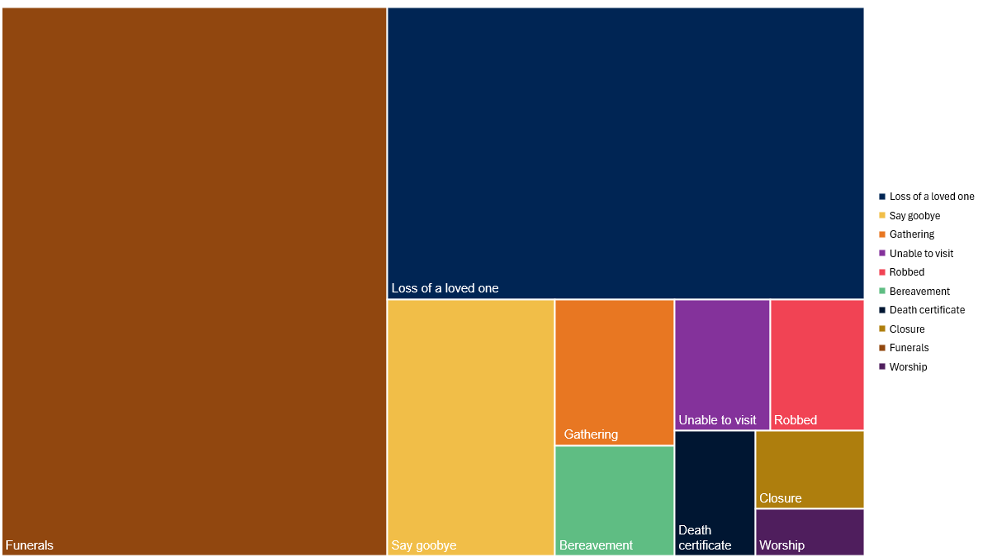
Bereaved Listening Events
Design and reflective workshops and Listening Events were audio-recorded, transcribed, coded and analysed via human review to identify key themes relevant to Module 10. Qualitative analysis software (NVivo) was used to manage and code the data into themes. Each part of a transcript could be coded multiple times to reflect one or more topic themes.
Targeted in-depth interviews
Interviews were audio-recorded, transcribed, coded and analysed via human review to identify key themes relevant to Module 10. Qualitative analysis software (NVivo) was used to manage and code the data into themes. Each part of a transcript could be coded multiple times to reflect one or more topic themes.
সীমাবদ্ধতা
It should be noted there are limitations to the approach taken by Every Story Matters. Through the online form, targeted research and holding listening events, Every Story Matters has been able to hear from a wide range of people and experiences. However, we have only heard from people who have chosen to share their views with the Inquiry and may have specific experiences which may be more negative or positive than other experiences. This means they should not be considered reflective of the experiences of the general public, particularly those from groups less likely to engage with online feedback tools.
অনলাইন ফর্মের মাধ্যমে ভাগ করা অভিজ্ঞতাগুলিকে সংগঠিত এবং বিশ্লেষণ করার জন্য NLP ব্যবহারের ক্ষেত্রেও সীমাবদ্ধতা রয়েছে। এই সীমাবদ্ধতাগুলি ভাষার জটিলতা এবং বিভিন্ন প্রেক্ষাপটে লোকেরা তাদের অভিজ্ঞতা সম্পর্কে কীভাবে কথা বলে তার সাথে সম্পর্কিত। আরেকটি চ্যালেঞ্জ হল, কিছু অভিজ্ঞতা যা অল্প সংখ্যক লোকের জন্য অনন্য, যারা প্রভাবশালী ধরণগুলির সাথে সঙ্গতিপূর্ণ নয়, তা কম প্রতিনিধিত্ব করা হতে পারে বা সম্পূর্ণরূপে উপেক্ষা করা যেতে পারে, কারণ তাদের একটি স্বতন্ত্র বিষয় গঠনের জন্য সমালোচনামূলক ভরের অভাব রয়েছে। এই সীমাবদ্ধতা কমাতে, একটি সাধারণ মডেলের পরিবর্তে তিনটি প্রশ্নের প্রতিটির জন্য পৃথক বিষয় মডেল চালানো হয়েছিল, যাতে ছোট বিষয়গুলি যেগুলি একটি নির্দিষ্ট প্রশ্নের সাথে আরও সম্পর্কিত হতে পারে তাদের উত্থানের আরও ভাল সুযোগ দেওয়া যায়। একাধিক মানব পর্যালোচনা পর্যায় বিশ্লেষণাত্মক প্রক্রিয়ার অবিচ্ছেদ্য অংশ এবং এই সীমাবদ্ধতাগুলি কমাতে সাহায্য করে। বিষয় মডেলিং পর্যায়ে উত্পাদিত বিষয় এবং থিমগুলির ম্যানুয়াল পর্যালোচনার মাধ্যমে এই থিমগুলি পরিমার্জিত করা হয় যাতে অনন্য বর্ণনাগুলি সঠিকভাবে ব্যাখ্যা করা হয় এবং থিমগুলি প্রাসঙ্গিকভাবে সঠিক হয় তা নিশ্চিত করা যায়।
How we have presented the experiences shared with Every Story Matters also has limitations. We have chosen to present quotes from consultative workshops, listening events, in-depth interviews and the NLP analysis in the same way, as every story and experience is equal. It should be noted that the in-depth interviews are from targeted samples, whereas the online form, consultative workshops and Listening Events are self-selecting samples, which can be focused on a particular experience. This means that interpretation across the three different data sources is required to construct an overall narrative that is balanced and reflective of the different voices we have heard.
Targeted in-depth interviews – sample numbers
The tables below outline the number of in-depth interviews conducted with target groups of bereaved people.
| ইংল্যান্ড | 41 |
| স্কটল্যান্ড | 11 |
| ওয়েলস | 8 |
| উত্তর আয়ারল্যান্ড | 6 |
| মোট | 66 |
| Asian or Asian British | 5 |
| Black, African, Caribbean or Black British | 9 |
| Ethnic mixed or multiple ethnic groups | 1 |
| মোট | 15 |
| Struggled with funeral costs | 7 |
| Lost a main earner in the household | 7 |
| Long term sick or disabled and lost a carer | 2 |
| মোট | 16 |
| Muslim | 5 |
| Hindu | 3 |
| Sikh | 2 |
| Jewish | 3 |
| Buddhist | 2 |
| মোট | 15 |
| 18-29 | 4 |
| 30-39 | 6 |
| মোট | 10 |
| Men | 10 |
| মোট | 10 |
- Sample numbers for each group are provided under the heading ‘Targeted in-depth interviews – sample numbers’ later in the appendix.